
Cycle Hanger for Garage Ideas That Clear the Floor
The best cycle hanger for garage storage depends on your bikes and how often you ride them. Vertical wall hangers make room for several bikes, while pivoting models let you swing one bike aside to reach another. Ceiling hoists keep bikes overhead, but need enough height and secure joist mounting. Freestanding stands avoid drilling, though they still take up floor space.
Before choosing, measure your bikes, check the hanger’s weight limit, and make sure you can still open car doors and reach each bike.
I’m Chris Johnson, owner of Johnson Closet Co., and I’ve spent more than 30 years designing practical storage for homes. When planning around a cycle hanger for garage use, I focus on safe placement and making the space easier to use every day.
Top Cycle Hanger for Garage Styles to Free Up Floor Space
If your garage floor has turned into an obstacle course of handlebars, pedals, and tangled spokes, getting your bikes off the concrete is the fastest way to reclaim square footage. When selecting a mounting system, understanding how different styles utilize vertical space, overhead volume, and wall boundaries helps you make the right choice.
| Hanger Style | Typical Weight Capacity | Floor Footprint Required | Best Suited For | Mounting Requirement |
|---|---|---|---|---|
| Vertical Swivel / Pivot | Up to 121 lbs (55 kg) | 0 sq ft (extends 16–39 in out) | Daily commuters, mixed family bikes, heavy e-bikes | Direct wood stud or masonry wall |
| Ceiling Pulley Hoist | 50–100 lbs | 0 sq ft (overhead clearance needed) | Seasonal bikes, tall ceilings (up to 14 ft) | Ceiling joists (parallel or perpendicular) |
| Horizontal Wall Mount | 45–65 lbs | 0 sq ft (spans bike length flat) | Road bikes, lightweight gravel, display setups | Wall studs at torso height |
| Freestanding Floor Stand | 60–70 lbs | 2.5–4 sq ft (approx. 24 x 17 in) | Renters, zero-drill zones, temporary storage | None (freestanding with casters) |
A well-designed tilt-and-pivot garage bike rack allows homeowners to customize vertical placement, letting you stagger bike heights and align brackets directly across wall studs.
Vertical Swivel and Pivot Wall Mounts
Vertical swivel mounts represent one of the most effective innovations for storing bicycles in garage setups. Instead of holding a bicycle static at a 90-degree angle sticking straight into your parking bay, these mounts pivot up to 150 degrees side to side. You simply roll the rear wheel against the wall, hook or cradle the front tire, and push the bike flat against the drywall.
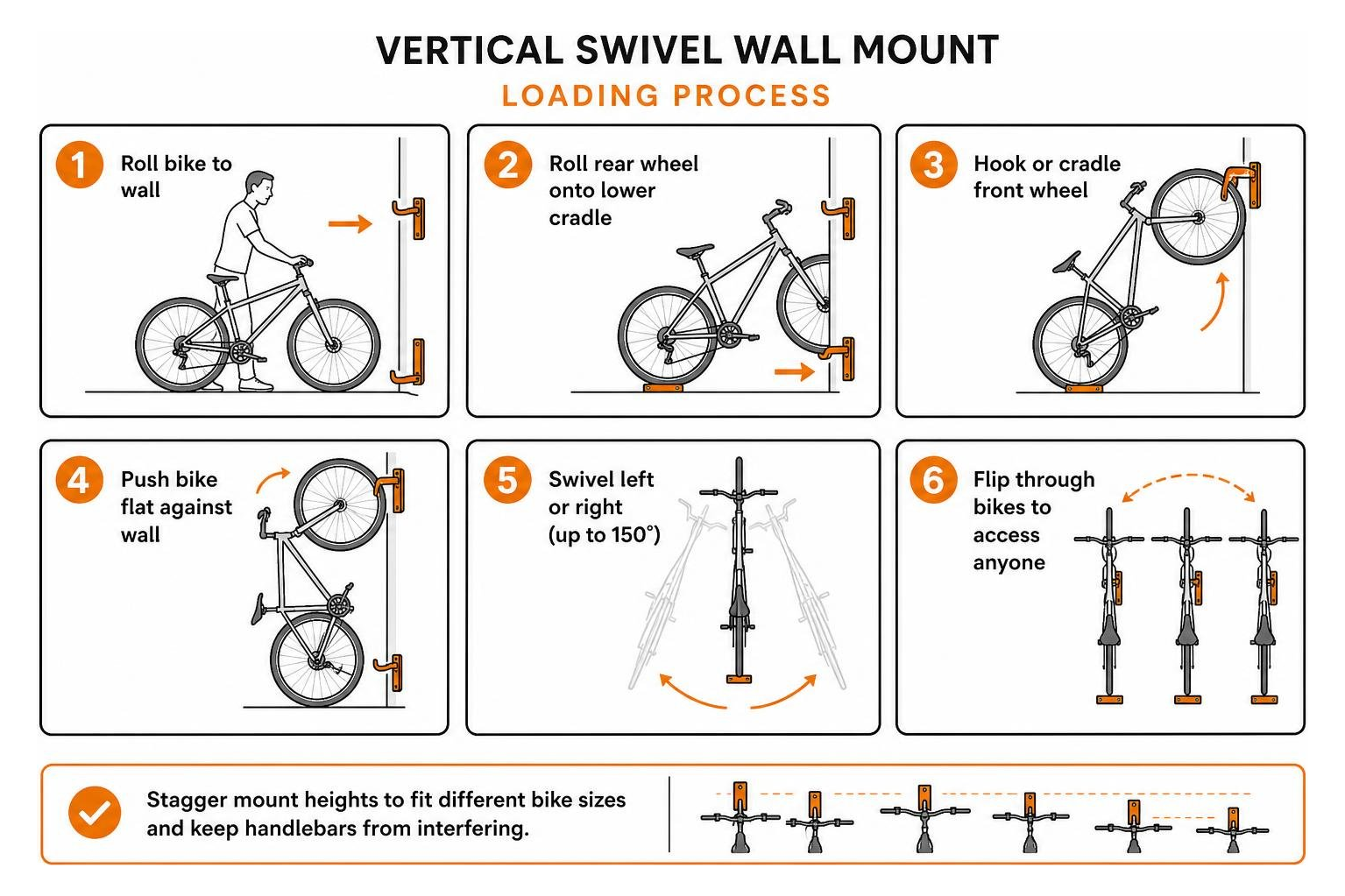
This swinging mechanism allows you to flip through your bike collection like pages in a book. When mounted with staggered bracket heights, wide mountain bike handlebars overlap cleanly with narrow road bike drop bars without catching cables or scratching paint. Best of all, rolling the rear wheel onto the lower cradle eliminates heavy deadlifting, making it effortless for every family member.
Ceiling Hoists and Overhead Pulley Systems
When wall real estate is occupied by workbenches or tall shelving, looking up into unused overhead space is the answer. Modern ceiling bike hangers utilize heavy-duty pulley lift systems designed with a 4:1 mechanical advantage. This setup reduces the physical effort required to lift a bike by 75 percent, meaning a 60-pound mountain bike feels like a manageable 15 pounds in your hands.
Premium hoists incorporate dual-rope control mechanisms to keep the bike level as it ascends toward the ceiling. Rubber-coated hooks attach securely to the handlebars and the saddle, while integrated locking clutches prevent accidental slipping if you let go of the pull rope. These systems are ideal for garages with ceiling heights up to 14 feet, safely keeping seasonal rides suspended well above vehicle hood clearance.
Horizontal Wall Hooks and Shelving Mounts
Horizontal racks store your bicycle parallel to the wall, suspended by the top tube. This configuration creates a clean, showroom-style display while maintaining a low profile that stays completely clear of the floor.
Many horizontal units feature integrated upper shelves and accessory hooks, allowing you to store helmets, cycling shoes, and hydration packs right above the bike frame. If you prefer minimal hardware, compact bike clips for garage wall grab the front or rear tire firmly to stabilize the bike with an ultra-compact footprint. Ensure any horizontal frame cradles feature thick, scuff-resistant rubber or vinyl coatings to protect carbon fiber and aluminum finishes from scratches.
Freestanding and Drill-Free Floor Stands
For renters, temporary workshops, or garages where wall drilling is prohibited by HOA guidelines or utility lines, freestanding stands offer immediate organization. Quality upright floor stands are constructed from Q235 structural carbon steel, featuring a broad triangular base that resists tipping.
Many freestanding upright stands occupy a compact 24-by-17-inch footprint and include 360-degree rotating, lockable casters. This allows you to roll your bike out of the way when parking vehicles or sweeping the floor, locking the wheels in place once parked. They support wheel sizes from 20 to 29 inches without requiring a single screw in your drywall.
How to Choose the Right Storage Setup for Your Bikes
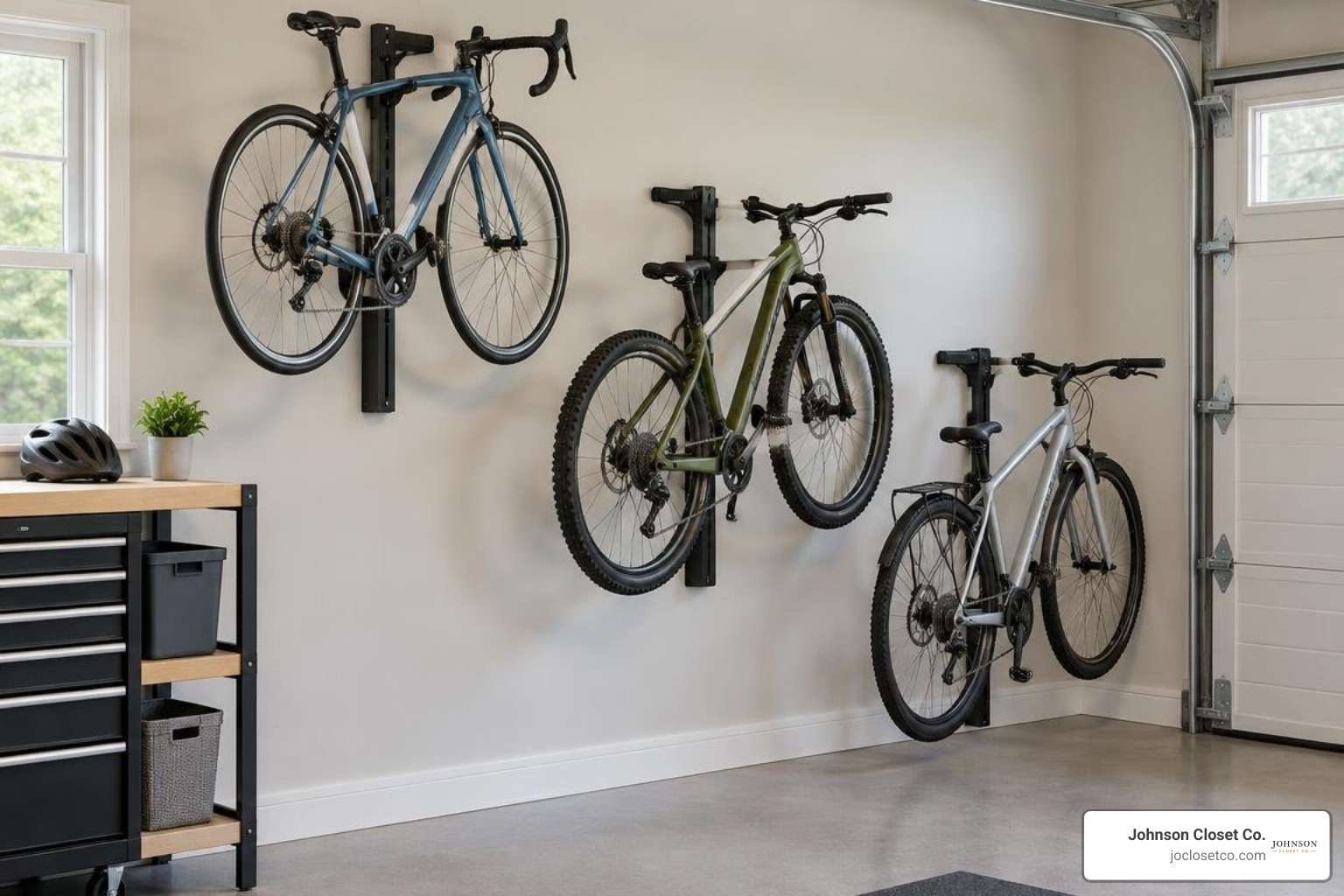
Choosing the ideal cycle hanger setup requires balancing your specific bike inventory against your garage dimensions. Road bikes, full-suspension downhill rigs, and commuter e-bikes impose completely different physical demands on storage hardware.
Weight Limits and Handling Heavy E-Bikes
The explosion of electric bikes has transformed garage storage requirements. While a traditional carbon road bike weighs between 16 and 22 pounds, an electric commuter or e-mountain bike easily tips the scales between 50 and 70 pounds once you factor in mid-drive motors and internal battery packs.
Using a dedicated electric bike storage rack for garage spaces ensures your hardware can handle these high-capacity loads. Look for heavy-duty vertical pivoting racks or reinforced hoists rated for up to 121 pounds (55 kg). Storing heavy e-bikes vertically on cradles that support the tire rather than hanging them by delicate wheel rims preserves your wheel true and avoids placing strain on spoke nipples.
Accommodating Different Frame Geometries and Wheel Sizes
Modern bike designs vary wildly, from 4-inch-wide fat tire snow bikes to low step-through cruiser frames and 20-inch kids' BMX models. Standard fixed-arm hooks often fail when encountering non-traditional frame geometries that lack a straight, horizontal top tube.
To solve this, comprehensive bicycle storage systems garage designs use wheel-mounted baskets and adjustable vertical tracks. Wheel-retention designs bypass frame geometry entirely by securing the rubber tire rather than clamping the tubing. When outfitting your garage for a family, choose modular racks with adjustable spacing trays so you can store a 24-inch youth bike side by side with a 29-inch adult trail bike without handlebar interference.
Choosing a Secure Cycle Hanger for Garage Protection
Garages remain one of the primary entry points for residential property theft. If you leave your garage door open while doing yard work, or if your garage lacks an integrated security system, securing high-value bicycles directly to the wall adds vital peace of mind.
Pairing your setup with a dedicated bike garage lock strategy or mounting an armored wall hanger with hardened steel casing deters opportunistic theft. Heavy-duty lockable wall hangers feature 30 mm hardened steel locking pins and tamper-resistant expansion bolts that sink deep into concrete or solid wall framing, providing maximum physical theft resistance right on your garage wall.
Key Installation and Structural Safety Factors
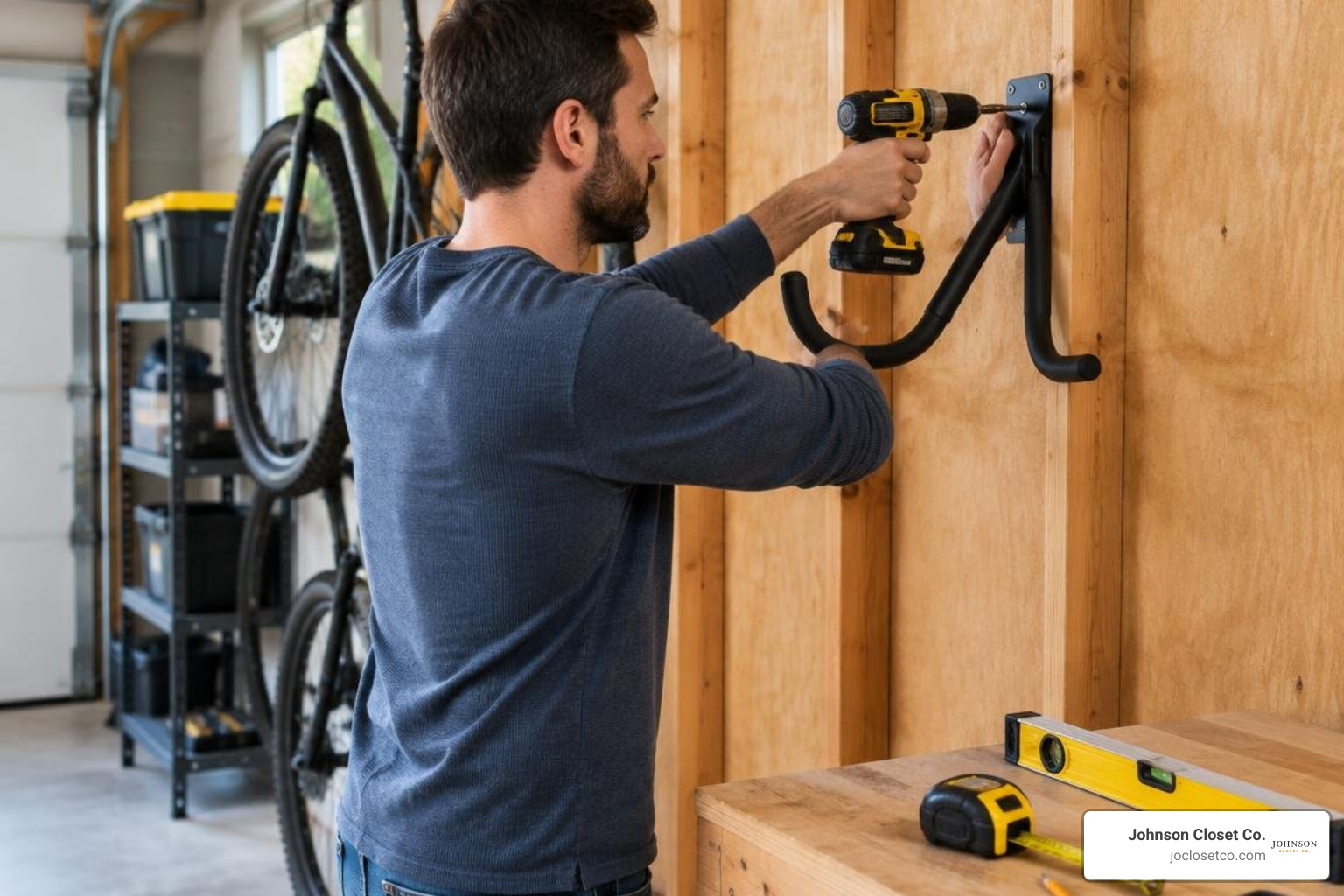
A bike storage system is only as reliable as the structure behind it. Dropping a 50-pound e-bike onto the hood of a car due to improper wall anchoring is every homeowner's nightmare. Taking time to locate structural framing guarantees safe, lifelong performance.
Installing a Heavy-Duty Cycle Hanger for Garage Walls
Drywall alone will not support a suspended bicycle over time. Constant loading and unloading introduces dynamic leverage that will tear plastic drywall anchors out of gypsum board within weeks.
Always use a precision stud finder to locate the center of solid wood framing studs (typically spaced 16 or 24 inches on center across Arizona homes). Secure your hanger mounting plates using heavy-duty lag screws that penetrate at least 2 inches into solid wood. If your garage walls are exposed cinder block or poured concrete, drill pilot holes with a masonry bit and drive high-strength expansion sleeve anchors. For the cleanest visual layout, we often coordinate bike hanger zones adjacent to custom garage storage cabinets, creating an organized, unified wall profile across your entire garage footprint.
Overhead Ceiling Joist Alignment and Clearance Checks
Installing overhead ceiling pulley hoists requires careful planning around garage door opener tracks, light fixtures, and vehicle roof lines.
First, determine your ceiling joist orientation. If your ceiling joists run perpendicular to the length of your bicycle, you can mount the front and rear pulley brackets directly into separate structural joists. If the joists run parallel or have non-standard spacing, span two joists with a sturdy 2x4 wood backer board secured with structural lag bolts, then mount your pulley assemblies directly to that header board. Always measure your vehicle's hood and roof clearance—accounting for roof racks or truck cabs—to ensure suspended bikes hang safely out of the strike zone.
Frequently Asked Questions About Garage Bike Hanging
Will storing a bike vertically on a cycle hanger damage hydraulic brakes or suspension forks?
No, storing a bicycle vertically does not damage hydraulic disc brakes or suspension forks, provided the components are properly maintained. In fact, vertical storage allows the bath oil inside suspension lower legs to migrate toward the upper foam rings and main dust wiper seals, keeping them lubricated and preventing premature seal dry-out.
If air has previously entered your hydraulic brake lines, vertical hanging may temporarily allow tiny air bubbles to rise toward the brake lever cylinder. If your brake levers feel spongy when taking the bike down, simply pump the brake levers 5 to 10 times to return firm hydraulic pressure before you head out on your ride.
How much floor space does a vertical garage cycle hanger actually save?
A standard bicycle parked on its kickstand or leaning against a wall consumes roughly 8 to 10 square feet of usable floor area. In a crowded two-car garage, parking three or four bikes on the floor consumes nearly 40 square feet—often preventing vehicles from pulling in completely.
A vertical pivoting cycle hanger reduces that floor footprint to zero square feet. By rotating the bike flat against the wall, the entire assembly protrudes only 16 inches (for drop-bar road bikes) to roughly 35 inches (for wide mountain bike bars). This clears significant walking and parking space around your vehicles.
Can I install a bike hanger on garage drywall without hitting a wood stud?
You should never install a load-bearing bike hanger directly into hollow garage drywall using drywall anchors or toggle bolts. The static weight of the bike combined with dynamic downward leverage when pulling the bike off the wall will tear the drywall and cause structural failure.
If your wall studs do not align with where you want your bike hanger positioned, mount a horizontal 2x4 or 3/4-inch plywood backer plate across two adjacent wall studs using heavy-duty wood screws. Once that backer board is firmly tied into the wall framing, you can mount your bike hanger anywhere along its surface with complete structural stability.
Conclusion
Transforming a chaotic garage into a clean, highly functional space starts with smart vertical storage. Whether you choose space-saving swivel wall mounts, overhead mechanical hoists for seasonal storage, or drill-free freestanding racks, getting your bikes off the floor protects your cycling investments and restores everyday access to your home.
At Johnson Closet Co., we help homeowners throughout the Phoenix Valley—including Scottsdale, Gilbert, Chandler, Mesa, and Tempe—maximize every square foot of their living and storage spaces. Our precision CNC in-house manufacturing allows us to design and build tailored home storage solutions and cabinetry that fit your garage dimensions perfectly. Ready to transform your garage layout? Explore our custom garage cycle storage options and schedule your design consultation with our local team today!