
Ceiling Bike Hangers: Which Type Fits Your Garage?
Choose fixed hooks for a low-cost way to store a bike you can lift easily. Choose sliding tracks when you have several bikes and want to move them apart to reach one. Choose a pulley hoist if lifting a bike overhead is the main challenge. For any option, check the weight rating for each bike, mount to structural ceiling framing, and make sure the hanging bikes clear people, cars, and the garage door.
I'm Chris Johnson, owner of Johnson Closet Co., and I've spent more than 30 years working in custom home storage. My approach to ceiling bike hangers is simple: the right setup should be safe, fit the space, and make it easy to get out for a ride.
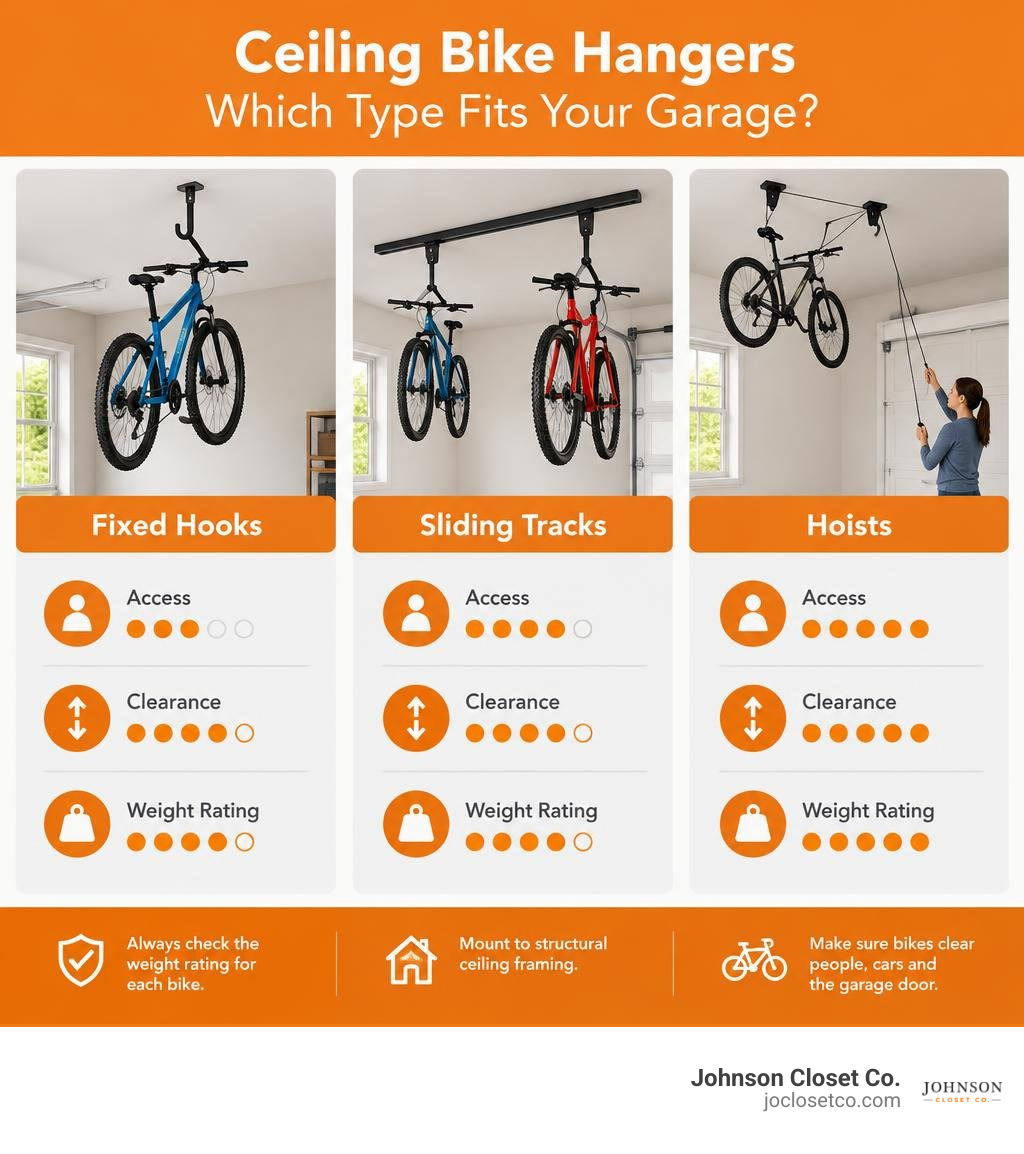
Garages throughout the Phoenix Valley, from modern builds in Gilbert and Chandler to classic homes across Scottsdale and Tempe, often run out of usable floor space quickly. Between family vehicles, workbenches, and storage bins, our garage floors end up completely congested. Overhead ceiling storage takes advantage of vertical air space that otherwise goes unused, freeing up the perimeter for parking and everyday movement.
Types of Ceiling Bike Hangers for Garage Storage
Finding the ideal overhead storage system depends on ceiling height, how frequently you ride, and how many bicycles you own. While a solo commuter might only need a single pulley system, an active family storing four to eight bikes benefits from lateral sliding racks. Across the garage storage industry, average hardware costs range from $10 for entry-level hooks to $150 for multi-bike systems, with specialized sliding gear systems reaching upwards of $300 to $400.
| System Type | Typical Bike Capacity | Weight Capacity (Per Bike) | Best Ceiling Height | Primary Advantage |
|---|---|---|---|---|
| Fixed Hooks | 1–2 bikes per pair | 30–50 lbs | 8–9 feet | Budget-friendly, simple installation |
| Pulley Hoists | 1–2 bikes | 50–100 lbs | 10–14 feet | Mechanical lifting ease, high-reach friendly |
| Sliding Tracks | 4–9 bikes | 35–65 lbs | 9–12 feet | High storage density, lateral adjustability |
| Tension Poles | 2 bikes | 40–100 lbs (total) | 7–11 feet | No-drill setup, rental-friendly |
Fixed Hooks and Heavy-Duty Overhead Brackets
Direct-mount hardware is the most straightforward overhead storage approach available. Heavy-duty threaded hooks or drop-down ceiling brackets anchor directly into solid wood ceiling joists. When storing bicycles in garage setups with low to moderate ceiling heights (around 8 to 9 feet), vertical hanging hooks let you hang bikes by their front or rear wheels with minimal visual clutter.
Quality fixed brackets feature thick rubber or vinyl coatings that protect delicate aluminum and carbon fiber wheel rims from scratches. Basic vertical hooks support approximately 30 to 50 lbs each. If you prefer to keep bicycles horizontal, dual-bracket ceiling racks cradle the top tube or both wheels, storing the frame flat against the ceiling to preserve maximum walk-through headroom underneath.
Pulley and Hoist Ceiling Bike Hangers
If your garage has tall 10-to-12-foot ceilings, lifting a 35-pound bike overhead manually is awkward and risks back strain. Pulley hoists use mechanical advantage to reduce lifting effort by half or more. High-grade systems like the Single Bike Ceiling Hoist - Delta Cycle Australia and commercial 2-pack hoist models rated up to 100 lbs feature integrated auto-locking rope brakes. These cam-lock mechanisms immediately stop the rope from slipping if you accidentally let go while raising the bike.
Padded twin hooks grab the handlebars and seat post securely, lifting the frame horizontally so it remains parallel to the ceiling. Heavy-duty hoists—such as a Wall Hook Rack Aluminium Alloy Black Multifunction Ceiling Mounted Hanger—often accommodate ceiling heights up to 12 feet with industrial tensile cords. This keeps your bicycles safely stored above the vehicle roofline without demanding extreme physical exertion.
Sliding Track Systems and Strut Channels
For households managing four, six, or even eight bikes, fixed hooks quickly become frustrating because handlebars and pedals tangle together. Sliding track systems solve this problem by hanging bikes from rolling trolleys mounted inside industrial overhead rails, such as heavy-gauge Unistrut or aluminum channels.
When planning comprehensive bicycle storage systems garage designs, sliding systems provide unmatched storage density. You can slide bikes side to side smoothly on 6000-Z cartridge bearings, creating an opening right where you need it to pull down a specific bike. Modular designs, like the 51-inch sliding garage mounts or custom 10-foot strut setups, can hold up to nine bikes across a single continuous run. Many cyclists pair these tracks with 360-degree swivel hooks to stagger handlebars and alternate front and rear wheels, squeezing maximum utility out of every linear foot of ceiling.
Key Considerations When Selecting Overhead Hangers
Before drilling into your drywall or rafters, take exact measurements of your space and assess your bicycles.
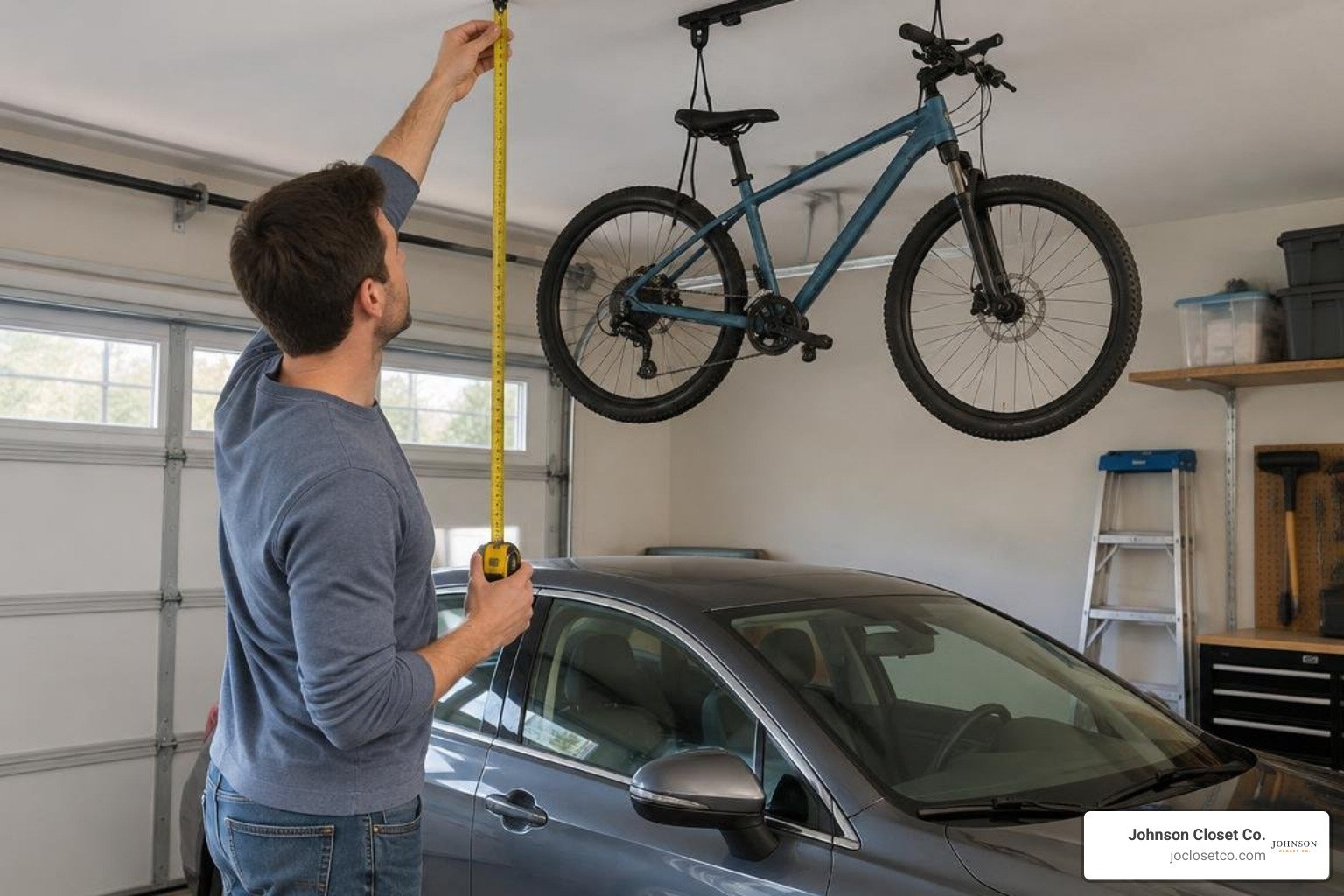
Keep these primary factors in mind:
- Overhead Drop Height: Measure from your ceiling down to the lowest part of your hanging bike (usually the handlebars or rear tire). Ensure there is ample clearance above your tallest family vehicle, garage door tracks, or walking paths.
- Tire and Wheel Profiles: Standard hooks easily accept road and commuter tires up to 2.3 inches wide. For mountain bikes and fat tires, choose oversized hooks with wide cradle profiles (up to 5 inches).
- Ceiling Joist Spacing: Residential garage joists in Arizona are typically spaced 16 or 24 inches on center. Confirm that your mounting brackets match this spacing or install an intermediary wood ledger board.
Weight Ratings and Heavy-Duty Ceiling Bike Hangers
Exceeding hardware weight ratings is dangerous for your equipment, vehicles, and family. Standard road bikes weigh 18 to 25 lbs, standard mountain bikes average 30 to 35 lbs, while modern electric commuter bikes easily reach 45 to 70 lbs.
If you plan to store heavier rigs, explore our guide on selecting an electric bike storage rack for garage spaces. Heavy-duty sliding tracks with large steel hooks are rated for 65 lbs (29 kg) per hook, making them suitable for most electric builds if the battery pack is removed before lifting.
Structural Requirements for Overhead Systems
Never hang overhead racks from bare drywall or drop-ceiling tiles. The entire weight must transfer directly into structural ceiling joists or roof trusses using heavy-duty lag bolts.
When integrating overhead racks alongside full garage storage cabinets, balance is key. At Jo Closet Co., we use precision CNC manufacturing to ensure custom cabinetry and ceiling storage layouts align perfectly with the structural frame of your home, keeping walking corridors clear and functional.
How to Safely Install Overhead Bike Storage
Safe installation requires locating structural members accurately and fastening hardware with appropriate depth.
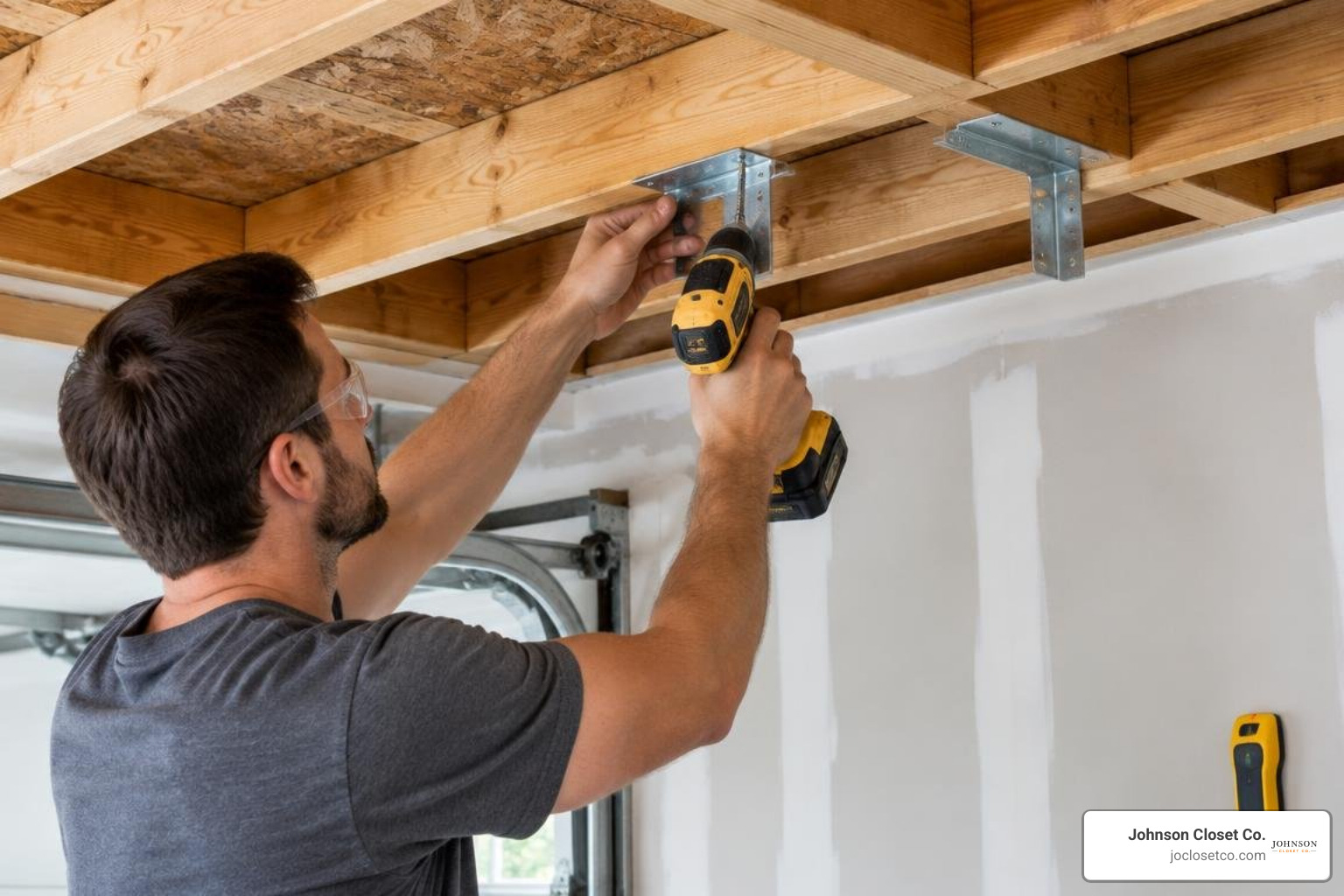
Follow these installation steps:
- Locate Joist Centers: Use a high-density deep-scanning stud finder to locate the solid wood joists behind your drywall. Mark both edges of the joist to identify the exact center.
- Pre-Drill Pilot Holes: Drill pilot holes using a 1/8-inch (3 mm) drill bit. Pre-drilling prevents dense structural lumber from splitting and ensures the lag screw threads engage tightly.
- Drive Lag Screws Securely: Fasten your mounting plates or channels using structural steel lag screws and wide washers. Tighten until flush against the drywall surface, taking care not to over-torque and strip the wood fibers.
- Load Test the Bracket: Before hanging your bicycle, grip the installed mount and apply firm downward body weight to confirm the bracket is solidly anchored.
- Secure Your Equipment: For open garage setups or added peace of mind, pair your overhead system with a reliable bike garage lock around the overhead frame.
Frequently Asked Questions About Ceiling Bike Storage
How much weight can ceiling bike hangers safely hold?
Standard single vertical hooks hold 30 to 50 lbs, while heavy-duty pulley hoists support 50 to 100 lbs per bike. Industrial overhead racks and modular track systems anchored across multiple joists can support total system weights of 200 to 600 lbs when weight is evenly distributed.
Can ceiling mounts hold electric bikes or fat-tire bikes?
Yes, provided you choose heavy-duty hardware rated for 65+ lbs and hooks with wide openings designed for 4-to-5-inch tires. To reduce overall weight and prevent battery strain in warm Arizona garages, remove the battery pack before hoisting an electric bike overhead.
How much ceiling height is required to store bikes overhead?
For vertical hanging, you need at least 9 to 10 feet of ceiling height to walk comfortably beneath the wheels. Horizontal pulley systems and flat ceiling mounts tuck the frame closer to the ceiling, requiring roughly 8.5 to 9 feet to clear parked cars safely.
Conclusion
Overhead storage transforms chaotic garage spaces into clean, organized utility areas. Whether you opt for straightforward fixed hooks, high-reach mechanical hoists, or high-capacity sliding tracks, utilizing ceiling space protects your valuable gear while reclaiming everyday floor access.
At Jo Closet Co., we specialize in creating custom garage environments tailored to your lifestyle across Phoenix, Scottsdale, Mesa, Chandler, Gilbert, and Tempe. Discover how our custom garage cycle storage solutions and precision-built cabinets can transform your garage today.