
Comparing System Types for an Electric Bike Storage Rack for Garage Spaces
Comparing System Types for an Electric Bike Storage Rack for Garage Spaces
When selecting an electric bike storage rack for garage spaces, understanding how different mounting styles manage heavy loads is critical. E-bikes easily tip the scales at 50 to 80 pounds, turning basic bike hooks into safety hazards.
| System Type | Typical Weight Capacity | Floor Space Saved | Best For | Key Installation Requirement |
|---|---|---|---|---|
| Wall-Mounted Track | Up to 500 lbs total (65–75 lbs/hook) | High (frees floor entirely) | Multi-bike households with sturdy walls | Direct anchoring to 16" wood studs or masonry |
| Pivoting Wall Arm | 65–75 lbs per arm | High (folds flat against wall) | Heavy e-bikes requiring roll-in access | Solid wood stud mount at specific height |
| Ceiling Lift / Hoist | 70–100+ lbs per bike | Maximum (100% floor clearance) | High ceilings; seasonal or infrequent storage | Direct connection to structural ceiling joists |
| Freestanding Frame | 65 lbs per hook (300+ lbs total) | Moderate (preserves floor, no wall contact) | Renters, metal-stud walls, or finished drywall | Level floor and adequate ceiling height |
Choosing the right approach comes down to balancing weight thresholds, garage layout, and how often you ride. Integrating dedicated bicycle storage systems for garage setups lets you keep heavy electric frames secure without sacrificing vehicle parking. For broader context on how e-bike weight and wheel dimensions affect rack design, the electric bicycle overview provides useful background on motor and battery configurations.

Wall-Mounted Electric Bike Storage Rack for Garage Walls
Wall-mounted storage represents the gold standard for reclaiming garage floor space. High-capacity horizontal rail designs distribute massive dynamic loads across multiple wall studs. Built from industrial steel with a rust-resistant powder coat finish, these systems support up to 500 pounds across multiple bikes.
For bulky e-bikes, look for adjustable tracks featuring 3D pin-locking mechanisms. These allow you to space bikes every few inches, preventing handlebars and wide pedal cranks from colliding. If lifting an e-bike off the ground is difficult, pivoting designs offer vertical roll-in loading. These arms swing side-to-side, allowing you to load one bike and pivot it flush against the wall to make room for vehicles. Multi-functional rails even pair high-capacity bike hooks with integrated shelving to hold helmets, tools, and chargers.
Ceiling-Mounted and Hoist Electric Bike Storage Rack for Garage Ceilings
If your garage has tall ceilings, elevating your ride overhead frees up critical square footage along the walls and floor. However, manual rope hoists designed for 25-pound road bikes can be dangerous when used with heavy e-bikes.
Instead, look for mechanical systems engineered specifically for extreme loads. Drill-operated gear systems allow you to raise up to four bicycles smoothly into overhead space using a standard cordless drill. For maximum convenience with heavy frames, motorized units and heavy-duty automatic lift racks provide powered lifting at the touch of a button, handling loads up to 71 pounds or more with automatic mechanical drop-stops to prevent accidental slips.
Freestanding and Floor-Supported Heavy-Duty Racks
For homeowners who prefer not to drill into walls or renters dealing with strict lease agreements, heavy-duty freestanding frames provide a dependable, no-drill alternative.
Modern modular units rely on a sturdy base and vertical uprights to hold up to 8 bikes with individual hooks rated for 30 kg (65 lbs). These systems provide the density of vertical wall hanging while transferring all dynamic loads directly to the garage floor.
Key Specifications: Weight Capacity, Wheel Depth, and Frame Protection
When evaluating any e-bike rack, basic utility hooks from the hardware store simply will not cut it. Heavy commuter and electric cargo bikes require purpose-built hardware to protect both your equipment and your garage. When organizing a multi-use space, pairing your bike setup with comprehensive home storage solutions ensures that tools, chargers, and spare parts remain neatly stowed alongside your ride.
Load Limits and Battery Weight Distribution
Most modern electric commuter bikes weigh between 45 and 65 pounds, while electric cargo and fat tire bikes easily reach 75 to 85 pounds. When hanging an e-bike, that weight sits concentrated around the bottom bracket motor and downtube battery.
- Check Hook vs. Rail Ratings: Verify both the individual hook rating (which should be at least 65 lbs for e-bikes) and the overall system capacity.
- Battery Removal: If your e-bike pushes the maximum load limit of your rack, removing the 7-to-10-pound battery before mounting reduces strain on the rack and makes lifting significantly easier.
- Center of Gravity: The uneven weight profile of mid-drive motors means your bike may hang slightly tilted; modular systems with adjustable hook angles prevent uneven frame stress.
Tire Width and Rim Protection for Fat Tire E-Bikes
Standard bicycle racks are built for road and trail tires between 1.0 and 2.25 inches wide. In contrast, many e-bikes feature 2.8-inch to 4.0-inch tires mounted on deep rims.
Look for hooks engineered to support tire widths of at least 75 mm (3.0 inches) and rim depths up to 95 mm. Furthermore, ensure all contact points feature thick PVC dip, polymer sleeves, or dense non-marking rubber. This prevents the metal hook from gouging expensive alloy rims or scratching carbon fiber wheels when rolling the bike onto the mount.
Wall Stud Requirements and Safe Garage Installation
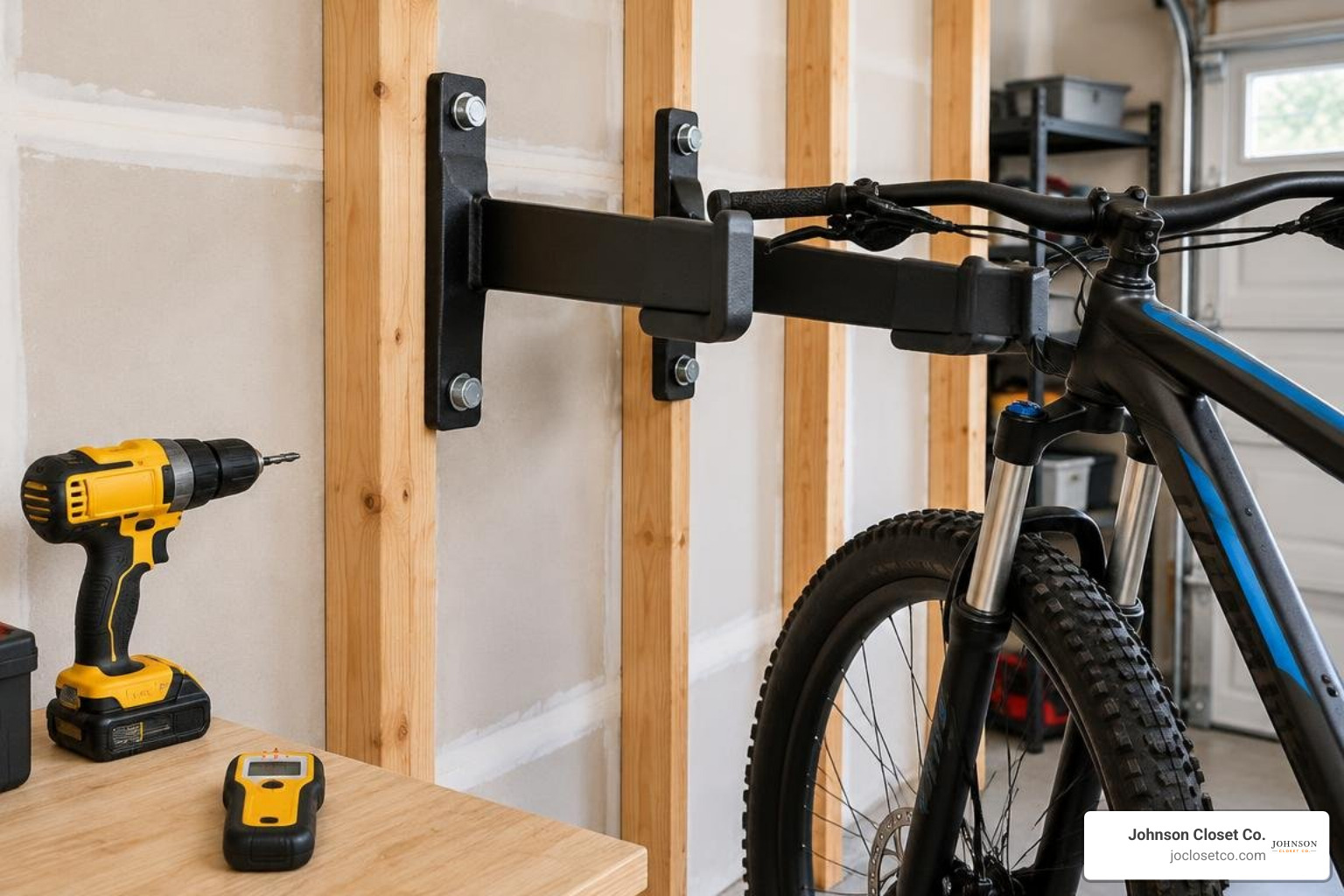
Installing a heavy-duty rack holding several hundred pounds of electric machinery demands strict adherence to structural best practices.
- Use a Quality Stud Finder: Locate the precise center of standard 2x4 or 2x6 wall studs (spaced 16 inches on-center).
- Never Rely on Drywall Anchors: Never use drywall anchors or hollow-wall toggle bolts for e-bike racks; dynamic loading will tear them straight out of the wall.
- Pre-Drill Pilot Holes: Always pre-drill pilot holes to prevent splitting the structural wood studs when driving large-diameter fasteners.
- Use Heavy-Duty Lag Screws: Secure horizontal mounting rails using minimum 5/16-inch or 3/8-inch lag screws extending at least 2.5 inches into solid framing.
Anchoring into Wood Studs vs Masonry
In many garage layouts, you will encounter either wood-framed drywall or solid masonry/concrete block walls. Each surface requires specific hardware to achieve full weight ratings:
- Wood Stud Framing: Fasten horizontal steel tracks perpendicular to the studs across at least two to three framing members. This spreads the shear load evenly across the building's skeleton.
- Concrete and Masonry Walls: Use heavy-duty sleeve anchors or masonry screws (such as Tapcons) with appropriate embedment depth. Solid concrete provides exceptional shear strength for heavy-duty 500-pound systems.
Ergonomic Loading and Roll-In Clearance
The greatest storage system in the world is useless if you dread lifting your bike onto it every evening. To avoid back strain, position wall mounts so you can lift the bike's front wheel onto the hook while the rear wheel stays on the floor. Once hooked, roll the rear wheel inward against a wall bumper or tray.
Leave at least 24 to 28 inches of clearance between adjacent bikes to prevent handlebar tangling, and ensure you have roughly 4 to 5 feet of open floor space in front of the rack to maneuver bikes safely past parked vehicles.
Frequently Asked Questions About Garage E-Bike Storage
Can heavy e-bikes be hung vertically by the wheel without damaging rims or hydraulic brakes?
Yes. Quality bicycle wheels are built to withstand hundreds of pounds of dynamic force while riding over potholes and rough terrain. Hanging a 60-to-80-pound stationary bike by its wheel places far less stress on the rim than riding it. For hydraulic disc brakes, modern sealed fluid systems prevent air ingress during vertical hanging, provided the brake lines are in good working order.
How much floor space does a vertical e-bike storage system save?
A horizontally parked e-bike occupies roughly 10 to 12 square feet of floor space. Storing your bikes vertically on a wall-mounted rail reclaims approximately 70% of that usable floor area, pulling the frames upright and allowing you to comfortably park vehicles or install workbench cabinetry underneath.
Should e-bike batteries be removed before mounting bikes on overhead or wall racks?
Removing the battery is always recommended if you need to reduce lifting weight. Additionally, in regions that experience extreme summer garage temperatures (such as the Phoenix Valley), storing lithium-ion batteries in a climate-controlled room extends battery life, ensures safe charging, and avoids thermal degradation.
Conclusion
Choosing the right electric bike storage rack for garage spaces transforms a cluttered, hazardous layout into a streamlined workstation. Whether you opt for a 500-pound modular wall track, a space-saving pivoting vertical mount, or an overhead lift system, matching the rack's weight rating and tire clearance to your e-bike is essential.
At Jo Closet Co., we specialize in elevating garage spaces across the Phoenix Valley—including Scottsdale, Gilbert, Chandler, Mesa, and Tempe. By leveraging our in-house precision CNC manufacturing, we design and build seamless storage environments that integrate heavy-duty bicycle mounts alongside custom cabinetry, workbenches, and overhead storage. Explore our custom garage cycle storage options to discover how tailored craftsmanship can maximize your garage today.