
Reclaim Your Garage Floor With Bike Clips
Reclaim Your Garage Floor With Bike Clips
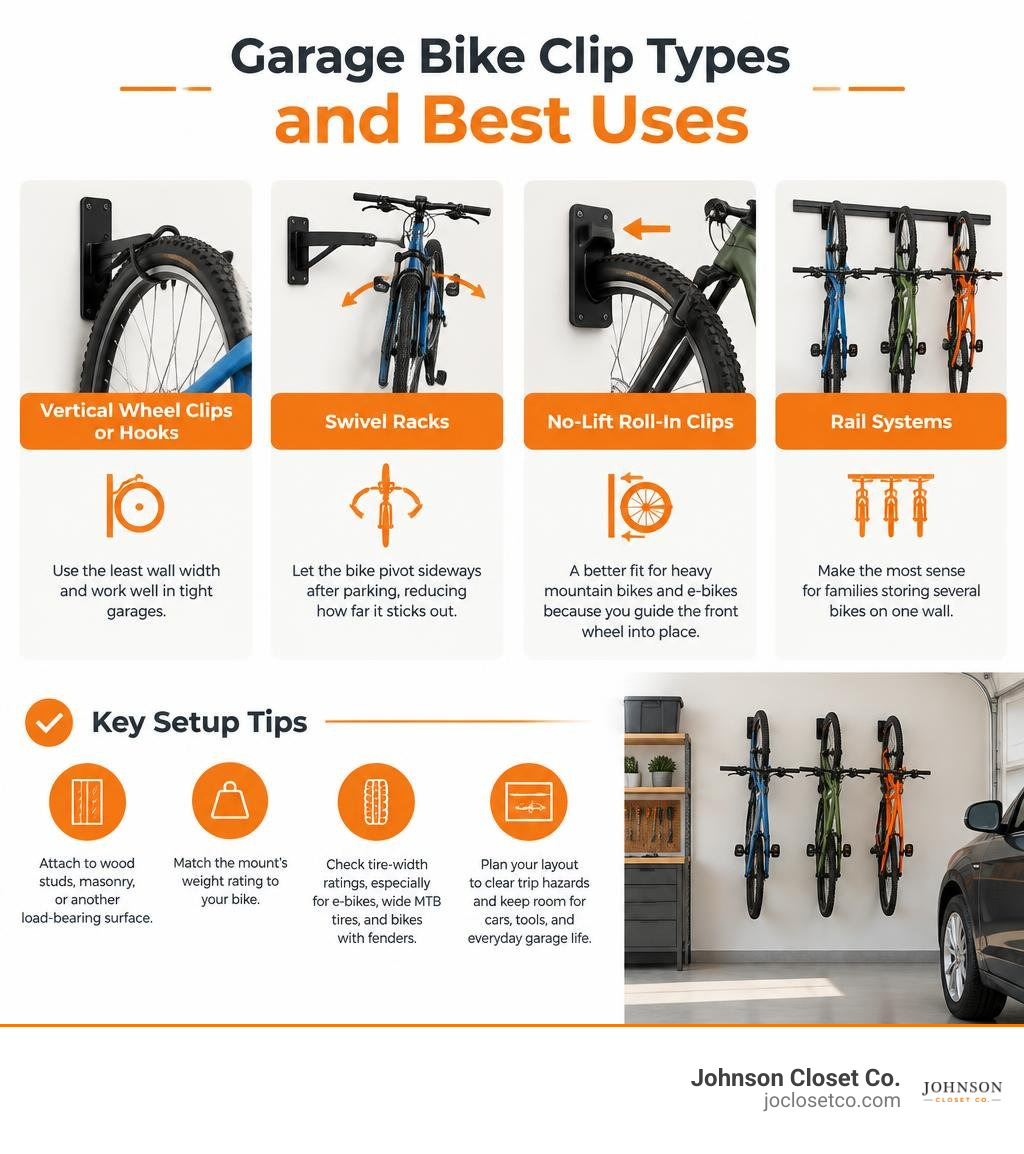
Bike clips for garage wall storage keep bicycles upright, off the floor, and easier to reach. Start by measuring your bike's weight, tire width, and handlebar clearance. Then choose a clip style that fits how you use the bike:
- Vertical wheel clips or hooks use the least wall width and work well in tight garages.
- Swivel racks let the bike pivot sideways after parking, reducing how far it sticks out.
- No-lift roll-in clips are a better fit for heavy mountain bikes and e-bikes because you guide the front wheel into place instead of lifting the whole bike.
- Rail systems make the most sense for families storing several bikes on one wall.
The safest setup attaches to wood studs, masonry, or another load-bearing surface. Match the mount's weight and tire-width rating to the actual bike, especially for e-bikes, wide MTB tires, and bikes with fenders. A well-planned wall layout clears trip hazards while leaving room for cars, tools, and everyday garage life.
I'm Chris Johnson, owner of Johnson Closet Co. and a custom-storage professional with more than 30 years of experience designing practical spaces for Arizona homeowners. That work includes planning garage layouts where bike clips for garage wall storage fit the bikes, the wall structure, and the way a family actually uses the space.
Why Bike Clips for Garage Wall Systems Maximize Floor Space
Garages across Phoenix, Scottsdale, and Gilbert often double as workshops, home gyms, and parking bays. When bicycles rest on kickstands or lean precariously against drywall, each bike swallows roughly 10 to 12 square feet of floor area. Multiply that across a family of four, and half a parking stall disappears beneath handlebars and pedals.
Elevating bikes vertically or securing them with specialized wall clips eliminates that floor footprint entirely. By treating the wall as usable real estate, you convert dead vertical space into active storage. Mastering the basics of storing bicycles in garage setups lets you walk past parked vehicles without catching your belt loop on a handlebar or scratching car doors. Whether you are dealing with lightweight carbon road frames or hefty city cruisers, dedicated wall mounts keep tires elevated and tires clear of floor-level dirt and oil.
Vertical vs. Horizontal Orientation
Choosing between vertical and horizontal wall storage comes down to wall width versus wall projection:
- Vertical Wall Clips: The bike stands upright on its rear wheel (or hangs completely clear of the floor) with the front wheel gripped by a wall clip. While the bike projects outward 40 to 50 inches into the room, it occupies only about 6 to 12 inches of horizontal wall width. This makes vertical orientation the clear winner for organizing multiple bikes side by side.
- Horizontal Frame Hangers: The bicycle hangs parallel to the wall, supported under the top tube. Horizontal racks extend only 12 to 15 inches into the room, making them ideal for narrow walkways or alongside parked cars. However, each bike consumes 6 feet of horizontal wall space, making it difficult to store more than two bikes on a standard garage wall.
No-Lift Roll-In vs. Hanging Systems
Lifting a 45-pound commuter bike over your head every afternoon gets old fast. Traditional hooks require you to hoist the entire bicycle off the ground to seat the front rim.
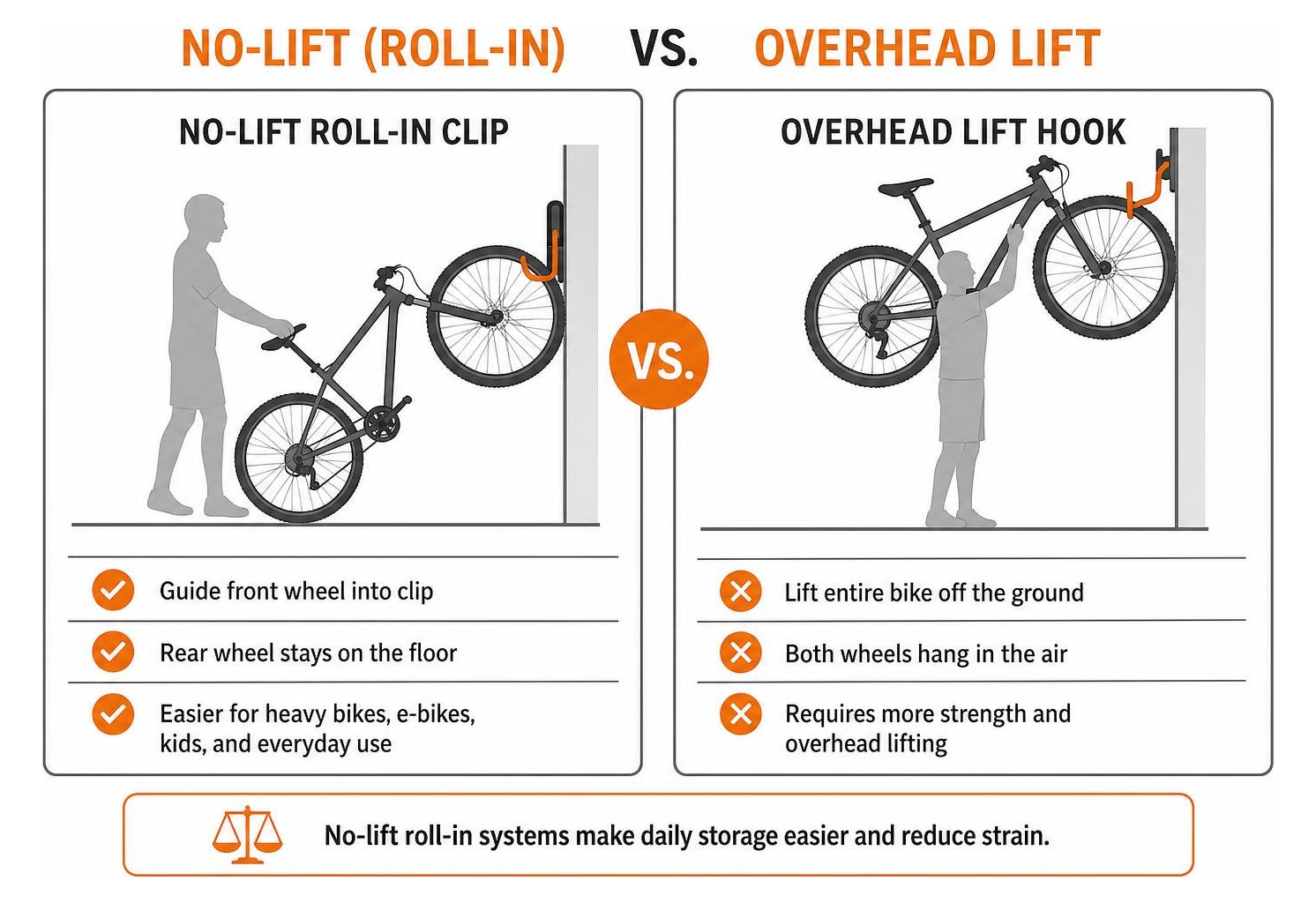
In contrast, a no-lift roll-in system keeps the rear wheel resting firmly on the floor. You simply pull the bike backward onto its rear tire, roll it toward the wall, and pop the front tire into a clip. The wall clip stabilizes the front wheel while the concrete slab carries all the downward weight. This eliminates back strain and makes daily storage effortless for kids and adults alike.
Key Features to Compare When Selecting Wall Storage
Wall clips and hangers come in several structural designs. The table below outlines how common configurations compare across durability, spatial demands, and cost:
| System Type | Weight Capacity | Wall Width Needed | Extension From Wall | Ideal Bike Types | Typical Cost Range |
|---|---|---|---|---|---|
| Micro-Clips | Up to 66 lbs (30 kg) | 4–6 inches | Full bike length (~45") | Road, Hybrid, Light MTB, E-Bikes | $20 – $35 per bike |
| Swivel Hook Mounts | Up to 66–77 lbs (30–35 kg) | 8–10 inches | 12–18" (when folded flat) | Road, Gravel, Full-Suspension MTB | $30 – $90 per bike |
| Adjustable Wall Rails | Up to 200–500 lbs total | 36–68 inches (rail width) | Full bike length (~45") | Multi-bike family fleets, heavy gear | $100 – $250 per system |
| Horizontal Frame Cradles | Up to 55 lbs (25 kg) | ~72 inches per bike | 12–16 inches | Classic road, commuter, diamond frames | $25 – $60 per bike |
For homeowners evaluating comprehensive home storage solutions, picking the right system depends on weight ratings, tire profiles, and locking mechanisms.
Weight Capacity and Heavy E-Bike Demands
Modern electric bicycles pack heavy hub motors and internal frame batteries, routinely weighing between 45 and 70 pounds. Before mounting an electric ride, check our dedicated guide on choosing an electric bike storage rack for garage walls.
For solo heavy rigs, heavy-duty swivel units support up to 66.2 lbs (30 kg) and 77 lbs (35 kg) respectively. If you are mounting multiple heavy frames along a single wall line, high-strength rail solutions can handle up to 500 lbs across modular tracks, while heavy-duty multi-bike wall mounts manage up to 200 kg (440 lbs) in a roll-in configuration.
Sizing Bike Clips for Garage Wall Tire Compatibility
Tire width dictates which clip model will securely grab your wheel. Micro-clips use flexible polymer arms sized to specific tire profiles:
- Road & Narrow Hybrids (23mm – 28mm): Narrow clips feature calibrated rollers that grip skinny 700c performance rubber without pinching side walls or touching carbon spokes.
- Gravel & Commuter (32mm – 47mm): Mid-range clips provide enough spread to clamp wider touring rubber and knobby gravel treads.
- Trail, Enduro & Plus Tires (2.0" – 3.0"): Mountain bike clips require deeper cradles to encompass chunky knobs. Some hooks accommodate tires up to 3 inches wide.
- Fat Bikes (3.5" – 5.0"): Require extra-wide, custom-stamped steel cradles or wide-mouth coated hooks.
Rim Protection, Magnetic Latches, and Security Locks
High-end carbon and aluminum rims require thoughtful protection to prevent cosmetic abrasions and structural scratches:
- Polymer and Rubberized Coatings: Quality wall hooks feature thick rubberized coatings or soft thermoplastic sleeves that isolate metal hooks from your wheel's clear coat.
- Magnetic Winch & Ratchet Systems: Advanced vertical mounts employ magnetic winch handles and ratcheted cables that loop through the rim. This guarantees your bike will not pull free if someone accidentally bumps into the handlebars or if a tire slowly deflates over winter.
- Integrated Security Locks: If your garage is accessible to service contractors or left open during yard work, choose clips with locking knobs or dedicated steel eyelets that let you run a cable lock directly through the bike frame into the wall stud.
Step-by-Step Installation and Layout Guide
Proper wall mounting requires finding structural support and using the correct hardware. Follow this structured process to mount your bike storage securely:
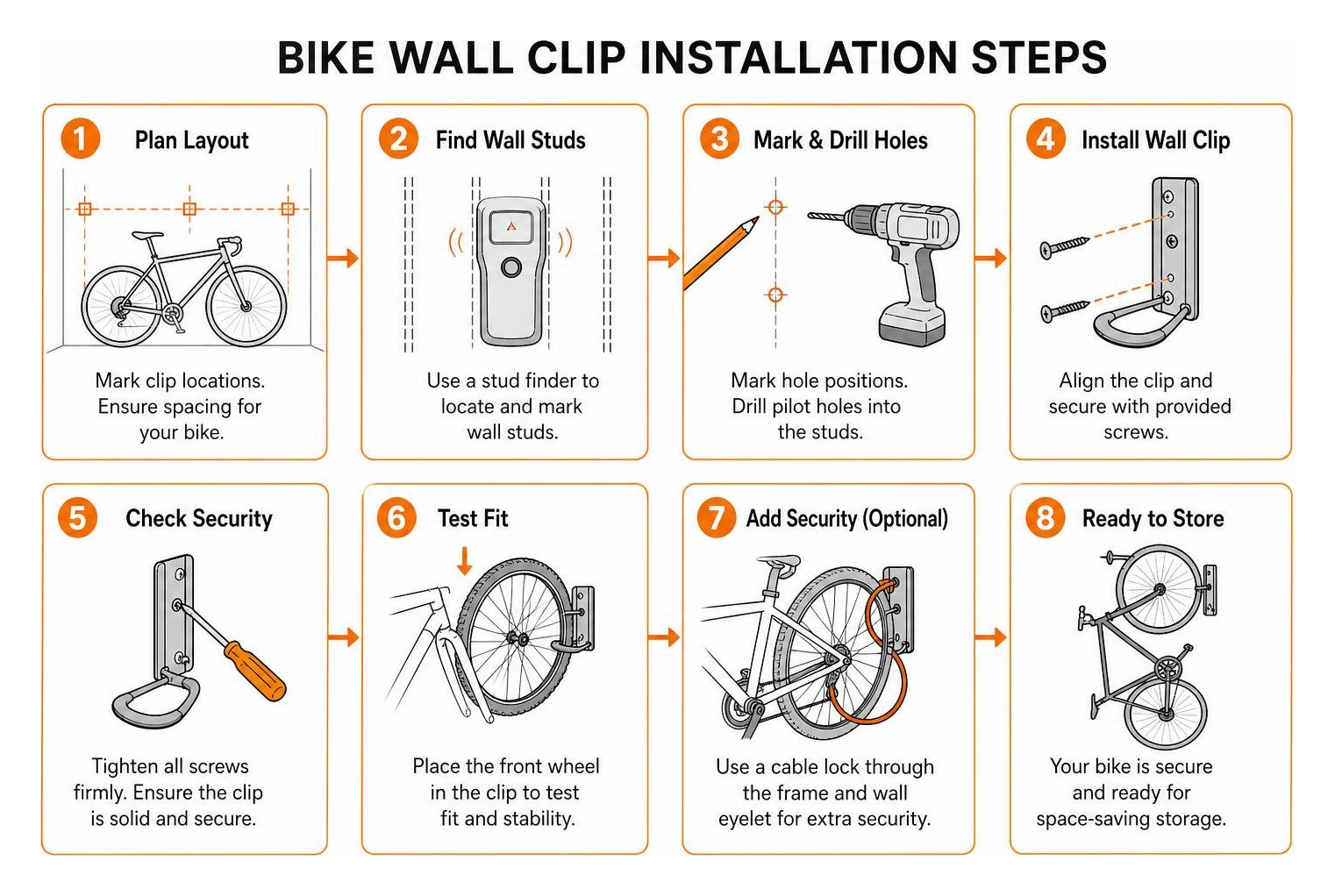
When outfitting comprehensive bicycle storage systems garage wide, investing thirty minutes in precise layout planning keeps your garage functional for years.
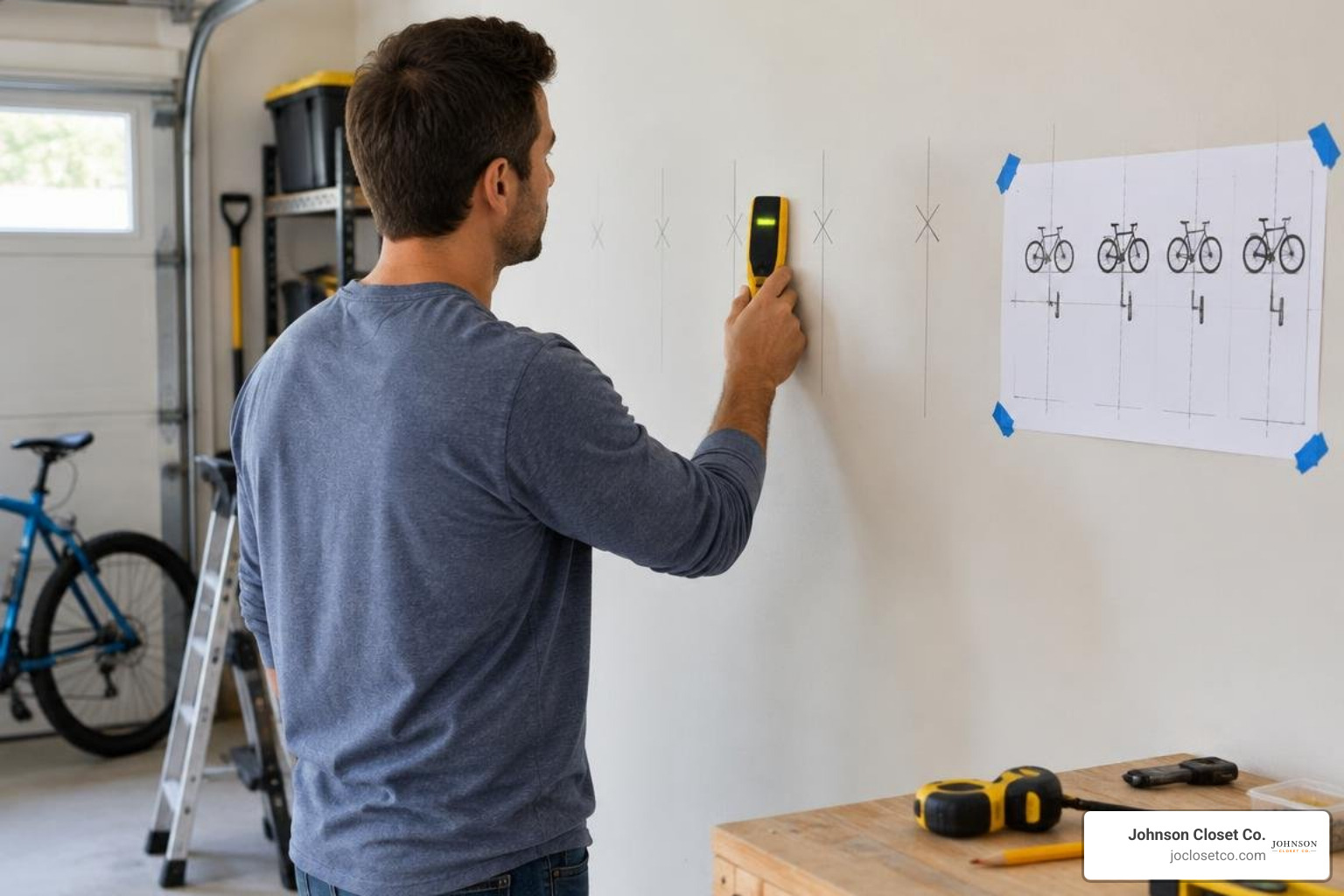
Installing Bike Clips for Garage Wall Studs and Masonry
Garages in Arizona often feature finished drywall over wood framing, while exterior walls may consist of solid masonry or block:
- Wood Stud Mounting: Always locate standard 2x4 wood studs spaced 16 inches on center using a magnetic or electronic stud finder. Drill 1/8-inch pilot holes directly into the center of the stud and secure the bracket using heavy-duty 2-inch to 2.5-inch steel wood screws.
- Masonry and Concrete Block: For unfinished stem walls or masonry construction, drill using a carbide-tipped masonry bit. Insert heavy-duty nylon expansion wall plugs or concrete screw anchors to guarantee a secure, vibration-resistant hold.
- Drywall Anchors (Use With Caution): While toggle bolts can support static loads in drywall, the repeated twisting and tugging of parking a bike will fatigue gypsum over time. For no-lift clips where the floor carries 80% of the weight, heavy-duty toggle anchors can work for lightweight road bikes, but structural studs are always recommended for heavy mountain and electric bikes.
Staggering Heights for Multi-Bike Arrangements
When parking four or five bikes along one garage wall, handlebar collision is the biggest layout hurdle. Standard mountain bike flat bars measure 30 inches wide, creating wide profiles that bang into adjacent brake levers.
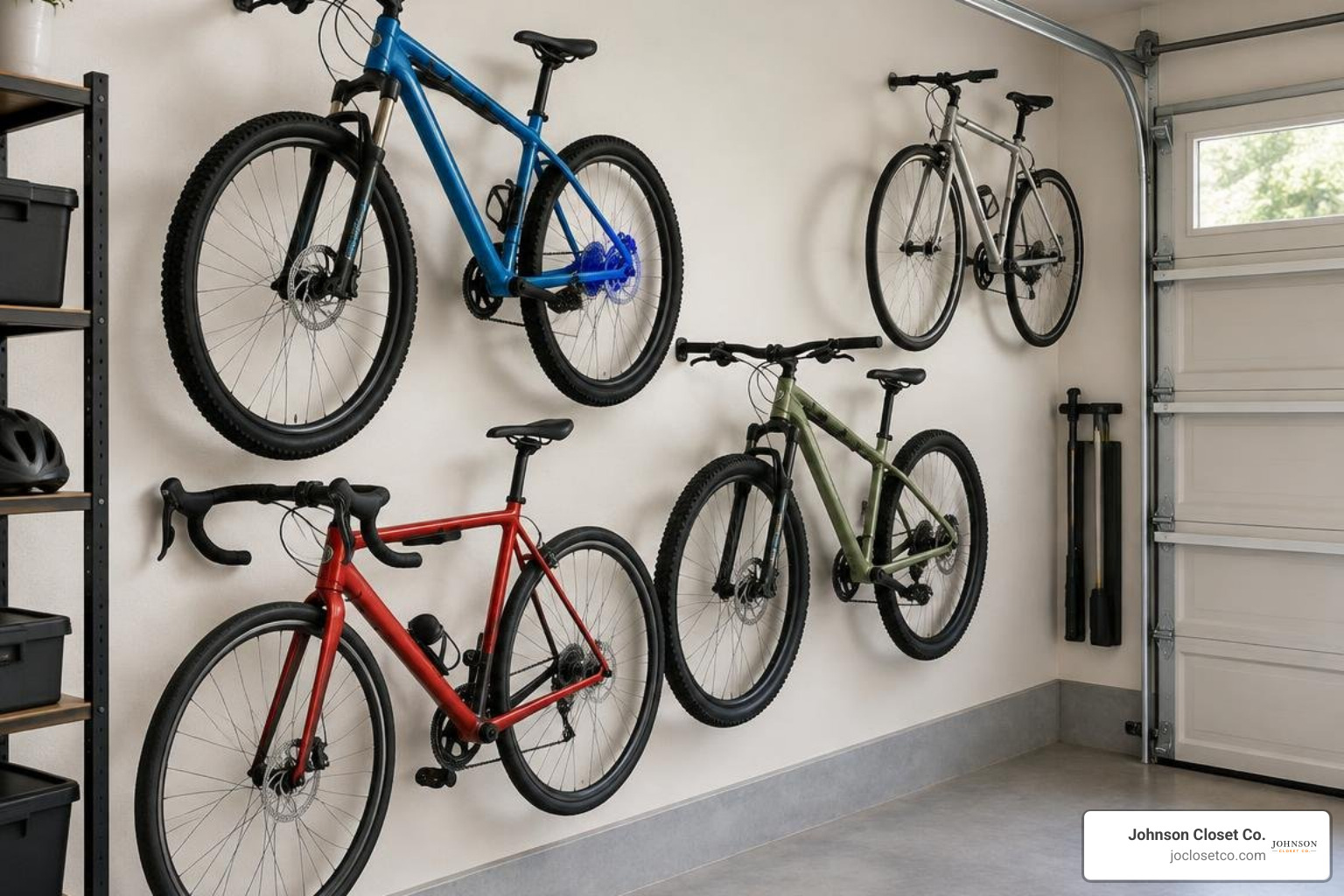
To store bikes efficiently without tangled cables, use a staggered vertical layout:
- Alternate Mounting Heights: Stagger your wall clips by 8 to 12 inches vertically between adjacent bikes (e.g., Bike 1 high, Bike 2 low, Bike 3 high).
- Set Minimum Horizontal Spacing: Keep horizontal wall spacing between 14 and 16 inches on center. The higher bike's handlebars will clear the lower bike's top tube or front fork.
- Use Swivel Brackets in Tight Bays: If you need to park a vehicle close to the wall, install swivel mounts. Once the bikes are clipped in, simply pivot them 45 to 70 degrees flat against the wall surface, dramatically opening up walkway clearance.
Frequently Asked Questions About Bike Wall Clips
Can I mount bikes with fenders, disc brakes, or unusual frame geometries?
Yes. Wheel-mounted vertical clips hold the bicycle solely by its tire tread, making them completely independent of frame shape, step-through tubing, or rear suspension shocks.
For disc brakes, standard clips grip the tire rim far above the brake rotor, preventing contact with delicate discs. If your bike has full-coverage commuter fenders, select a bottom-hook cradle or a no-lift roll-in system that holds the front wheel from behind the fender stay rather than pressing down against the top of the mudguard.
Will vertical wall clips damage bike rims or wheel alignment over time?
No. High-quality wall clips will not bend rims or pull wheels out of true. When a bike rests vertically in a no-lift clip, the floor supports the bicycle's mass, while the clip simply acts as a lateral stabilizer.
Even in fully suspended hanging hooks, bicycle rims are engineered to absorb hundreds of pounds of dynamic impact from road potholes and trail drops. The static 20 to 35-pound weight of a hanging bicycle is distributed safely across the rim radius, especially when supported by a wide, protective rubberized contact pad.
How much weight can drywall hold versus a wood stud installation?
Standard 1/2-inch drywall secured with heavy-duty snap toggles can technically support up to 50 pounds of static downward pull. However, bicycle clips experience constant dynamic tugs, lateral torque, and rotational forces every time a bike is inserted or removed. Over several months, this dynamic movement can loosen anchors and tear drywall paper.
A direct wood stud connection fastened with 2.5-inch structural screws safely holds 100 to 200+ pounds of dynamic pull, giving you complete peace of mind that heavy gear will never pull out of the wall.
Conclusion
Climbing over dropped frames, untangling brake cables, and dodging dirty tires takes the fun out of daily riding. Installing well-engineered wall clips clears trip hazards, protects expensive rims, and reclaims vital garage square footage for your cars and workbenches.
At Johnson Closet Co., we help homeowners across Phoenix, Scottsdale, Chandler, Mesa, and Tempe design high-performance garage layouts. Our in-house precision manufacturing uses CNC machinery to build tailored cabinetry, workbench suites, and storage accessories that integrate seamlessly with your wall mounting hardware. For more layout ideas, explore our full guide to garage cycle storage and discover how simple an organized garage can be.