
Make Garage Bike Storage Work for Your Space
Make Garage Bike Storage Work for Your Space
The best approach to storing bicycles in garage spaces is to get bikes off the floor without making them hard to use. Mount frequently ridden bikes on a wall rack or rail, use ceiling storage only for bikes you access less often, and choose a freestanding rack when drilling is not an option.
Before buying anything:
- Measure bike height, handlebar width, wall space, and ceiling clearance.
- Match the rack's weight and tire-width rating to every bike, especially heavy e-bikes.
- Fasten wall mounts to studs or masonry and ceiling systems to joists - not drywall alone.
- Add padding at contact points and lock valuable bikes to a fixed anchor.
A vertical wall mount usually uses less wall width and keeps the floor clear. Horizontal storage is easier to load and can work well along a long, open wall. For families, modular rails, staggered hooks, or multi-bike racks keep adult and kids' bikes from becoming a leaning, tangled pile.
The goal is not simply to hide bicycles. It is to create a layout that protects frames and wheels, preserves room for cars and tools, and makes every bike easy to grab when it is time to ride. I'm Chris Johnson, and the sections ahead will help you choose a garage bike storage setup that fits how your household actually uses the space.
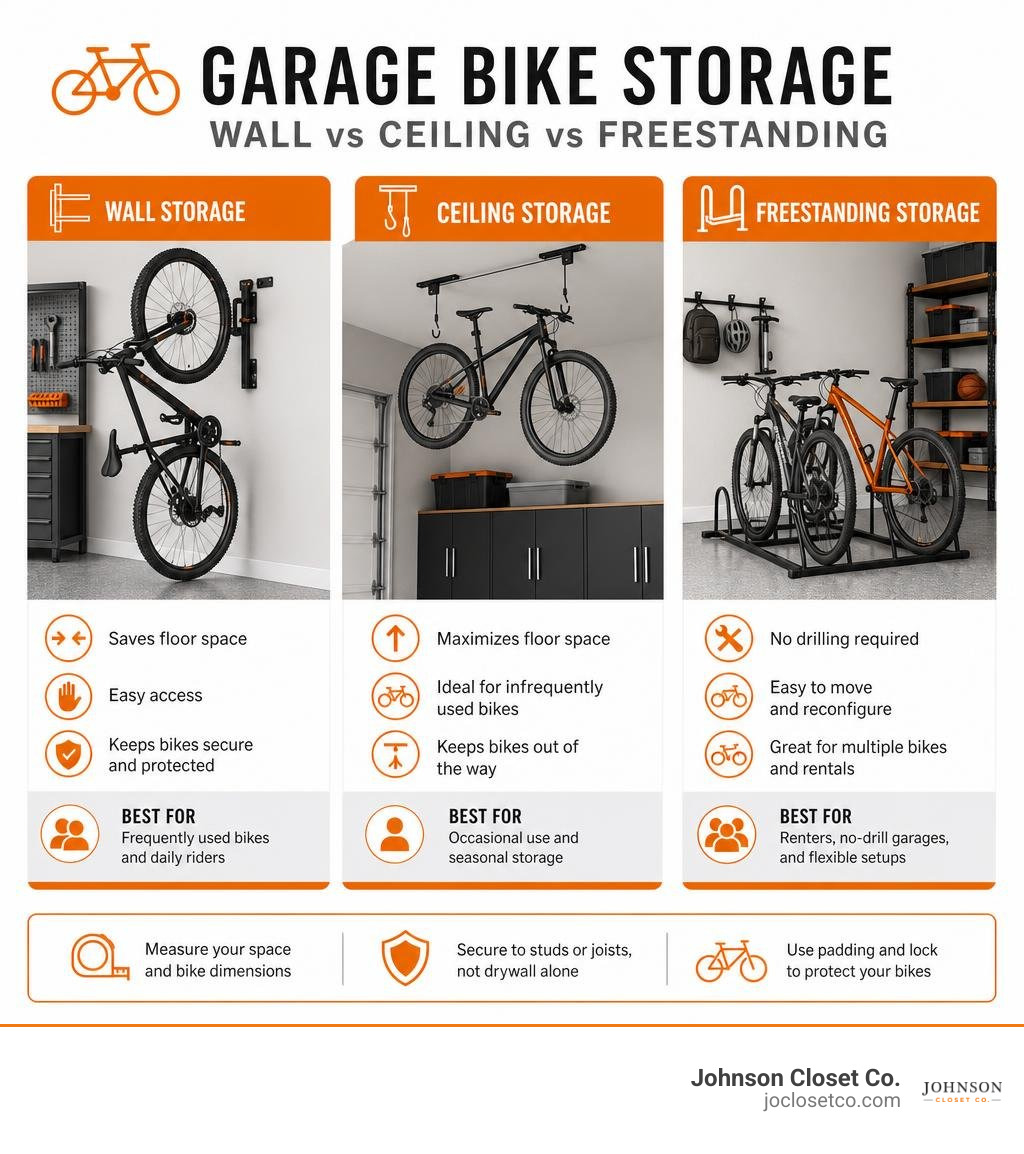
Proven Strategies for Storing Bicycles in Garage Environments
Choosing the right storage hardware boils down to how often you ride, how much weight you are lifting, and how much floor or wall real estate you can spare.
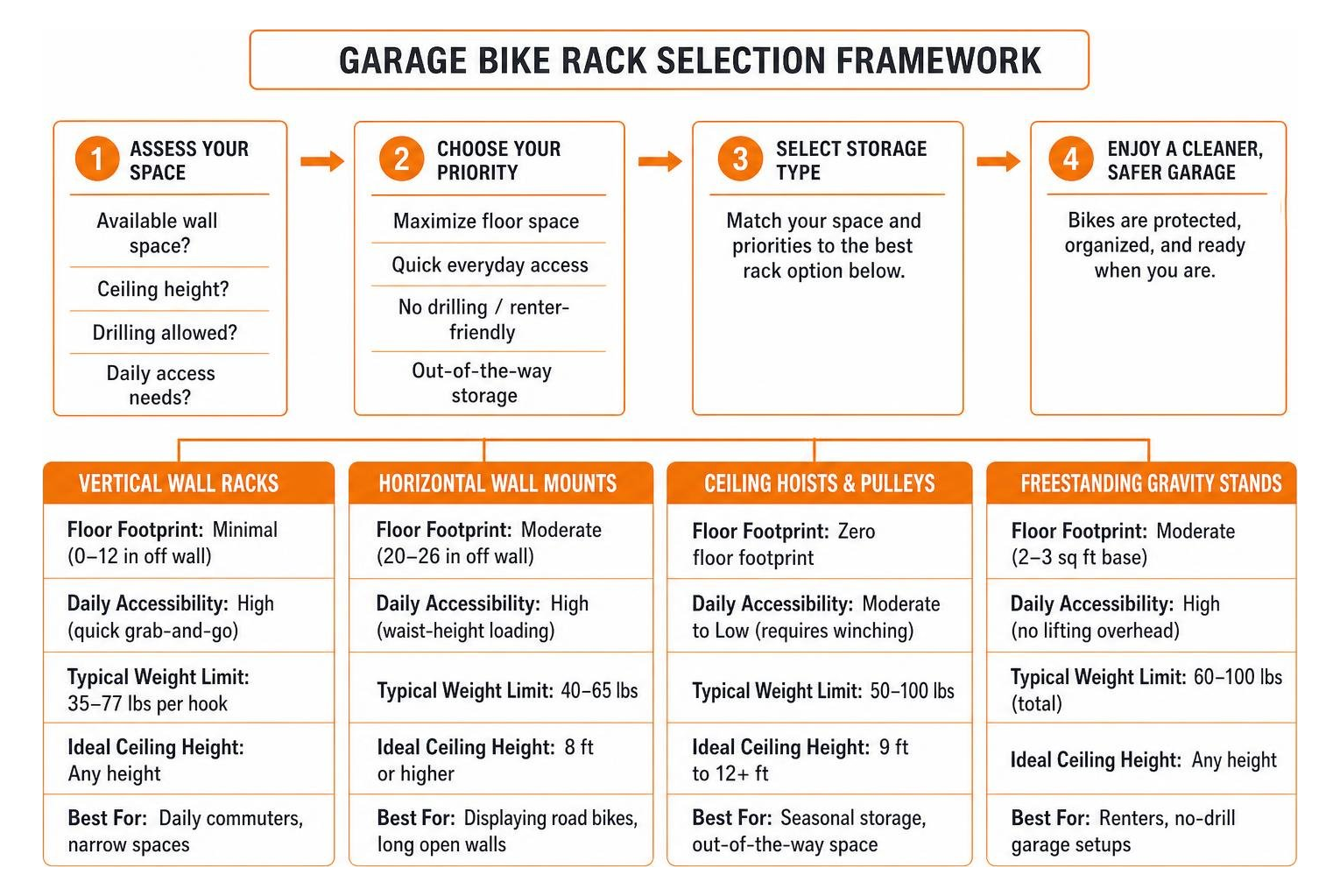
| Storage Type | Floor Footprint | Daily Accessibility | Typical Weight Limit | Ideal Ceiling Height | Best For |
|---|---|---|---|---|---|
| Vertical Wall Racks | Minimal (0–12 in off wall) | High (quick grab-and-go) | 35–77 lbs per hook | Any height | Daily commuters, narrow spaces |
| Horizontal Wall Mounts | Moderate (20–26 in off wall) | High (waist-height loading) | 40–65 lbs | 8 ft or higher | Displaying road bikes, long open walls |
| Ceiling Hoists & Pulleys | Zero floor footprint | Moderate to Low (requires winching) | 50–100 lbs | 9 ft to 12+ ft | Seasonal storage, out-of-the-way space |
| Freestanding Gravity Stands | Moderate (2–3 sq ft base) | High (no lifting overhead) | 60–100 lbs (total) | Any height | Renters, no-drill garage setups |
Wall-Mounted Racks and Track Systems
Wall-mounted setups are the gold standard for active riders. They lift bicycles off concrete floors while keeping them accessible at arm height. When planning a wall-mounted layout, you generally choose between individual brackets, horizontal display cradles, or full-width track systems.
Individual vertical swivels allow bikes to hang by the front wheel and pivot nearly flat against the drywall. This design cuts the outward profile dramatically, letting you walk past without catching a handlebar in the ribs. For broader walls, horizontal hooks support the bike by the top tube, turning your ride into an attractive wall feature while leaving open space underneath for lower storage cabinets.
If you have multiple bikes of different sizes, horizontal rail or track systems offer incredible versatility. You bolt a continuous steel rail into wall studs and clip on specialized hooks that slide side to side. When exploring how to hang bikes in a garage: storage options that protect the bike, prioritizing rubberized, wide-mouth hooks ensures you protect delicate wheel rims while retaining the freedom to slide hooks around as your collection evolves.
Overhead Hoists and Ceiling Pulleys
When floor and wall space are completely spoken for by workbenches and parked vehicles, looking upward is the logical solution. Ceiling-mounted pulley systems use mechanical advantage—usually a 2:1 or 4:1 rope reduction system—to lift bikes smoothly up to the ceiling rafters.
These setups work best in garages with high ceilings (9 feet or higher). Dual-hook assemblies grab the handlebars and the saddle, balancing the frame as you pull the hoisting rope. Built-in locking clutches prevent the rope from slipping, ensuring the bike stays safely suspended overhead. While ceiling pulleys take bikes completely out of your walking paths, they take a minute or two to lower and raise, making them ideal for winter storage, backup road bikes, or secondary family equipment.
Freestanding Gravity Stands and Floor Racks
Not every homeowner wants to drive structural screws into their garage framing, and renters often cannot drill into walls at all. Freestanding floor stands and gravity racks solve this problem cleanly.
- Gravity Racks: These lean directly against the wall, using the downward weight of one or two bicycles to lock the steel frame securely in place. They require zero drilling, set up in minutes, and can be relocated whenever you reorganize.
- Floor-Based Wheel Cradles: These hold the front or rear tire upright on the floor without touching the frame. They are perfect for children who cannot lift their own bikes onto wall hooks.
- Dual-Tier Freestanding Towers: Built on a heavy, wide-stance base, these towers let you stack two adult bikes vertically in the corner of your garage without placing any load on the wall drywall.
Space Planning: Layout, Orientation, and Clearance
A bike storage system is only as good as the layout planning behind it. A single adult bicycle spans 68 to 74 inches in length and features handlebars measuring 18 to 30 inches wide. Without careful spacing, pedals interlock, derailleurs get knocked out of alignment, and car doors end up with fresh dings.
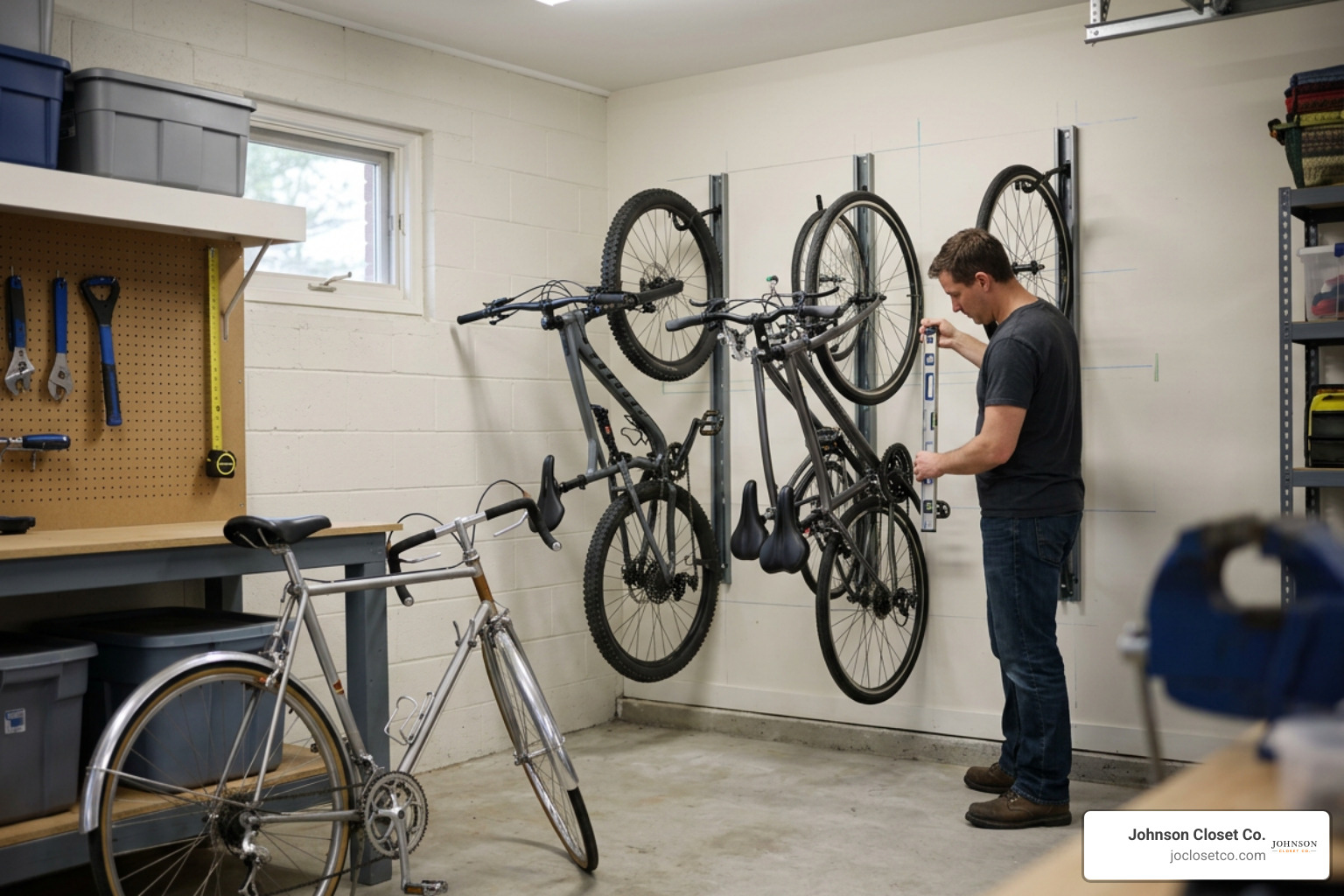
Vertical vs Horizontal Orientations for Storing Bicycles in Garage Layouts
Deciding between vertical and horizontal placement depends entirely on the dimensions of your garage walls and where your vehicles park.
- Vertical Storage (Wheel-Hung): Bikes hang perpendicularly by their front wheel. Each bike requires roughly 24 inches of lateral wall width and projects out 30 to 36 inches into the room. If you install pivoting vertical mounts, you can fold the hung bikes sideways, reducing their projection to around 12 to 14 inches.
- Horizontal Storage (Frame-Cradled): Bikes rest parallel to the wall on support arms. This configuration requires approximately 6 feet of horizontal wall length per bike, but the bike only extends 18 to 22 inches out into the walking aisle.
To prevent handlebars from clashing on wall tracks, stagger vertical hooks by 6 to 8 inches in height. This alternation lets wide mountain bike bars overlap adjacent narrow road bike bars cleanly, doubling your storage capacity across a single wall span.
Structural Requirements and Weight Capacities
Bicycles exert dynamic, pulling forces on storage mounts when loaded and unloaded. Securing hardware properly is critical for safety:
- Wood Studs: Always locate the center of the 2x4 framing using a stud finder. Mount heavy-duty racks using structural lag screws (minimum 5/16-inch diameter, penetrating at least 2 inches into solid wood).
- Drywall Limits: Never use plastic drywall anchors or toggle bolts alone to hold a suspended bicycle. Drywall cores soften under seasonal temperature shifts and will eventually tear loose under cyclical loads.
- Masonry and Concrete: For brick or poured-concrete stem walls, drill pilot holes using a masonry bit and secure mounts with heavy-duty sleeve anchors or concrete screws.
- Weight Verification: While standard carbon and aluminum road bikes weigh between 16 and 30 pounds, modern electric commuter bikes easily weigh 45 to 75 pounds. Check that both the rack and the wall fasteners match the specific weight class of your ride.
Protecting Components, Security, and Climate Care
Garages subject equipment to dust, ambient temperature swings, and humidity. Setting up your storage properly protects your high-end components from mechanical strain and premature aging. For a deeper look at environmental management, check out this guide on how to store bicycle in garage to establish optimal conditions.
Component Protection and Maintenance Considerations
- Protecting Wheel Rims: Standard steel J-hooks can scratch rim clear coats and gouge lightweight alloy or deep-section carbon wheels. Use hooks dipped in heavy-duty vinyl, powder-coated steel cradles, or slip foam pipe insulation over bare metal prongs.
- Hydraulic Disc Brakes: Hanging bikes vertically by the wheel is safe for most modern disc brake systems. However, if air is trapped in the lines, upside-down or vertical storage can migrate bubbles into the calipers, creating a spongy brake lever. If this happens, a quick brake bleed or a few firm lever squeezes once the bike is down will restore pressure.
- Tire Care: If storing a bike on a floor rack for extended periods, maintain at least 50% of the recommended tire pressure. Storing a completely flat tire resting on bare concrete can cause sidewall cracking and flat-spotting over time.
- Heat and Moisture Management: Garages in hot climates experience internal temperatures that can dry out hydraulic seals and degrade chain lubes. Apply a dedicated dry chain lubricant before long-term storage to repel airborne dust and grit, and avoid placing bikes directly next to water heaters or clothes dryers where humidity spikes.
Garage Bike Theft Deterrence and Security Anchoring
Garages are primary targets for opportunistic property theft. An open garage door while mowing the lawn takes only seconds for an unsecured bike to disappear.
- Fixed Anchors: Install a hardened steel floor or wall anchor directly into the foundation or structural framing studs.
- Locking Up: Thread a Sold Secure Diamond-rated chain or heavy-duty U-lock through the frame triangle and rear wheel, locking it directly to your wall anchor or heavy-duty rack rail.
- Visual Deterrence: Position high-end bikes away from direct line-of-sight through garage windows, and consider installing a motion-activated garage light or security camera aimed across the storage zone.
Maximizing Multi-Bike Storage and Garage Organization
When a household owns four, five, or six bicycles, they quickly overtake the garage floor plan. Seamlessly integrating your bike racks into the broader room layout ensures you retain room for vehicles, trash bins, and work zones.

Multi-Bike Options for Storing Bicycles in Garage Spaces
Managing a mix of adult cruisers, high-end mountain bikes, and children's bikes requires an adaptable system:
- Modular Sliding Rails: Sliding hook tracks allow you to push bikes tight against one another during the winter, and slide them apart for effortless access during riding season.
- Dedicated Kids' Zones: Children should never have to lift heavy bikes onto high wall hooks. Dedicate lower wall space or floor-level grid racks for kids' bikes, giving them ownership of putting their rides away safely.
- Accessory Consolidation: Install a section of slatwall or heavy pegboard right alongside the bike rack. Add wire baskets and dedicated hooks for helmets, hydration packs, floor pumps, and riding shoes so your riding essentials stay in one organized hub.
Integrating Bike Racks with Garage Cabinetry and Parking
The biggest layout mistake homeowners make is mounting bike racks without accounting for vehicle door swings and walking paths.
When mapping your garage footprint, position bike storage along the side wall forward of the vehicle doors, or mount them flat against the rear wall behind the parking bay. Integrating your bike rack alongside organized shelving like a hyper tough 4 shelf garage cabinet keeps chain lubes, spare tubes, tools, and riding gear cleanly enclosed behind solid doors rather than scattered across work surfaces.
At Jo Closet Co., we custom-build garage cabinet systems and storage layouts manufactured with in-house CNC machinery right here in Arizona. We routinely integrate precision-measured bike alcoves alongside tall storage cabinetry, keeping sports gear, camping totes, and riding gear completely streamlined.
Frequently Asked Questions About Garage Bike Storage
Is it harmful to hang a bicycle by its wheel?
No, hanging a standard bicycle vertically by a single wheel causes no structural harm to the rim or spokes. The wheel supports the full weight of rider and bike under dynamic road forces; resting 20 to 30 pounds of static weight on a padded hook is well within its structural limits. The only exception is deep-section, ultra-lightweight carbon rims with non-structural fairings, which should be supported by the frame or tires rather than hung on narrow hooks.
How do you store heavy e-bikes safely in a garage?
Because electric bikes frequently weigh 50 to 75 pounds, storing them overhead on ceiling pulleys is rarely practical or safe. Instead, use heavy-duty, floor-resting roll-in vertical mounts that allow you to roll the front wheel into the tray without lifting the full frame weight. If wall-mounting, anchor commercial-grade steel brackets directly into solid wall studs using heavy structural lag bolts, and consider removing the battery to shave 6 to 10 pounds off the lift weight.
What is the best storage method for garages with low ceilings?
For garages with 7- to 8-foot ceilings, ceiling hoists will hang bikes too low, creating dangerous headroom hazards for walking and parking. The ideal solutions for low ceilings are horizontal wall-mounted cradles that hold the frame parallel to the floor, or vertical pivoting wall brackets that let you fold the hung bikes flush against the drywall to maximize aisle clearance.
Conclusion
A well-planned garage bike storage system eliminates floor clutter, protects your bike frames and components, and makes heading out for a ride effortless. By matching your storage style to your wall space, anchoring mounts into solid framing, and keeping gear organized nearby, you transform a chaotic garage into a clean, functional space.
If you are ready to completely transform your garage with custom cabinetry, integrated tool zones, and tailored garage cycle storage, our team at Jo Closet Co. is here to help. We design and manufacture exact-fit storage solutions built for your home's exact dimensions. Contact us today to start planning your dream garage setup!