
Ceiling Bike Hangers: Which Setup Fits Your Garage?
Ceiling Bike Hangers: Which Setup Fits Your Garage?
For a bike hanger ceiling setup, choose a fixed hook or rail if you can lift the bike yourself. Choose a pulley, spring-powered lift, or electric lift if you want to raise and lower it with less effort. Before buying, check your bike’s weight against the hanger’s rated capacity, measure the clearance above your car, and confirm that the mount can attach securely to ceiling joists.
I’m Chris Johnson, owner of Johnson Closet Co., and I’ve spent more than 30 years designing and installing storage that makes homes easier to use. I’ll bring that practical approach to helping you choose a bike hanger ceiling setup that fits your garage.
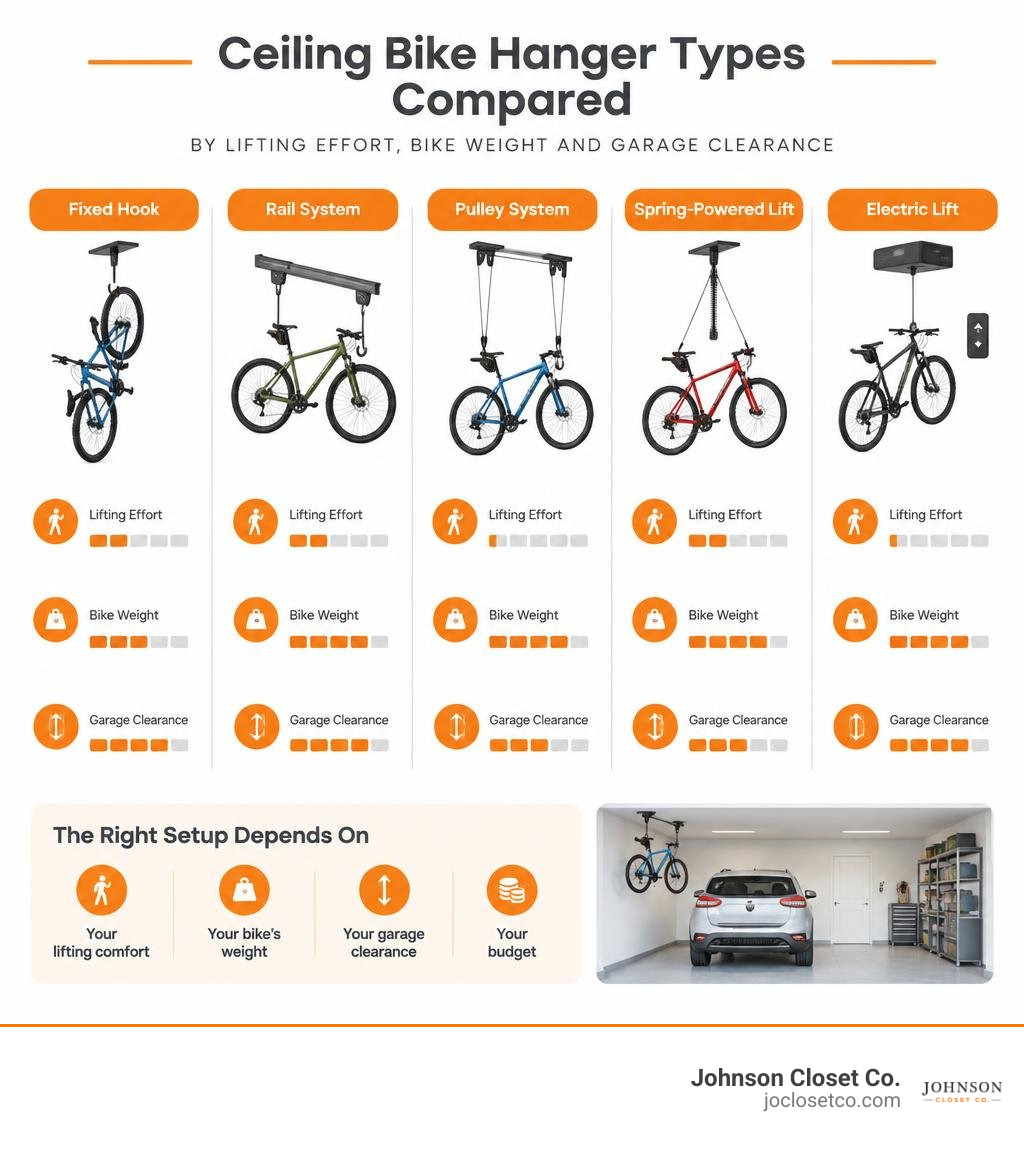
Types of Bike Hanger Ceiling Systems for Garage Storage
Tripping over handlebars or squeezing past parked bikes to get into your car is an everyday headache. Storing bikes overhead transforms unused vertical space into functional storage, freeing up 30% to 50% of your garage floor area. Choosing the right mechanism comes down to lifting effort, ceiling height, load capacity, and budget.
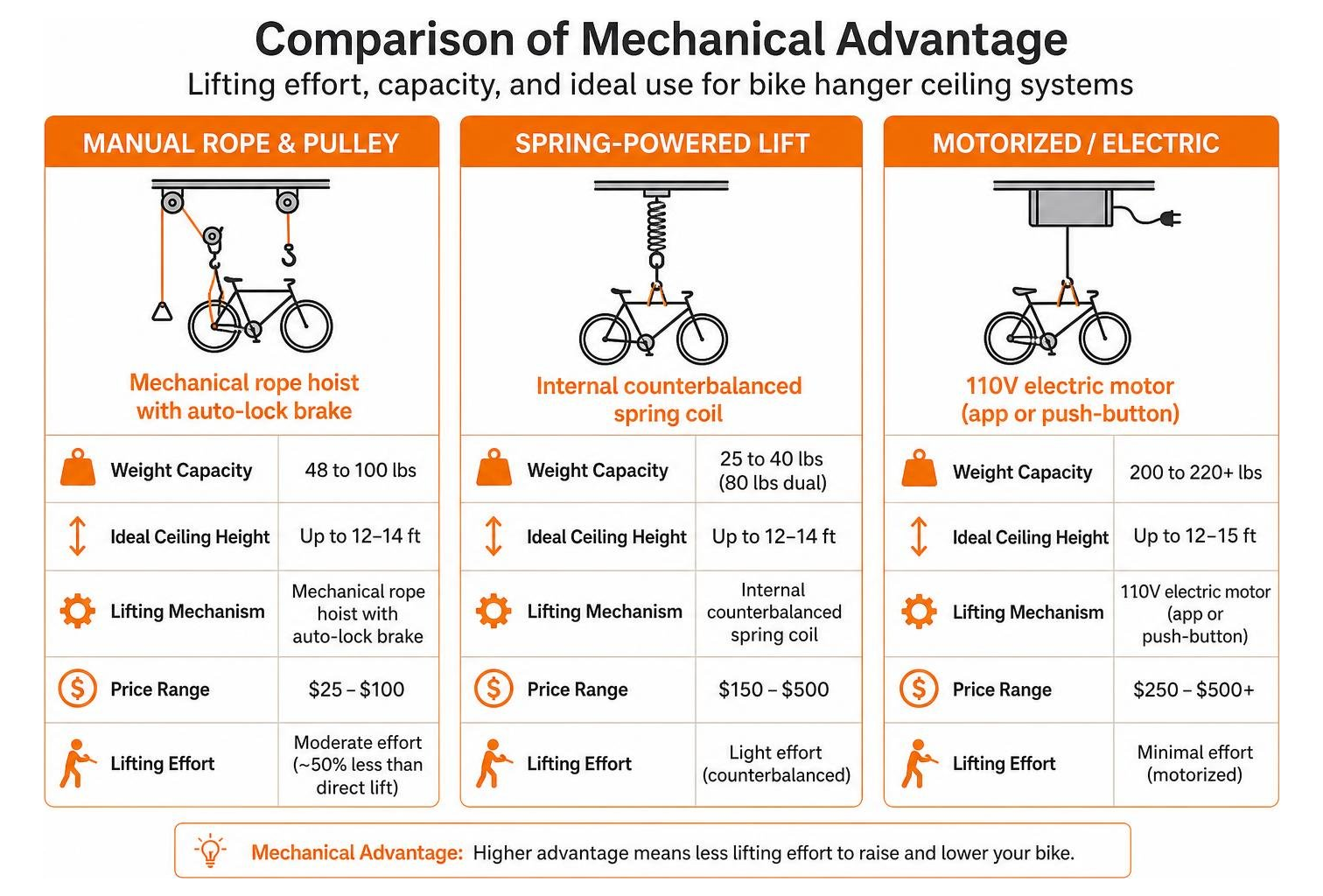
| System Type | Weight Capacity per Unit | Ideal Ceiling Height | Lifting Mechanism | Price Range |
|---|---|---|---|---|
| Manual Rope & Pulley | 48 to 100 lbs | Up to 12–14 ft | Mechanical rope hoist with auto-lock brake | $25 – $100 |
| Spring-Powered Lift | 25 to 40 lbs (80 lbs dual) | Up to 12–14 ft | Internal counterbalanced spring coil | $150 – $500 |
| Motorized / Electric | 200 to 220+ lbs | Up to 12–15 ft | 110V electric motor (app or push-button) | $250 – $500+ |
| Fixed Hooks & Rails | 50 to 260+ lbs (multi-bike) | 8 to 10 ft | Direct manual lift onto vinyl-coated hooks | $15 – $120 |
When evaluating dedicated ceiling bike hangers, consider how frequently you ride and who will be lowering the equipment.
Manual Rope and Pulley Hoists
Manual hoists use a system of compound pulleys combined with heavy-duty tensile nylon rope to cut the physical effort of lifting a bicycle in half. Popular models support up to 48.5 lbs (22 kg) on ceilings up to 12 feet high, while heavy-duty variants offer a 100-pound payload capacity per hoist.
The standout safety feature in modern pulley units is the integrated auto-locking clutch brake. As you pull the rope, the brake releases; if you let go or slip, the mechanical teeth grab the tensile cord instantly, preventing the bike from dropping onto whatever sits below. High-tensile nylon ropes are standard because they do not stretch under tension, keeping your setup stable. Beyond bicycles, these hoists often double as utility storage for kayaks, cargo carriers, or extension ladders when integrated into complete bicycle storage systems for garage layouts.
Spring-Powered and Pneumatic Lifts
If you dislike managing loose ropes or wrapping cords around wall cleats, spring-powered systems provide an electricity-free alternative. Premium units rely on a heavy-duty internal counterbalance spring that operates similarly to a heavy-duty roll-up shade.
These lifts are typically calibrated to specific bicycle weights:
- Lightweight models (approx. 25 lbs): Designed for high-end road bikes and lightweight commuters, providing up to 12 feet of cable travel for ceilings up to 14 feet.
- Mid-weight models (approx. 40 lbs): Built for standard mountain bikes and hybrid cruisers, offering 10 feet of cable travel on ceilings up to 12 feet.
With zero electrical wiring needed, you pull the bike downward gently to release the lock, and the internal spring smoothly lifts it back toward the rafters.
Motorized and Electric Overhead Hoists
For multi-bike households, heavier gear, or those who want zero manual lifting, motorized systems eliminate the physical effort entirely. Heavy-duty options use a 460-watt electric motor (drawing about 3.9 amps) to lower a nine-foot steel bar capable of holding up to eight bicycles at a steady lifting speed of 30 feet per minute.
Modern motorized hoists incorporate dual synchronized motors and Bluetooth smartphone app controls. With a 200-pound total payload, they easily handle four electric commuter bikes or a mixture of bikes and gear. For families storing expensive motorized cycles, choosing an electric bike storage rack for garage with key-lock safety switches or digital app locks ensures children cannot accidentally lower heavy frames.
Fixed Hooks and Sliding Rail Systems
Fixed ceiling hooks and sliding track channels represent the simplest, most budget-conscious storage styles. Heavy-duty steel ceiling channels support between 250 and 640 pounds across 4 to 8 bicycles.
These setups use solid steel crossbars secured directly into overhead rafters, fitted with industrial vinyl-coated hooks and gated safety locking pins to stop sliding hooks from dislodging. While they require lifting the bike's entire weight manually to hook the front or rear rim, they are unbeatable for compact horizontal hanging on ceilings between 8 and 9.5 feet high when storing bicycles in garage settings.
Overhead Ceiling Storage vs. Wall and Freestanding Alternatives
Choosing the best storage orientation depends on your floor dimensions, wall availability, and how often you pull your bike down for a ride.
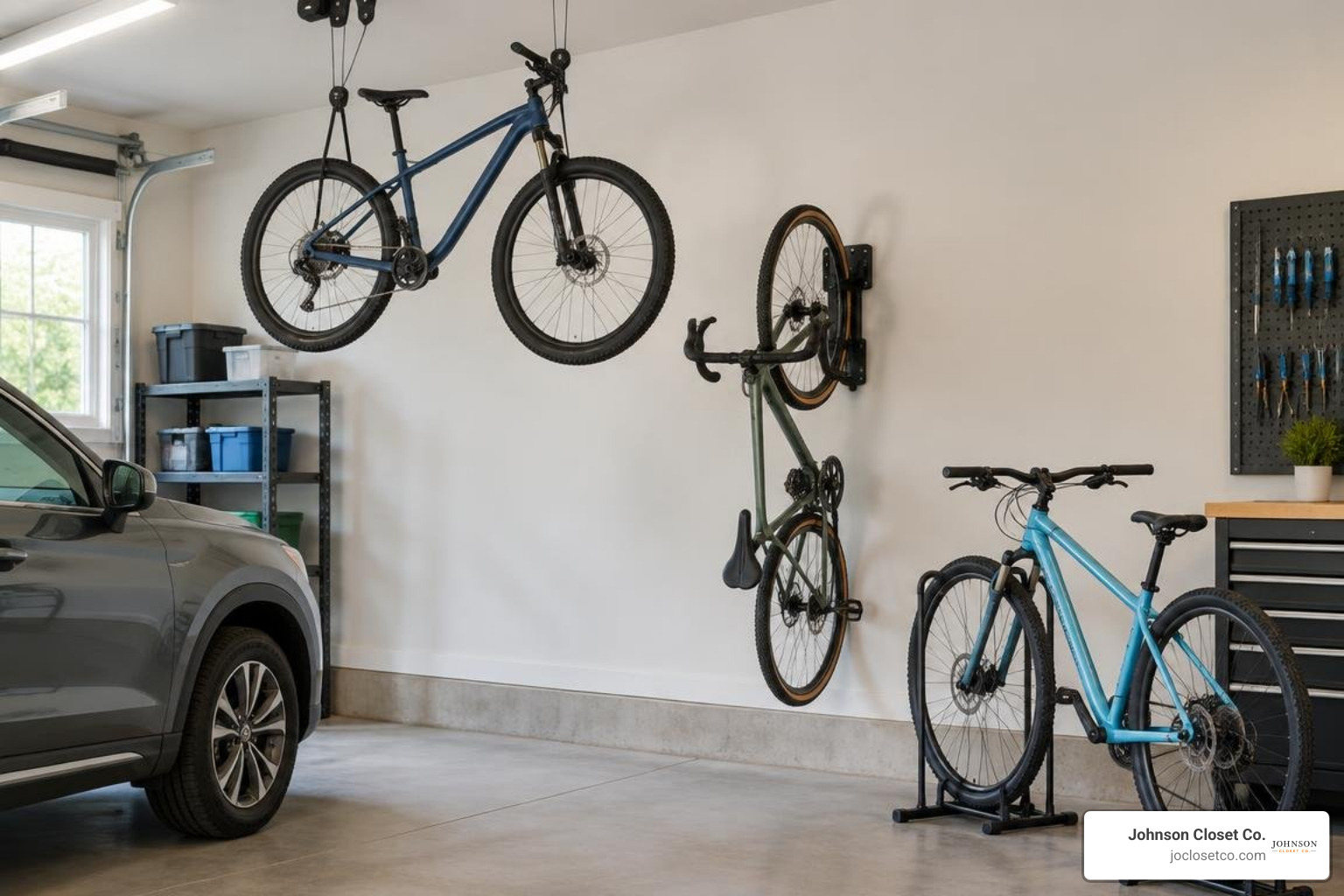
- Overhead Ceiling Hangers: By lifting bicycles into the dead airspace above car hoods or overhead garage door tracks, ceiling mounts preserve 100% of your usable floor area. They are ideal for seasonal riders, high-value bikes kept out of high-traffic zones, and garages with tight vehicle clearances. The trade-off is accessibility: retrieving a bike from the ceiling takes slightly more time than grabbing it off a floor stand.
- Wall-Mounted Racks and Clips: Wall brackets and vertical bike clips for garage wall keep bikes accessible at chest height without heavy overhead lifting. However, they demand continuous perimeter wall space. In narrow two-car garages, wall-hung bikes often conflict with opening vehicle doors.
- Freestanding Floor Stands and Gravity Towers: These require zero drilling, making them renter-friendly. The downside is that they sit directly on the floor slab, taking up valuable footprint that could otherwise hold workbenches, vehicles, or bins.
How to Choose and Install Overhead Bike Storage
Choosing the Best Bike Hanger Ceiling System for Your Bike Type and Weight
Selecting the right mount starts with weighing your bicycle and measuring tire dimensions. Standard road bikes weigh between 16 and 22 pounds, standard hardtail mountain bikes range between 28 and 35 pounds, and modern electric bikes easily weigh between 45 and 75 pounds.
| Bike Style | Typical Weight Range | Wheel & Tire Considerations | Best Ceiling Mount Match |
|---|---|---|---|
| Road & Gravel | 16 – 24 lbs | Narrow rims, lightweight carbon or alloy | Manual Pulley, Spring Lift, Fixed Hook |
| Mountain (MTB) & Trail | 28 – 38 lbs | Wide 2.3"–2.6" tires, dropper seatposts | Heavy-Duty Pulley, Spring Lift, Sliding Rail |
| Fat Tire Bikes | 35 – 45 lbs | Oversized 3.8"–5.0" tires | Wide-opening hook hoist, Sliding Rail Track |
| Electric Bikes (e-Bikes) | 45 – 75+ lbs | Heavy motor/battery, wide frames | Dual-Motor Electric Lift, Dual Spring Hoist |
| Kids' & Youth Bikes | 15 – 30 lbs | Compact wheelbases, smaller frames | Multi-Bike Rail Track, Manual Pulley |
For heavy cruisers and e-bikes, never overload a single-pulley unit rated for 50 pounds. If you work on your own gear, you can even explore a DIY bike stand and workshop setup to keep bikes tuned before hoisting them into the rafters.
Key Safety and Installation Tips for Every Bike Hanger Ceiling Mount
Secure overhead storage demands firm anchoring into the structural framing of your home. Drywall, plasterboard, and drop-ceiling tiles cannot support overhead dynamic loads.
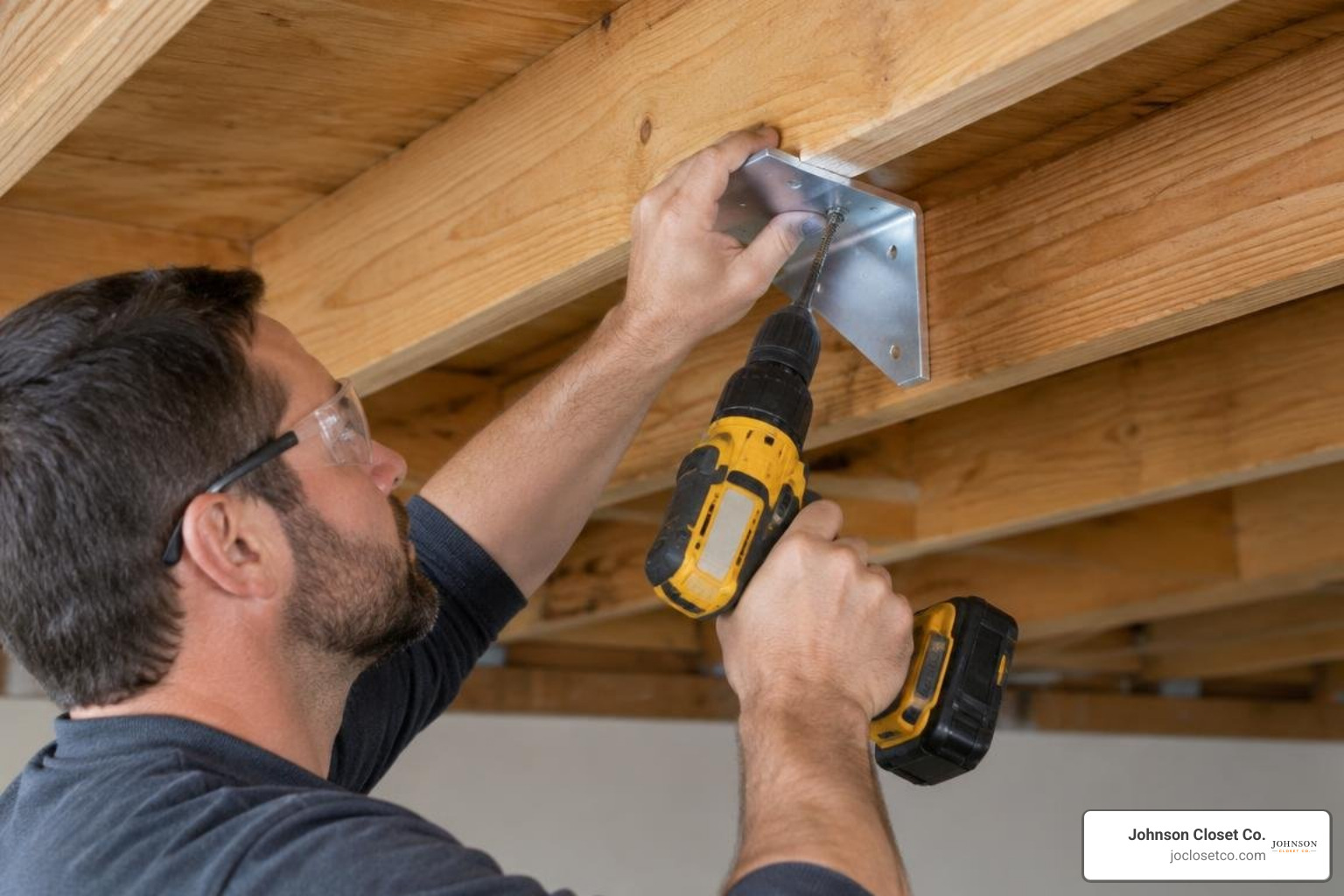
- Locate Joist Centers: Use an electronic stud finder to pinpoint the edges and center of your ceiling joists. Rafters in Phoenix Valley garages are typically spaced 16 or 24 inches on center.
- Determine Joist Orientation: If your joists run parallel to your bicycle's top tube, mount the front and rear brackets along the same beam. If the joists run perpendicular, you can bridge two joists by fastening a 2x4 or 2x6 structural backing board using heavy-duty lag bolts, then attaching your hanger to the board.
- Pre-Drill Pilot Holes: Always pre-drill pilot holes with the manufacturer-recommended drill bit (typically 1/8" or 3mm). Pre-drilling prevents splitting the structural ceiling framing when driving in thick lag screws.
- Maintain Safe Obstruction Clearances: Mount the system at least three feet away from side walls, high garage door tracks, light fixtures, and ceiling fans.
- Perform a Weight Load Test: Before suspending an expensive bicycle, perform a load test. Pull downward firmly on the lowered hooks with your own body weight to verify the lag bolts are securely seated into solid lumber.
Best Practices for Maintenance and Safe Operation
Regular maintenance ensures that your overhead storage remains smooth, safe, and reliable for years:
- Inspect Cords and Webbing Straps: Check nylon tensile cords and lifting straps every six months for fraying, chafing, or UV breakdown. Replace cords showing visible wear immediately.
- Check Hook Coatings: Ensure the soft vinyl or rubber dipping on the hooks remains intact so metal never scratches your bike's wheel rims or handlebars.
- Lubricate Pulley Axles: Apply a light drop of dry silicone or PTFE lubricant to the pulley wheel bearings annually to prevent squeaking and reduce pulling friction.
- Balance Weight Evenly: When using multi-bike electric elevators or sliding tracks, balance the load across the support bar to avoid placing uneven torque on the motors or mounting plates.
For a completely seamless layout, integrate overhead racks alongside custom garage storage cabinets. Unifying your vertical space with durable cabinetry creates comprehensive home storage solutions that keep your garage organized and clutter-free.
Frequently Asked Questions About Ceiling Bike Storage
Can ceiling bike hangers safely hold heavy electric bikes?
Yes, provided the system's weight rating exceeds your e-bike's total weight. Standard manual hoists rated for 45–50 pounds are often too light for 60-pound e-bikes. Instead, choose a heavy-duty electric lift rated for 200+ pounds, or pair two 40-pound spring-powered lifts together. To reduce overall hoisting weight and protect battery cells from extreme ceiling heat during Arizona summers, remove the battery pack before lifting the bike.
How much ceiling height is required for overhead bike storage?
A garage with 9- to 15-foot ceilings works best for overhead bike storage. To determine your minimum clearance:
- Measure the vertical height of your bicycle from the top of the tire to the bottom of the lowest wheel (usually 30 to 48 inches depending on vertical or horizontal hanging).
- Add 8 to 12 inches for the bracket and pulley drop hardware.
- Confirm that the lowest point of the hanging bicycle sits at least 6 inches above your vehicle's roofline or 7 feet above walking paths for comfortable head clearance.
Can you install a ceiling bike hanger on pitched or angled rafters?
Yes, but you must ensure the lifting brackets remain level. Some spring-powered lifts include pivoting angle brackets designed for vaulted ceilings. For manual pulley or electric lifts, level the mounting surface first by securing a plumb wooden ledger board or angled mounting block across the pitched rafters before attaching the hardware.
Reclaim Your Garage Floor Space
Storing your bicycles overhead is one of the most effective ways to clear garage floor clutter, protect expensive frames from accidental dings, and keep your space functional. Whether you select a budget-friendly manual rope hoist, a sleek spring-powered lift, an automated electric platform, or a fixed sliding rail, matching the system to your ceiling height and bike weight ensures a safe and durable setup.
If you are planning a complete garage transformation across the Phoenix Valley—including Scottsdale, Gilbert, Chandler, Mesa, or Tempe—our team at Johnson Closet Co. specializes in designing precision-manufactured, custom garage storage systems that fit your lifestyle. Explore our dedicated guide on garage cycle storage to see how integrated cabinetry, wall tracks, and overhead systems can completely organize your home.