
Why a Shelf Board Cut to Size Beats a Box-Store Plank
Why a Shelf Board Cut to Size Beats a Box-Store Plank
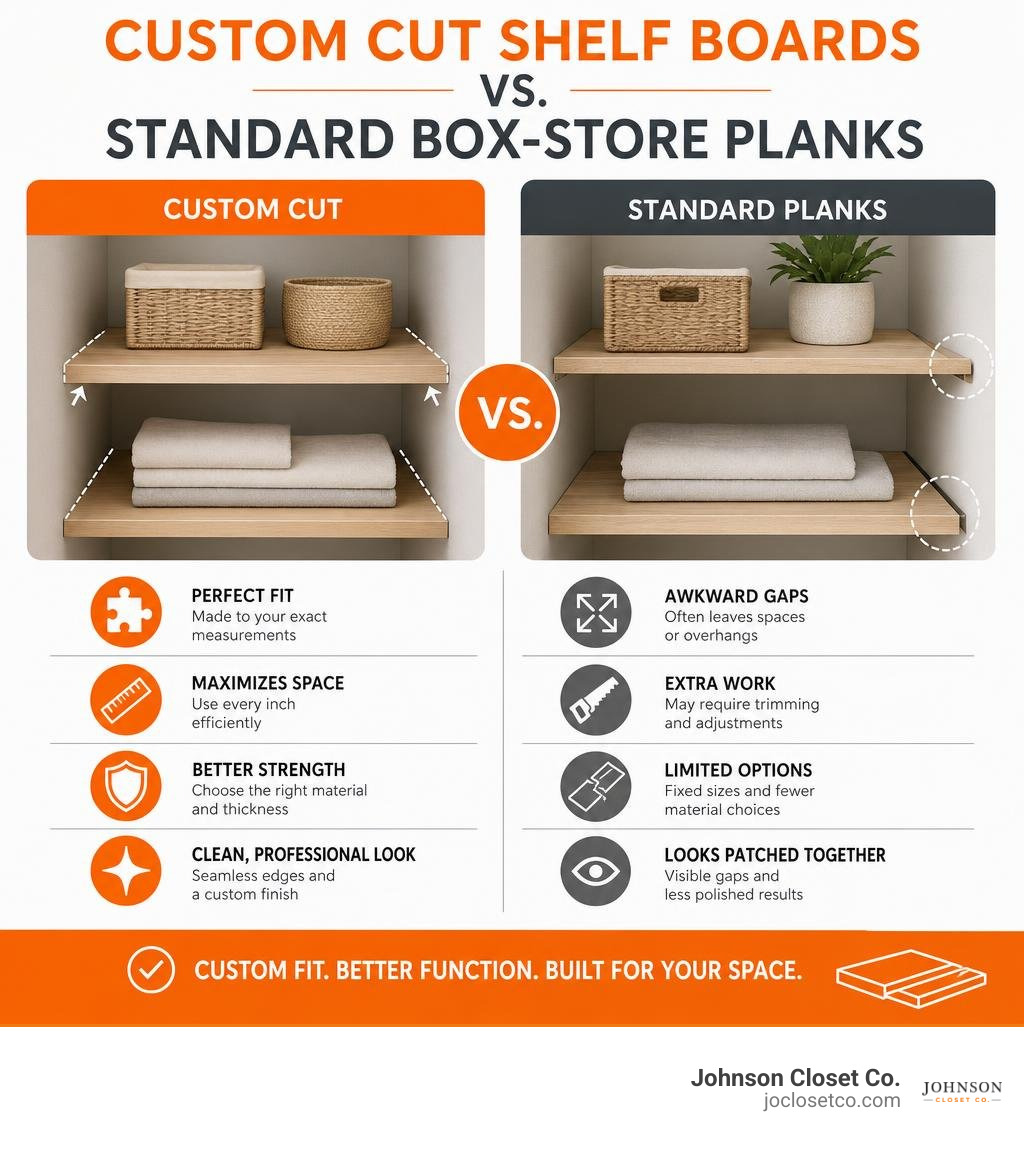
A shelf board cut to size gives you a cleaner fit, better use of every inch, and more control over strength and finish than a standard box-store plank. Measure the opening at several points, order the smallest measurement with about 1/16-inch clearance for a snug alcove or cabinet fit, then choose the material and thickness for what the shelf needs to hold.
Standard boards can leave awkward gaps, require extra trimming, or force you to redesign around the sizes on the rack. A custom-cut board is made for your width, depth, edge finish, and mounting method - whether you need a simple closet shelf, a built-in pantry insert, or a seamless floating display shelf.
The result is storage that looks planned rather than patched together. Chris Johnson here - next, let's compare the best shelf-board materials for your space and budget.
Top Material Options for a Shelf Board Cut to Size
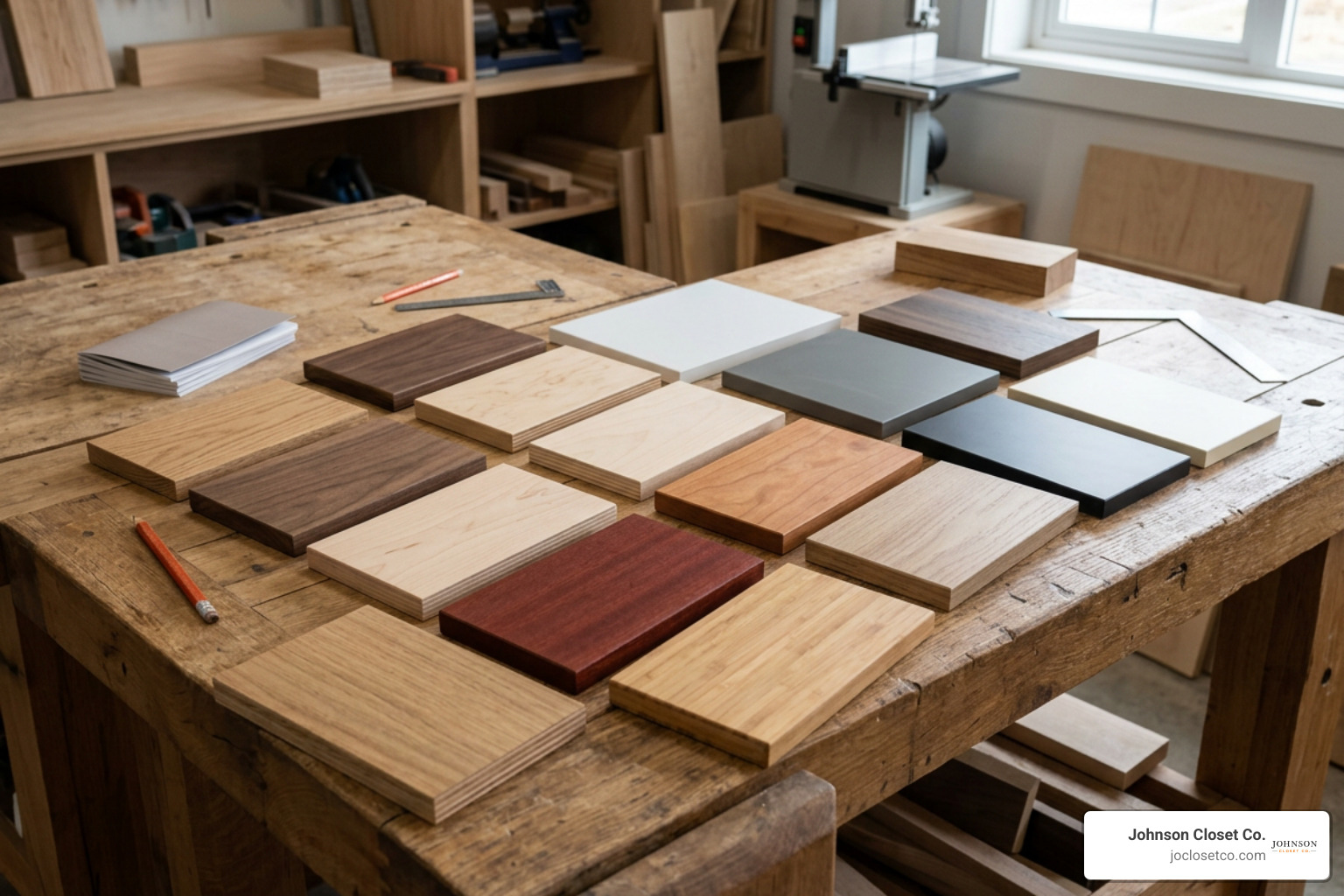
Choosing the right core material dictates how much weight your shelf carries, how it handles everyday humidity, and how well it complements your room's aesthetic. When creating tailored closet shelving, selecting a material that balances structural integrity with visual warmth ensures your storage performs reliably year after year.
Let's break down the primary material categories available when planning your tailored project.
1. Solid Hardwoods and Real Wood Veneer
Solid hardwood planks and architectural-grade wood veneers provide organic beauty and structural strength.
- Wood Species: Premium choices include American black walnut, white oak, cherry, hard maple, and red oak. Sourcing sustainably harvested woods provides long-term stability and distinctive grain character.
- Grain Direction Alignment: When setting up a multi-tier unit or open cabinetry, specifying continuous grain direction across boards prevents visual clashes.
- Finishes: High-grade shelves benefit from low-VOC conversion varnishes, plant-based spray lacquers (often delivering a subtle 10% matt gloss), or deep-penetrating hand-rubbed oil finishes.
- Pros: Incredible span capacity, natural resistance to bending, and the ability to be sanded down and refinished over time.
- Cons: Higher upfront investment and susceptible to natural expansion if exposed to high moisture without proper sealing.
If you are sourcing artisanal slabs, options like a Custom-Cut Walnut Floating Shelf Board | Shelfology or specialty listings for a Wood Shelf Cut to Order offer handcrafted appeal.
2. Moisture-Resistant MDF and Plywood
Engineered wood boards deliver dimensionally stable, flat surfaces free of natural grain knots or voids.
- Birch Plywood: Multi-ply cross-laminated construction gives birch plywood superior screw-holding strength and deflection resistance. It is well suited for modern exposed-edge styling or clean lacquered builds. You can review options like Plywood Shelf Boards | Birch Ply Wall Shelves | Cut My to explore thickness varieties.
- Medium-Density Fiberboard (MDF): Made of dense wood fibers compressed with resin, paint-grade MDF offers an ultra-smooth face with zero grain telegraphing. Moisture-resistant (MR) MDF cores prevent swelling in humid laundry rooms or bathroom nooks. Detailed sizing options can be reviewed through MDF Shelf Boards | MDF Shelving Cut To Size | Cut My.
- Pros: Budget-friendly, warp-resistant, and readily machined with custom curves and profiles.
- Cons: Standard MDF is heavy and prone to sagging across spans wider than 30 inches without front reinforcement.
3. Melamine-Faced Chipboard (MFC)
Melamine-faced panels represent the gold standard for durable, cleanable utility and closet interiors.
- Construction: A high-density composite core bonded on both sides with decorative resin-impregnated paper creating a non-porous shell.
- Aesthetic Range: Available in solid neutrals, crisp whites, and realistic textured woodgrains.
- Everyday Durability: Melamine resists scuffs, scratches, household chemicals, and common spills, making it standard for high-performance built-in cabinets.
- Pros: Highly cost-effective, uniform thickness (industry-standard 3/4-inch or 18mm), and zero requirement for post-installation painting or sealing. Explore platforms like Shelves Cut to Size | MFC Shelf Boards | Made to Measure – Bridgewater Direct or general portals for Shelf Boards Cut To Size to see standard laminate varieties.
- Cons: Exposed core edges must be protected with machine-applied edge banding to prevent moisture ingress.
4. Custom Acrylic and Tempered Glass
Non-wood shelving materials introduce light transmission, modern styling, and clean visual lines for accent displays.
- Clear Acrylic (Plexiglass): Acrylic delivers shatterproof transparency at roughly half the weight of standard plate glass. In fact, popular 1/4-inch custom cut clear acrylic sheets maintain an average rating of 4.7 out of 5 based on 510 customer reviews, showing strong customer satisfaction for DIY display inserts.
- Tempered Safety Glass: Heat-treated to withstand thermal variations and resist impact, tempered glass will crumble into small, dull granules rather than sharp shards if fractured. High-quality 3/16-inch clear tempered glass cut-to-size products achieve a reliable rating of 4.6 out of 5 based on 41 customer reviews, while wall-mounted acrylic glass systems achieve 4.3 out of 5 stars across 1,054 reviews.
- Pros: Water-impervious, allows downlighting to pass through lower shelves, and offers clean polished edge treatments. You can browse online marketplaces like Custom Shelves Cut To Size and general listings for a Custom Shelf Board - Amazon.com for pre-packaged acrylic kits.
- Cons: Acrylic can scratch if cleaned with abrasive towels, while glass requires specialized silicone-cushioned support brackets to prevent localized stress fractures.
How to Measure and Specify Dimensions for an Exact Fit
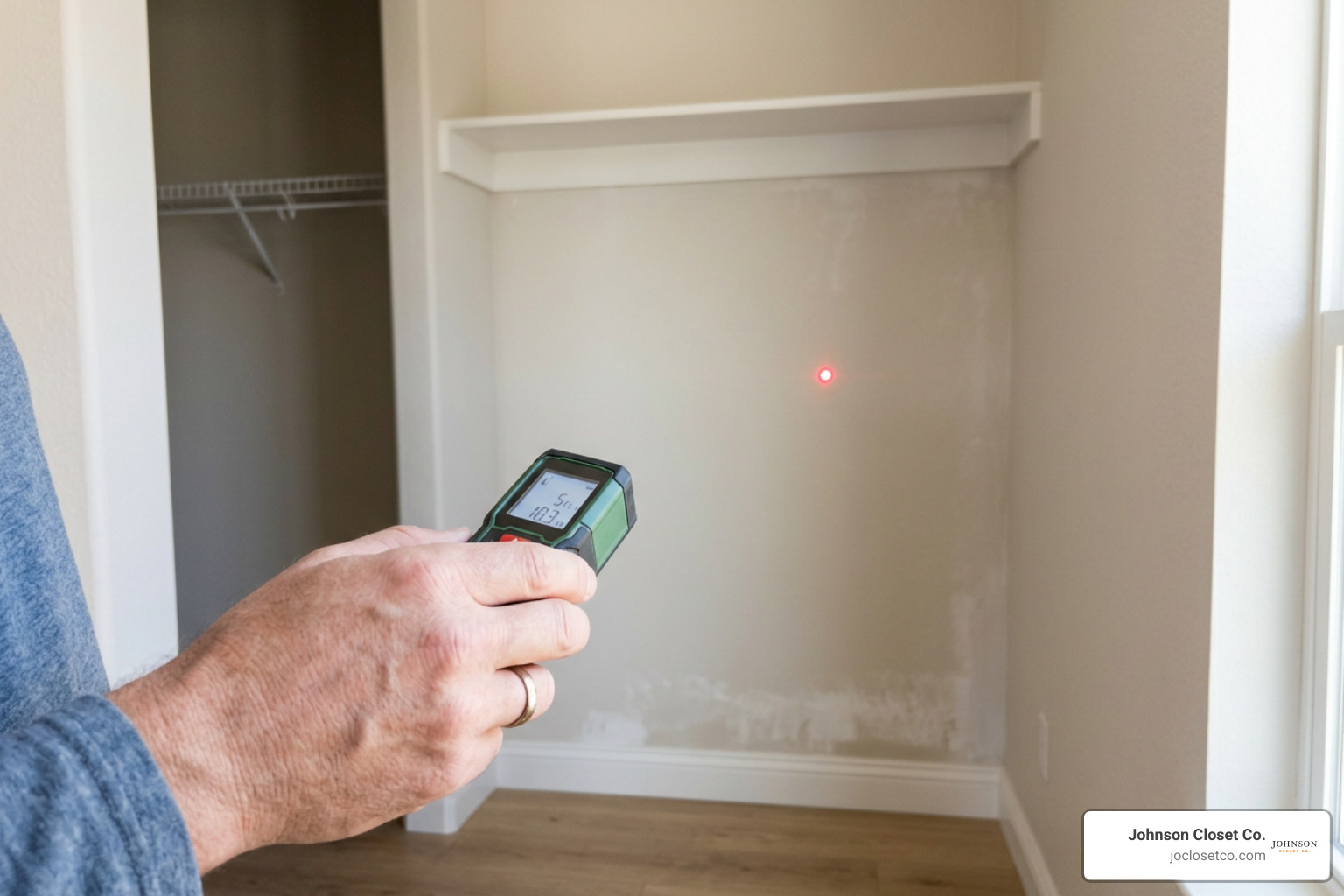
Walls are rarely perfectly plumb, flat, or square—especially in drywall alcoves. Taking accurate measurements prevents on-site trimming headaches and ensures a clean installation.
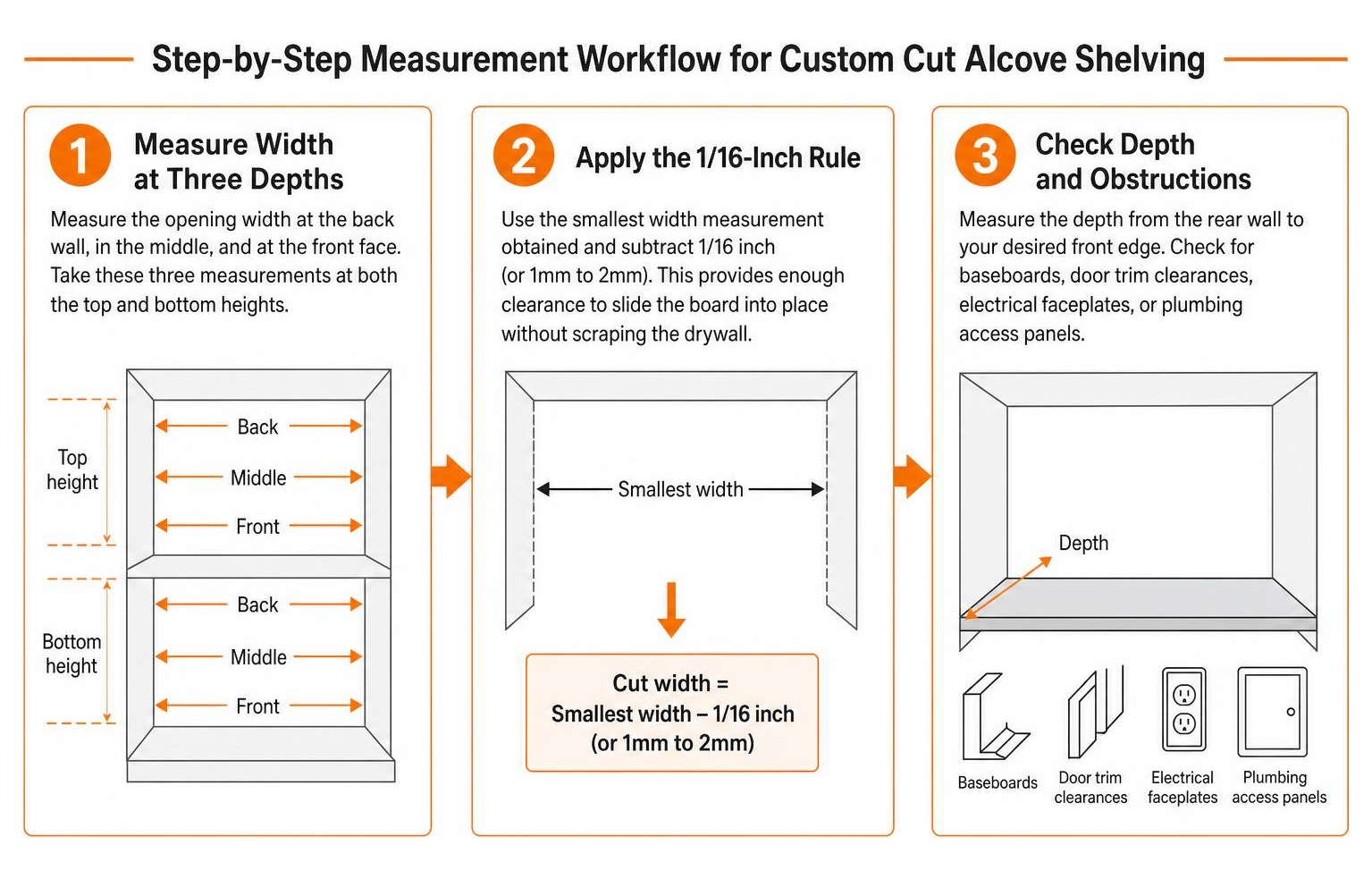
Follow this step-by-step measuring process when planning your custom closet design:
- Measure Width at Three Depths: Measure the opening width at the back wall, in the middle, and at the front face. Then, take these three measurements at both the top and bottom heights of the planned installation.
- Apply the 1/16-Inch Rule: Use the smallest width measurement obtained and subtract 1/16 inch (or 1mm to 2mm). This provides enough clearance to slide the board into place without scraping the drywall.
- Check Depth and Obstructions: Measure the depth from the rear wall to your desired front edge. Check for baseboards, door trim clearances, electrical faceplates, or plumbing access panels.
- Determine Corner Radius: For curved cabinet shelves or desks, measure corner curves using two perpendicular straight edges. Place them against the adjacent edges, mark where the curve starts, and measure to the intersection point to calculate the exact corner radius (typically 40mm or larger for CNC routing).
Thickness, Span Ratings, and Sag Prevention
Shelf deflection—the visible sagging in the center of a loaded span—occurs when the board's thickness or elasticity cannot support the distributed load.
To maintain an unnoticeable deflection (less than 1/32 inch per foot), align your board thickness with your storage requirements:
| Material Type | Nominal Thickness | Maximum Unsupported Span | Typical Use Case |
|---|---|---|---|
| Melamine (MFC) | 3/4 in. (18–19mm) | 28 to 32 inches | Folded clothes, linens, pantry goods |
| Moisture-Resistant MDF | 3/4 in. (18mm) | 26 to 30 inches | Light decorative items, craft supplies |
| Birch Plywood | 3/4 in. (18mm) | 32 to 36 inches | Hardcover books, kitchen appliances |
| Solid Hardwood (Oak/Walnut) | 3/4 in. to 1 in. | 36 to 42 inches | Heavy reference libraries, cast iron cookware |
| Solid Hardwood Slab | 1.5 in. to 1.75 in. | 48 to 60 inches | Floating architectural displays |
| Clear Cast Acrylic | 1/4 in. to 1/2 in. | 18 to 24 inches | Collectibles, perfume displays, lightweight retail |
| Tempered Glass | 3/8 in. (10mm) | 24 to 30 inches | Barware, vanity toiletries, highlighted decor |
When outfitting extra-deep storage areas, such as 24 inch deep closet shelves, span limits become even more critical. Wide, deep shelves holding heavy dynamic loads should use a 1-inch thick core or incorporate an underlying hardwood support cleat along the back wall to prevent sagging.
Edge Finishing and Secure Mounting Options
A custom-cut board requires the right edge treatment and mounting setup to look complete and perform securely under daily use.
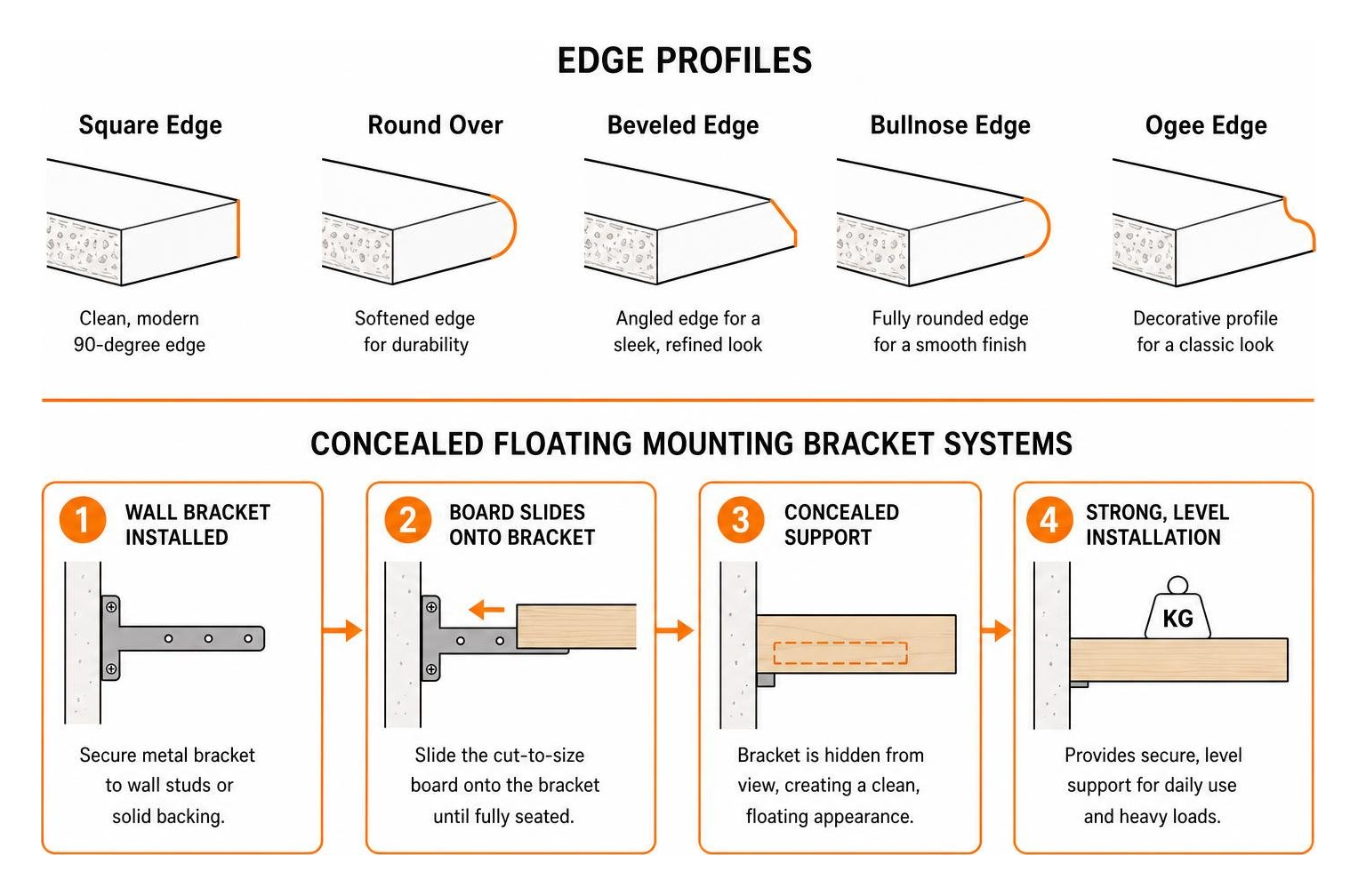
Edge Banding and Custom Profiling for a Shelf Board Cut to Size
Exposed raw composite or plywood cores require tailored edge treatments:
- ABS and PVC Edge Banding: High-durability 1mm to 2mm thick polymer banding applied with industrial hot-melt adhesives. It seals the core against moisture and resists impact damage along front edges.
- Real Wood Edge Tape: Natural wood veneer strips ironed or pressed onto plywood edges, sanded flush, and stained to match the main panel.
- Machined Edge Profiles: Solid timber boards can be finished with eased, beveled, or bullnose profiles. Acrylic and glass edges can be flat-polished or pencil-beveled for a crystal-clear sheen.
- Protective Factory Lacquering: Sealing all four sides with plant-based spray lacquer guards against moisture intrusion while creating a smooth, cohesive look across your closet organization system.
Installing a Floating Shelf Board Cut to Size with Hidden Brackets
Floating shelves provide a modern look by concealing all mounting hardware inside the shelf itself.
To mount thick solid hardwood or hollow-core shelves (typically 1.25 to 1.75 inches thick):
- Locate Wall Studs: Use a commercial stud finder to mark solid wood framing members. Fastening solely into drywall anchors will fail under moderate loads.
- Mount the Backing Plate: Secure the heavy-gauge steel bracket horizontally, leveling it with precision shims if the wall surface is wavy.
- Route Internal Channels: CNC routers drill matching internal core holes (often 1/2-inch to 3/4-inch diameter) into the back edge of the board, matching the rod spacing of the steel bracket.
- Secure the Board: Slide the board over the support rods until it rests flush against the drywall, locking it from underneath using set screws.
Cost, Lead Times, and Ordering Online vs. Local Fabrication
Understanding the pricing structure and turnaround differences helps you choose the best fabrication route for your space:
- Cost Metrics: Custom-cut basic melamine starts between $15 to $35 per running linear foot, while premium CNC-machined solid walnut or white oak slabs with factory conversion varnishes range from $45 to $120+ per linear foot depending on thickness and depth.
- Lead Times: Standard online cut-to-size suppliers usually require 1 to 3 weeks (typically 6 to 9 business days for custom solid timber milling) to cut, band, finish, and cure the panels prior to dispatch.
- Shipping and Freight: Heavy panels exceeding 48 inches or bundles over 40 lbs often incur freight shipping charges. Ordering locally eliminates freight charges and minimizes the risk of transit corner damage.
- Investment Comparison: While big-box pre-cut commodity boards appear cheaper initially, accounting for tool purchases, edge-tape irons, off-cut waste, and potential re-cuts brings total costs close to custom fabrication. Reviewing total walk in closet installation cost factors helps put custom component investments into clear perspective.
Frequently Asked Questions About Custom Shelving
How much clearance should I deduct when measuring for alcove shelves?
Subtract exactly 1/16 inch (approximately 1.5mm) from your narrowest width measurement. This provides adequate installation clearance so you can slide the board between walls without gouging drywall, while maintaining a clean, snug fit that covers support cleats.
What thickness is required to prevent long shelf spans from sagging?
For standard spans between 30 and 36 inches carrying moderate loads (such as pantry goods or folded clothes), use 3/4-inch (18–19mm) material. For heavy libraries, spans exceeding 36 inches, or floating shelves with hidden brackets, upgrade to 1-inch up to 1.75-inch thick solid timber or reinforced plywood.
Are acrylic and glass shelves suitable for heavy storage?
No. Standard 1/4-inch acrylic and 3/16-inch glass panels are engineered primarily for decorative displays, bathroom vanities, and lightweight barware. For books, small appliances, or heavy closet storage, use solid wood, birch plywood, or 3/4-inch melamine.
Conclusion
Standard store-bought boards rarely provide an exact fit for non-standard alcoves, closets, or built-in openings. Sourcing a precision-cut shelf board eliminates unsightly gaps, prevents center sagging, and delivers edge-banded or lacquered finishes tailored directly to your home.
At Jo Closet Co., we manufacture storage solutions using in-house CNC equipment with strict +/- 1mm tolerances for homeowners throughout the Phoenix Valley, including Scottsdale, Gilbert, Chandler, Mesa, and Tempe. Whether you are replacing builder-grade planks or outfitting a custom wardrobe, explore premium alternatives to 10-inch deep wire closet shelving to discover how tailored storage elevates your space.