
Why Closet Organization Transforms More Than Just Your Storage Space
Good closet organization can change how your entire morning feels. When everything has a place, getting dressed takes minutes instead of a frustrated search through piles. When nothing has a place, even a small closet can feel like a source of daily stress.
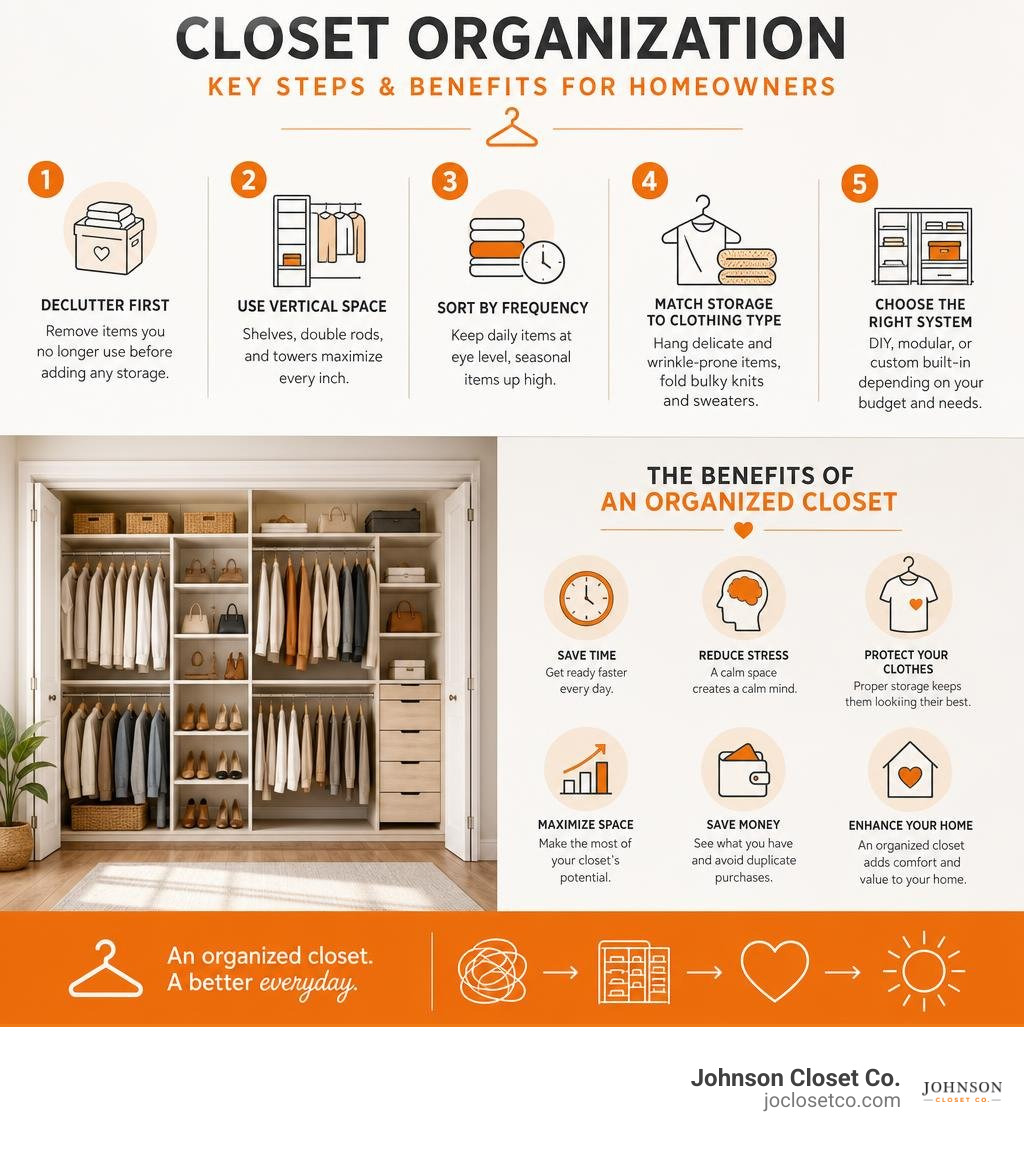
Here's a quick overview of what effective closet organization looks like:
- Declutter first — remove items you no longer use before adding any storage
- Use vertical space — shelves, double rods, and towers maximize every inch
- Sort by frequency — keep daily items at eye level, seasonal items up high
- Match storage to clothing type — hang delicate and wrinkle-prone items, fold bulky knits and sweaters
- Choose the right system — DIY, modular, or custom built-in depending on your budget and needs
The numbers back this up. According to Almanac Market Data, sales of home organization products rose 3.8% through 2021 — and they've continued climbing since. More homeowners are realizing that a chaotic closet isn't just an eyesore. It's a daily friction point.
As one organizing writer put it: "If closets didn't have doors to conceal their interiors, I imagine none of us would host visitors." That's painfully relatable — and it points to something most people sense but rarely act on.
The good news? You don't need a complete renovation to make a real difference. Small, deliberate changes can dramatically improve how your closet functions. And when you are ready for a full system, knowing your options saves time and money.
I'm Chris Johnson, and throughout this guide I'll walk you through everything — from the first decluttering steps to choosing the right closet system for your home.
The First Steps to Successful Closet Organization
Before you buy a single storage bin or browse design catalogs, you must address the inventory. Trying to organize a closet that is packed with clothes you no longer wear is like trying to arrange a Tetris board that is already filled to the top—it is a losing battle.

Successful closet organization starts with a blank slate. By emptying the space, you can see the actual physical footprint you have to work with, rather than being distracted by the clutter.
Preparing Your Wardrobe for a Fresh Start
To prepare your wardrobe, we recommend the classic "three-pile method" for a thorough wardrobe assessment:
- Keep: Items that fit you perfectly, are in good repair, and have been worn within the past year.
- Donate/Sell: Clothes that are still in great condition but no longer fit your style, size, or local Arizona lifestyle.
- Trash/Recycle: Stained, torn, or completely worn-out items that have reached the end of their lifespan.
As you sort, perform a realistic wardrobe assessment. Ask yourself: Does this item make sense for my daily life? If you live in Tempe or Chandler, those heavy, floor-length wool coats from your time in the Midwest are likely just taking up valuable real estate. Keep what matches your current reality, and let go of the rest.
Avoiding Common Closet Organization Mistakes
The most common mistake homeowners make is settling for the original, builder-grade layouts. Most standard homes in the Phoenix Valley come equipped with a single metal rod and a wire shelf above it. This default setup leaves up to 60% of the closet's volume completely empty and unused, while forcing your clothes to crowd together on a single line.
Another frequent error is wasting "prime real estate." The area between your shoulders and knees is your prime real estate zone. Daily-use items should live here. Moving rarely worn items, like formal wear or statement hats, to the highest shelves frees up this high-value space for what you actually wear every day.
Finally, avoid over-stuffing. When hanger rods are packed so tightly that you have to muscle garments apart just to see them, your clothes will wrinkle, and your organization system will quickly collapse.
Maximizing Space: Fold vs. Hang and Vertical Storage
Once you have decluttered, the next step is to maximize your physical layout. This is where the physics of closet organization comes into play. By balancing how you store different garments and capturing wasted vertical space, you can easily double your storage capacity.
When to Fold and When to Hang Your Clothes
Knowing what to fold and what to hang is essential for preserving your clothing and saving physical rod space.
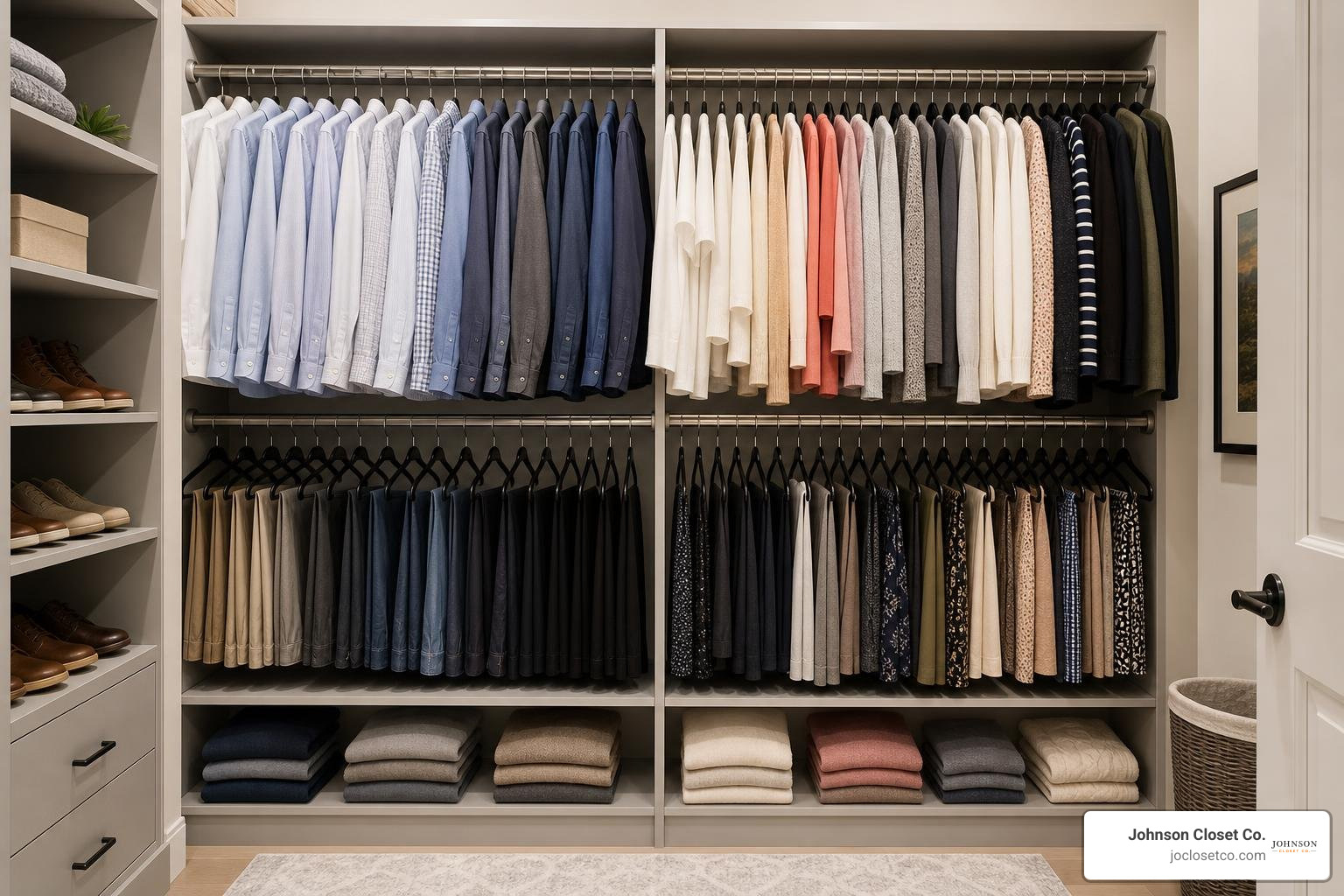
- What to Hang: Delicate fabrics (silk, linen, chiffon), formal wear, dresses, blazers, and easily wrinkled button-down shirts. Always use thin velvet hangers instead of bulky plastic or wooden ones; they prevent clothes from sliding off and allow you to fit up to 30% more items on the same rod.
- What to Fold: Heavy knits, sweaters, t-shirts, activewear, and jeans. Stacking bulky sweaters on shelves prevents them from stretching out of shape on a hanger while freeing up feet of hanging rod space.
For sentimental clothing or keepsake items that you rarely wear but cannot bring yourself to part with, move them out of your active closet rotation entirely. Store them in dedicated memory boxes on the highest shelves to keep your daily wardrobe easily accessible.
Utilizing Vertical Space and Tricky Nooks
In small reach-in or walk-in closets across Scottsdale and Gilbert, vertical space is your best friend. Standard closets leave a massive gap between the top shelf and the ceiling. By extending your shelving or cabinetry all the way to the ceiling, you capture this hidden storage zone for luggage, seasonal blankets, or out-of-season footwear.
Another quick win is installing double hanging rods. This setup allows you to hang shorter items like shirts on an upper rod and pants or skirts on a lower rod, instantly doubling your hanging capacity.
If you are still living with standard builder-grade wire racks, it is time to upgrade. Replacing 10-inch deep wire closet shelving with custom built-in wood or laminate shelving prevents clothes from getting wire-creased and stops small items from slipping through the cracks. Built-ins offer solid support, clean lines, and adjustable configurations that wire racks simply cannot match.
Smart Storage Solutions for Shoes and Accessories
Shoes and accessories are often the hardest items to keep organized. Without a dedicated home, shoes pile up on the closet floor, and accessories get lost in the dark corners of deep shelves.
Elevating Your Footwear with Dedicated Shoe Storage
Tossing shoes in a pile on the floor is a recipe for scuffed leather and lost pairs. Instead, elevate your footwear with dedicated shoe towers or angled shelves.
Angled shelves with front metal lips display your shoes beautifully, making it easy to grab your favorite sandals or sneakers. If you have a deep walk-in closet, utilizing 24-inch deep closet shelves allows you to install deep pull-out shoe drawers or store shoes in double rows—placing out-of-season pairs in the back and current favorites in the front.
Organizing Accessories and Small Items
Small accessories like sunglasses, jewelry, belts, and watches belong in stackable acrylic drawers or custom drawer inserts. Acrylic drawers keep these items clean, visible, and organized without taking up prime hanging space.
For belts, ties, and scarves, pull-out racks are a game-changer. These slim, sliding accessories mount directly to the side of a closet partition, sliding out smoothly when you need them and tucking away flush when you don't.
Choosing Your System: DIY, Modular, or Custom Closets
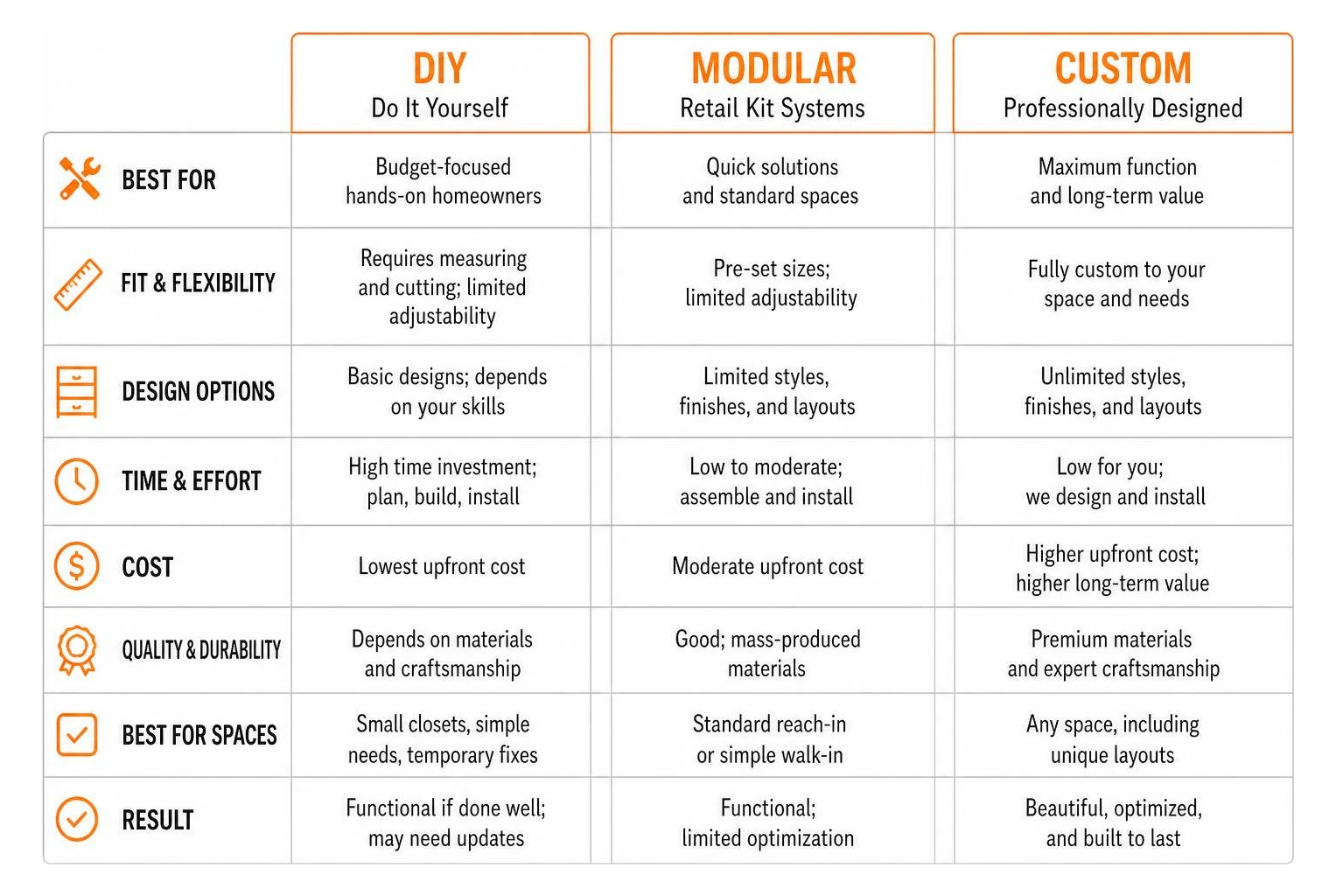
When it is time to install a physical system, you have three main paths: building it yourself, buying a modular retail kit, or investing in a professionally designed custom closet.
The Limitations of DIY and Modular Closet Systems
Many homeowners attempt the DIY route by using plans like the 1x12 Easy to Build and Hang Modular Closet System - Free Plans with Configurator for Custom Sizes | Ana White. While these plans are excellent for experienced woodworkers on a budget, building a system from scratch requires specialized tools, significant weekend hours, and precise cuts.
Other homeowners opt for retail flat-pack modular kits, such as the Genevieve Birch Adjustable Closet Organizer Large Drawer Kit, the Unikito 5FT Closet System with 2 Wood Drawers, Closet Organizer with 3 Hanging Rods & 2 Shelf Towers, or basic wooden setups like the YChoiceMe Solid Wood Closet Organizer System.
While these mass-market options are readily available, they suffer from several limitations:
- Fixed Dimensions: They rarely fit standard closet walls perfectly, leaving awkward gaps or requiring you to manually saw pieces on-site.
- Material Quality: Many retail kits rely on lightweight particle board or thin metal supports that can sag or pull away from the wall under heavy loads.
- Aesthetic Gaps: They lack a seamless, built-in look, often leaving pre-drilled holes visible and raw wood edges exposed.
| Feature | DIY Woodworking | Retail Modular Kits | Custom Built-In Systems |
|---|---|---|---|
| Average Cost | Low | Moderate | Premium |
| Material Quality | Varies (Softwood/Pine) | Particle Board / Laminate | Industrial Melamine & Hardwoods |
| Fit & Finish | Manual adjustments required | Standard sizes, gaps common | Perfect wall-to-wall CNC fit |
| Installation Time | High (Multiple weekends) | Moderate (A few hours of assembly) | Professional (Done in 1 day) |
| Durability | Moderate | Low to Moderate | High (Lifetime guarantee) |
The Value of a Professionally Installed Custom Closet
For a system that maximizes every square inch without the headache of self-assembly, a professionally installed custom closet is the ultimate solution.
At Jo Closet Co., we use in-house precision manufacturing with state-of-the-art CNC equipment. This means we design and cut every panel to the exact millimeter of your home's unique dimensions, ensuring a perfect, gap-free fit even if your walls are slightly warped.
When evaluating the Walk-in closet installation cost, it is important to consider the long-term value. A professionally built closet system is an investment that elevates your daily routine, eliminates the need for bulky dressers in the bedroom, and significantly boosts your home's market appeal to future buyers.
Advanced Closet Organization: Shared Spaces and Long-Term Maintenance
Once your physical system is in place, maintaining it requires a strategy—especially if you are sharing the space.
Achieving Harmony in a Shared Closet Space
Sharing a closet can be a test of any relationship. The secret to closet harmony is establishing clear, dedicated zones for each person.
Avoid mixing clothing categories. Instead, divide the closet down the center and customize each side to fit individual wardrobe needs. If one partner has more suits and button-downs, their side should prioritize hanging rods. If the other partner has an extensive shoe collection or activewear wardrobe, their side should focus on shelving and drawers.
Maintaining Your Closet Organization Long-Term
To keep your closet looking pristine year-round, implement a few simple habits:
- The "One-In, One-Out" Rule: When you buy a new clothing item, donate or sell an old one to prevent clutter from slowly rebuilding.
- Seasonal Rotation: In the Phoenix Valley, our winters are mild, but our summers are intense. Twice a year, rotate your wardrobe. Move summer tank tops and shorts to prime real estate in April, and swap them with light sweaters and jackets in October.
- Odor Control: Closets can easily trap stale air. Keep your space smelling fresh by using cedar blocks, lavender sachets, or charcoal air-purifying bags on your shelves.
Frequently Asked Questions about Closet Organization
How do I start my closet organization project?
Start by completely emptying your closet. Group your clothes into "Keep," "Donate," and "Trash" piles. Once you have a clean slate and a realistic count of your remaining items, you can accurately plan your shelf and hanging layout.
What is the cheapest way to achieve better closet organization?
The most budget-friendly upgrade is decluttering your wardrobe and replacing mismatched plastic hangers with slim, non-slip velvet hangers. This instantly frees up physical rod space and creates a cohesive, organized look without any construction.
How do I choose the right shelf depth for my closet?
As a general rule, 12-inch shelves are standard for reach-in closets to ensure your clothes do not block the sliding or bi-fold doors. For walk-in closets, a premium 14-inch or 16-inch depth is ideal, as it allows for deeper drawers, folded sweaters, and organized shoe displays.
Conclusion
An organized closet is more than just a beautiful storage space—it is an investment in your peace of mind and daily efficiency. Whether you start with small decluttering steps or choose to completely transform your layout, taking control of your closet will simplify your life.
If you are ready to upgrade from standard wire racks to a beautiful, durable storage system, we are here to help. Jo Closet Co. specializes in designing and installing custom closets, garage cabinets, and entertainment centers across the Phoenix Valley—including Scottsdale, Gilbert, Chandler, Mesa, and Tempe. With our in-house CNC precision manufacturing, we guarantee an exact-fit solution tailored specifically to your home and lifestyle.
Ready to design your dream closet? Learn more about our Simply Efficient and Simply Elegant design options, or visit Jo Closet Co. today to schedule your free consultation!