
How to Hang Bikes from the Garage Ceiling
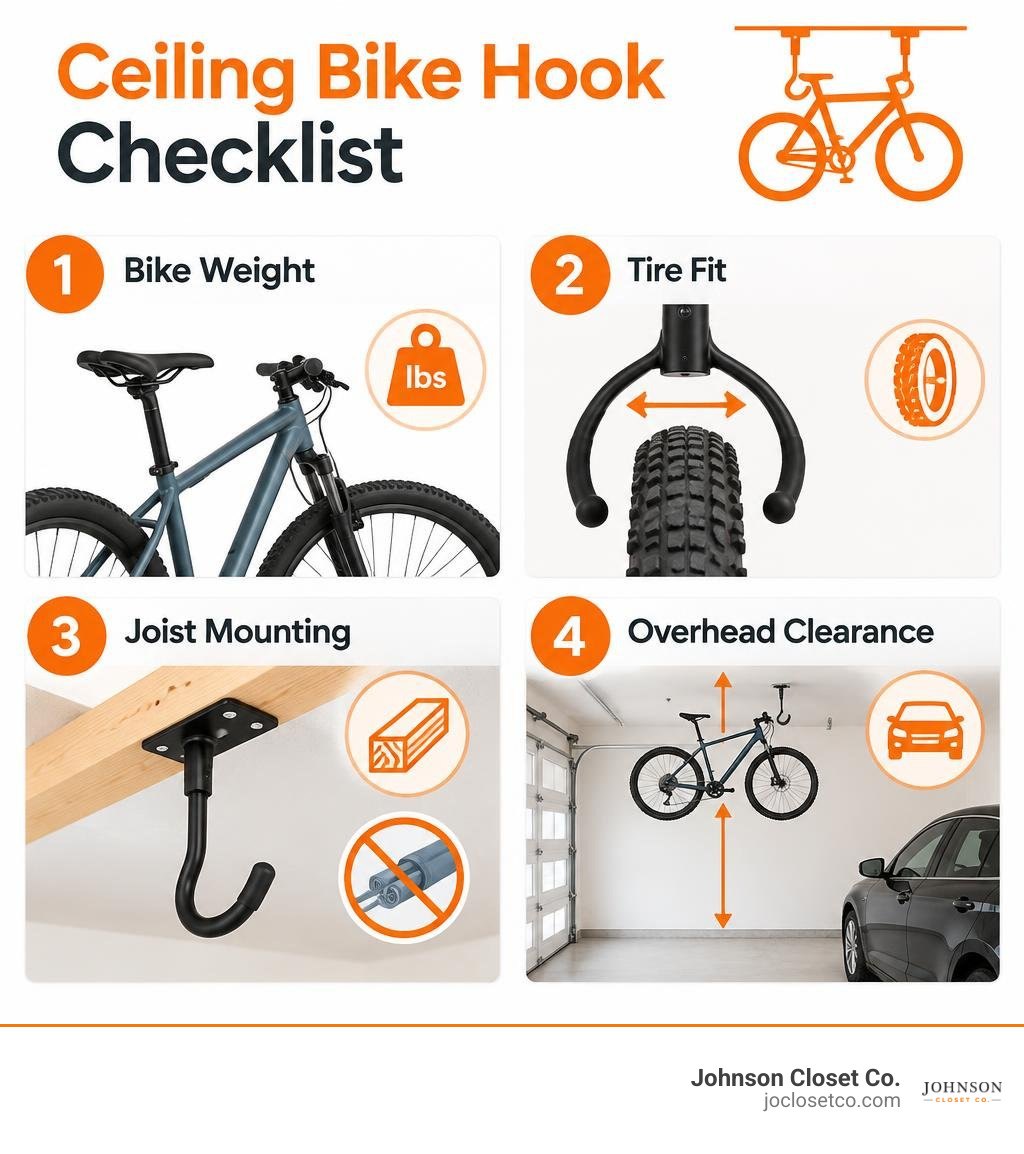
Bicycle ceiling hooks can free up garage floor space, but they must fit both the bike and the ceiling. Check your bike's weight and tire width against the hook's rating and opening. Then find a solid ceiling joist, check for hidden wiring or pipes, drill the pilot hole specified for the hook, and secure it as directed. Never rely on drywall alone. Before hanging the bike, make sure you can lift it comfortably and that it will clear your car, garage door, and walkway.
I'm Chris Johnson, owner of Johnson Closet Co., and I've spent more than 30 years designing practical storage for Arizona homes. I'll help you assess where bicycle ceiling hooks fit in a garage that's easier to use every day.
Compare bicycle ceiling-hook designs
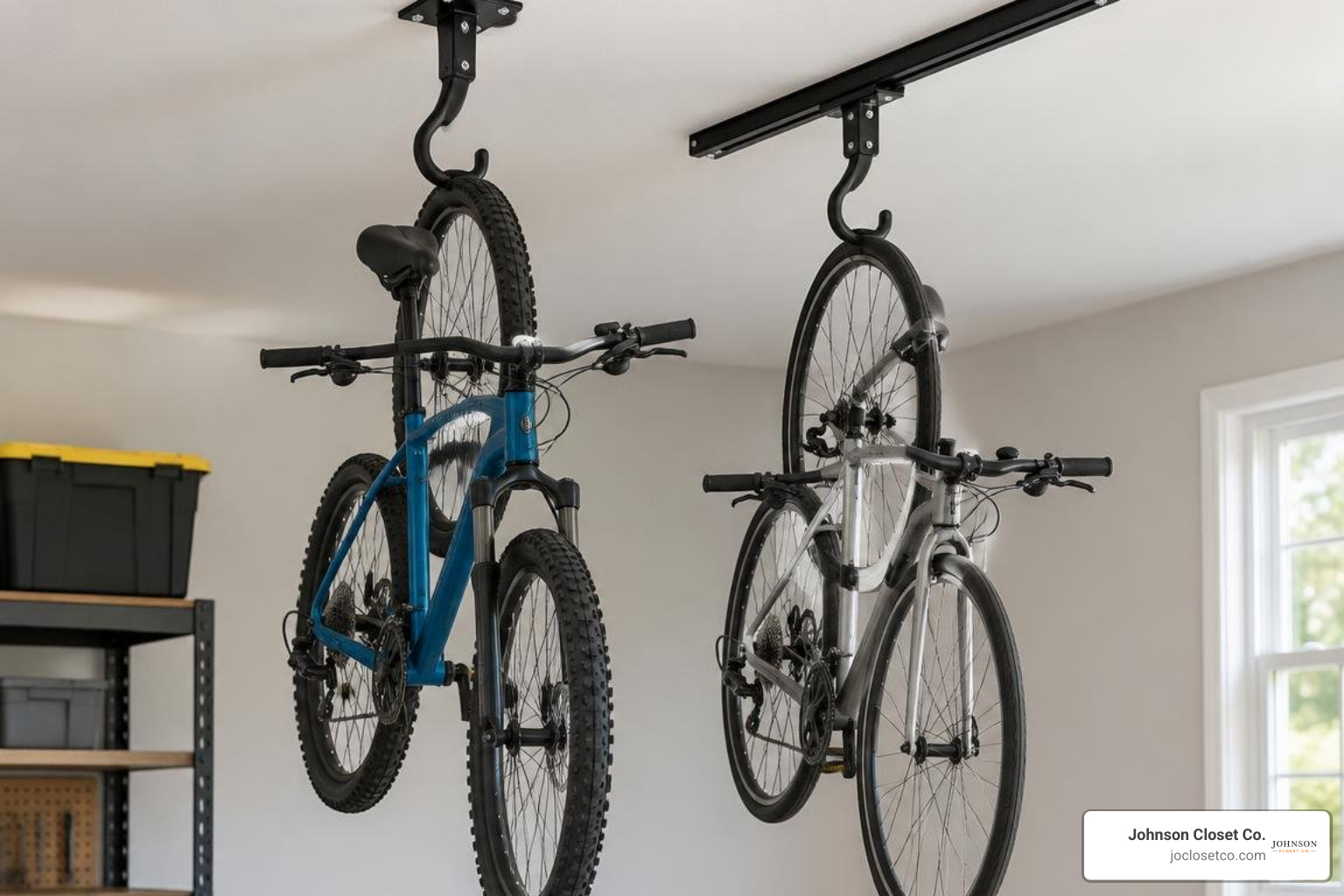
Not all ceiling hooks work the same way. Some stay put forever, some glide along a track, and some close around the wheel like a little claw. The right choice depends on how often you ride, how high your ceiling is, and how many bikes you own. If you're weighing hooks against other setups, our overview of garage bicycle storage options shows where each approach fits.
| Hook design | Access | Space use | Effort to install | Typical cost |
|---|---|---|---|---|
| Fixed screw-in J-hook | Lift the bike straight up and hang it | Very efficient, one bike per spot | Low, one pilot hole each | About $3 to $9 per hook |
| Closed-loop claw hook | Same as fixed, with a push-lock for security | Efficient | Low, two screws | About $32 for the Gladiator hook |
| Sliding track hook | Slide bikes along the ceiling | Flexible, bikes can be shifted aside | Moderate, track must be mounted | About $16 to $42 per hook, plus track |
| Pulley hoist | Rope lifts the bike for you | Good, works with high ceilings | Moderate | About $40 to $43 per system |
How bicycle ceiling hooks differ by design
Open J-hooks are the simplest option. A steel shank screws into a joist and a curved hook cradles the wheel rim. Look for a curved bottom and a vinyl coating. The curve gives the rim more contact surface than a flat-bottom hook, and the vinyl keeps the rim from getting scuffed. Basic versions are cheap, and specialist bike hooks cost only a few dollars more.
Closed-loop hooks add security. The Gladiator Advanced Ceiling Mount Claw Bike Hook uses two arms that form a loop around the wheel, with a push-lock you operate in one motion. It holds up to 50 lbs, holds the back wheel, and mounts through drywall into the joist or onto bare joists. The trade-off is that it is not designed around very wide tires.
Fixed-position hooks stay where you put them. That is fine for a bike you grab once a week. It's less fun if you need to shuffle a car or a ladder around them.
Sliding hooks ride in a metal channel, such as Unistrut, on steel roller bearings. Once the channel is up, you can slide bikes along the ceiling for easy access. This sliding trolley hook comes in Standard, Large, and Fat Tire versions. The Fat Tire hook swivels, which makes loading a wide wheel easier.
Pulley hoists, like the RAD Cycle ceiling mount rack, let you raise the bike with a rope instead of your arms. The RAD system lifts up to 75 lbs, handles ceilings up to 12 feet, and has a locking brake that pinches the rope. The Wallmaster hoist is similar, but its listing states both 50 lb and 100 lb capacities. When a listing contradicts itself, I'd plan around the lower number.
A quick rule: if you ride often, pick a hook you can reach easily. If the bike is a seasonal visitor, a fixed hook is the budget-friendly winner.
How to choose bicycle ceiling hooks for your bike and ceiling
Three things decide whether a hook works: the bike, the hook, and the ceiling. Get all three right and you'll forget the bike is up there. Get one wrong and you'll remember it very suddenly. Our guide to ceiling bike hanger options covers more styles.
| Bike type | Hook style | Fit check | Load consideration |
|---|---|---|---|
| Road bike | Standard or mid-size J-hook | Tire under 2.35 in | Light, well within 35 lbs |
| Gravel bike | Mid-size or Large hook | Deep-dish rims make tight fits | Light to moderate |
| Mountain bike | Large hook | Chunky knobs need a wide tip opening | Often 30 to 35 lbs |
| Plus or fat-tire bike | Large or Fat Tire hook | Tire 2.3 to 3.5 in or wider | Check the 55 to 65 lb ratings |
| E-bike | Heavy-duty hook or hoist | Confirm opening and rating | Often well above 50 lbs, so verify |
Match bicycle ceiling hooks to tire width and rim depth
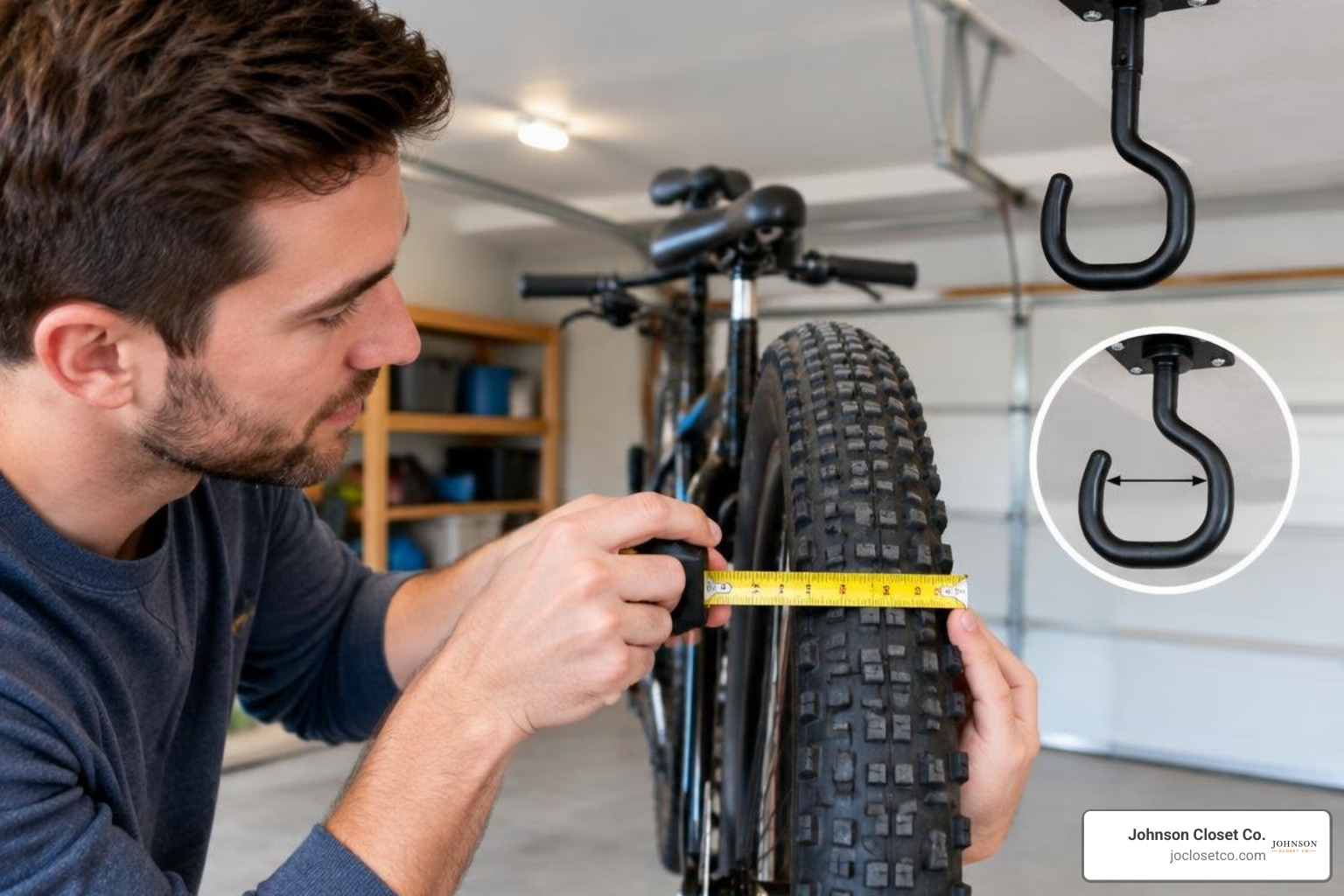
Hook width matters, but a measurement many people miss is the gap from the tip opening to the shoulder. That gap determines how easily a chunky tire slips in without tilting the wheel.
Park Tool's bike-specific hooks come in three widths: 55 mm for skinny road tires, 75 mm for most mountain, plus, and road bikes, and 125 mm for fat bikes. Fat bikes with tires such as 27.5 x 4.0, 26 x 4.2, and 26 x 4.8 inches fit the largest size. A larger hook can also hold a smaller wheel, so the mid-size is the more versatile pick unless you only own road bikes.
The sliding hook system sizes by tire: Standard for tires under 2.35 inches, Large for 2.3 to 3.5 inches, and Fat Tire for wider. One customer found a Standard hook tight with 32 mm gravel tires on 50 mm deep-dish rims, so deep-dish wheels with wider tires do better with the Large.
Check capacity, coating, and bike-specific fit
Ratings vary widely, so read the label:
- Everbilt vinyl-coated screw-in hook: 25 lbs, about $3. It's a handy utility hook, but I'd treat it as a light-duty option for kids' bikes and use two per bike, as the maker suggests.
- Gladiator claw hook: 50 lbs.
- Standard sliding hook: 35 lbs. Large: 65 lbs. Fat Tire: 55 lbs.
- Park Tool 471 Large Storage Hook: 125 lbs, provided it is screwed into solid material. Park Tool prices its hooks at $5.45, $5.95, and $8.95 depending on size.
A hook's rating only counts if the mounting spot can carry that load. Rated load and system capacity are different things. A ceiling track might hold 400 lbs overall but only 50 lbs per hook.
For carbon rims, choose a vinyl or PVC-coated hook with a curved bottom. Avoid letting the hook land on a valve stem or a rim graphic. Our cost guide helps you budget the whole setup.
Confirm your ceiling material before buying
- Solid wood joists: the ideal home for wood-thread hooks.
- Engineered I-joists: do not drill into the flange. Check the manufacturer's instructions for allowed locations.
- Concrete: you'll need masonry anchors and a hook or track designed for them.
- Drywall or drop ceilings: these cannot carry a bike on their own. Find the structure above.
Always match the fastener to the material and follow the hook maker's instructions.
Install ceiling bike hooks safely, step by step
Installing a hook takes minutes, but the prep deserves your attention. Our guide on the best way to hang a bike in a garage adds layout ideas. Park Tool's approach, described in this bicycle hook review, is the same simple one: a pilot hole in the center of a joist and a threaded hook.
Find the joist and drill the correct pilot hole
- Use a stud finder to locate joists. Note which way they run.
- Mark the center of the joist. Most ceilings have joists 16 inches apart on center, which works nicely for hook spacing.
- Check for electrical wiring, plumbing, and HVAC lines before drilling.
- Wear eye protection. Use a stable ladder and have a helper if you can.
- Drill the pilot hole the hook calls for. For Park Tool, that's 1/4 inch (6 mm) for the smallest hook and 11/32 inch for the larger ones. Everbilt recommends 1/4 inch.
Test the location first, and never mount into drywall alone. Avoid engineered-joist flanges.
Secure the hook and test it before hanging a bike
Rubbing the threads with a bar of soap or wax makes turning easier. Screw the hook in until it is firmly seated, with full thread engagement in solid wood and the hook facing the right way. Use only the screws or anchors supplied, or concrete anchors for masonry. Don't overtighten and strip the wood.
Then test it. Pull down firmly by hand, then hang a light load, and gradually work up to the bike. Look for any movement. Never exceed the rated capacity.
Hang multiple bikes while protecting components
Once one hook is in, the n+1 rule kicks in: you'll want more bikes, and more hooks. Our garage cycle storage planning guide helps you map the whole garage.
Space bicycle ceiling hooks for wide handlebars
Joists at 16 inches are nearly perfect, but wide handlebars are the catch. Three bikes with 800 mm bars can share 16-inch spacing if you alternate them, one bar-up and the next bar-down. This staggers the handlebars so they don't collide. A rack with 12-inch spacing was found tight for wide mountain-bike bars, though it suits many drop-bar bikes.
Also check wheelbase and ceiling height so longer bikes clear the floor and your car. Keep an access lane so you can reach each bike without wrestling its neighbor.
Is it safe to hang a bike by its wheels?
Yes, in general. Park Tool consulted brake and suspension makers, and the consensus from SRAM, Shimano, and Hayes/Manitou was that hanging is fine when components are in good working order.
- Hydraulic brakes: bar-up is probably safest, since any air bubble stays at the top of the reservoir. Don't squeeze the brake lever while the bike hangs. After taking it down, pull the lever a few times.
- Suspension: if concerned, set the compression adjuster to max, and cycle the fork a few times after hanging.
- Dropper posts: one reader found a dropper slow after hanging front-wheel-down, which was fixed by hanging rear-wheel-down.
- Carbon rims: a few old aero wheels with fragile carbon fairings carry warnings not to hang them. When unsure, ask the wheel maker, and keep the hook away from valves and decals.
- E-bikes: weight is the issue. Check your total bike weight, including the battery, against the hook. Our electric bike storage guidance covers heavier bikes.
Frequently asked questions about bicycle ceiling hooks
Can ceiling hooks hold fat-tire bikes and e-bikes?
Yes, with the right hook. Fat-tire bikes need an oversized opening, such as the 125 mm Park Tool hook or a Fat Tire sliding hook rated at 55 lbs. E-bikes are heavier, so add up the bike and battery and choose a hook or hoist with a rating well above that. If a 50 lb hook is close to the limit, step up. Lifting also takes effort, so consider a pulley hoist.
Can I install hooks on engineered joists or concrete?
Sometimes. On I-joists, do not drill the flange. Use only attachment points the joist manufacturer approves. In concrete, use masonry anchors, which many ceiling racks do not include. When in doubt, check the ceiling maker's guidance or ask a professional to assess it.
What do bicycle ceiling hooks cost, and how often should I inspect them?
Basic screw-in hooks run about $3 to $9. Specialist hooks like Park Tool's cost $5.45 to $8.95, claw hooks about $32, and sliding hooks $16 to $42 each plus track. For 15 bikes, hooks cost around $104 against roughly $1,350 for racks, according to one review. Inspect them each season. Look for coating wear, loose fasteners, or movement, and replace anything that looks tired.
Conclusion
Ceiling hooks are a space-saving choice that works when you match the hook to your bike, mount it to solid structure, and leave room to reach your bikes. Fit comes first, then safe installation, then easy access.
If you'd rather have the garage designed around your bikes, we build custom storage in-house with precision CNC equipment for exact fits across the Phoenix Valley, including Scottsdale, Gilbert, Chandler, Mesa, and Tempe. Start by planning a more organized garage, and we'll help you make it happen.