
Best Garage Racking for Your Space
Best Garage Racking for Your Space
The best garage racking depends on what you store. Choose heavy-duty steel racks for tools and tires, adjustable wire shelves for everyday bins, and wall-mounted or overhead racks when floor space is tight. Check the weight limit per shelf, leave room for your car and walkways, and place heavy items low.
I'm Chris Johnson, owner of Johnson Closet Co., and I've spent more than 30 years working in custom storage across the Phoenix Valley. When choosing the best garage racking, I start with what needs to fit, what weighs the most, and what you need to reach every day.
Core Types of Garage Racking Systems
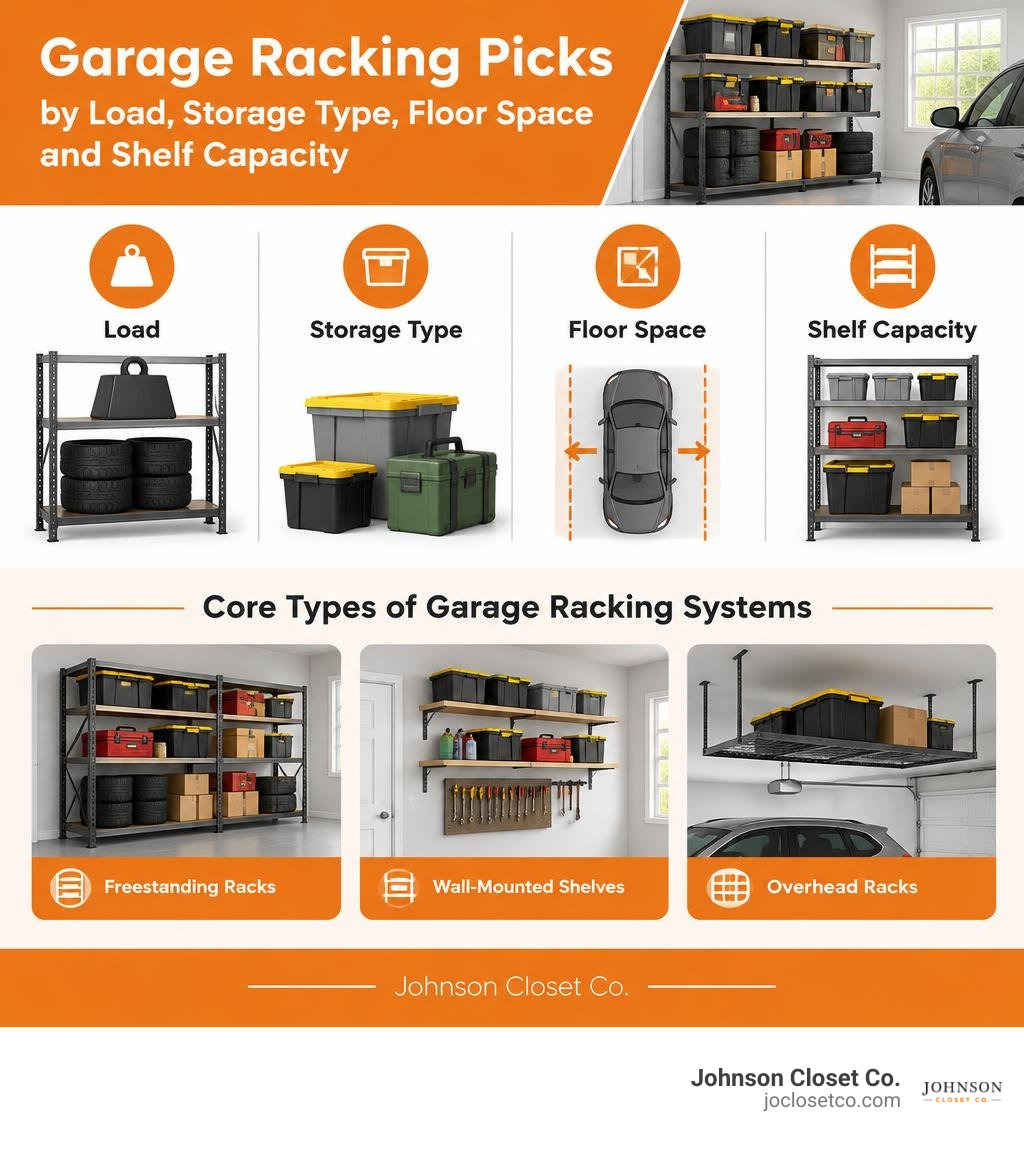
When you step into your garage, you want to see an efficient, open floor plan rather than stacks of leaning cardboard boxes. Selecting the right physical style of storage is the first step toward getting organized. Garage storage generally falls into three structural configurations: freestanding industrial racks, wall-mounted shelving systems, and overhead ceiling racks.
Freestanding shelving units are the workhorses of residential workshops and warehouses alike. They sit directly on the concrete slab, allowing them to support massive amounts of weight without transferring loads into your home's wall framing. Wall-mounted shelves, by contrast, keep the floor completely clear. When anchored into solid wood wall studs, wall racks offer incredible convenience for frequently used hand tools, automotive fluids, and everyday household gear. Ceiling-mounted overhead racks capture the unused vertical volume above your parked vehicles or garage door tracks, offering a great home for long-term storage and seasonal decorations.
| Racking Type | Best Material Build | Average Weight Capacity per Shelf | Ideal Storage Items | Main Advantage |
|---|---|---|---|---|
| Heavy-Duty Industrial | Welded channel or stamped steel | 1,500 lbs to 2,500 lbs | Engine blocks, tires, toolboxes, compressors | Extreme structural stability and load capacity |
| Adjustable Wire Grid | Chrome or powder-coated steel | 300 lbs to 800 lbs | Plastic bins, small power tools, pantry overflow | High adjustability and dust-free airflow |
| Resin / Utility Plastic | High-density polypropylene | 150 lbs to 200 lbs | Gardening supplies, paint, light totes | 100% rust-proof and quick tool-free setup |
| Overhead Ceiling Rack | Heavy-gauge tubular steel | 500 lbs to 1,000 lbs (total unit) | Holiday decor, camping gear, luggage | Maximizes floor clearance and overhead air space |
According to independent tested garage storage benchmarks, matching your storage hardware directly to your load profiles prevents shelf deflection, structural sag, and dangerous tipping incidents.
Best Garage Racking Materials: Steel vs. Wire vs. Plastic
The material makeup of your shelving determines how it reacts to heavy loads, direct impacts, and environmental conditions.
- Heavy-Gauge Stamped and Welded Steel: Stamped steel racks with industrial powder coating represent the gold standard for pure load-bearing performance. Industrial steel units can support between 1,000 lbs and 2,500 lbs per shelf level. Steel uprights resist torsional bending and keep their structural integrity under constant heavy loads. If you are building out a dedicated workspace, pairing open metal racks with integrated garage storage cabinets gives you open access for bulk items and concealed, locking protection for expensive tools.
- Steel Wire Decking: Wire shelving features welded steel wire grids supported by horizontal steel crossbeams. The wire grid design promotes airflow, reduces dust buildup, and lets overhead light filter down through lower shelves. Top-tier wire units readily hold 350 lbs to 500 lbs per shelf on leveling feet.
- Molded Plastic Resin: High-density resin units are lightweight, impervious to water, and completely immune to corrosion. While individual shelf capacities top out around 150 lbs to 200 lbs, plastic is an affordable, rust-free choice for storing pool chemicals, fertilizer, and light household totes.
Weight Capacity and Sizing Requirements
Determining your required weight capacity begins with an honest inventory of what you plan to store. A single automotive wheel and tire combo can weigh 50 to 80 pounds, a loaded mechanic's toolbox can exceed 200 pounds, and a stack of storage bins filled with hardware quickly adds up.
When calculating capacity, always check the per-shelf rating rather than relying solely on the total unit capacity. For example, a heavy-duty industrial rack rated for 10,000 pounds total distributes that capacity as 2,500 pounds across each of its four shelf tiers.
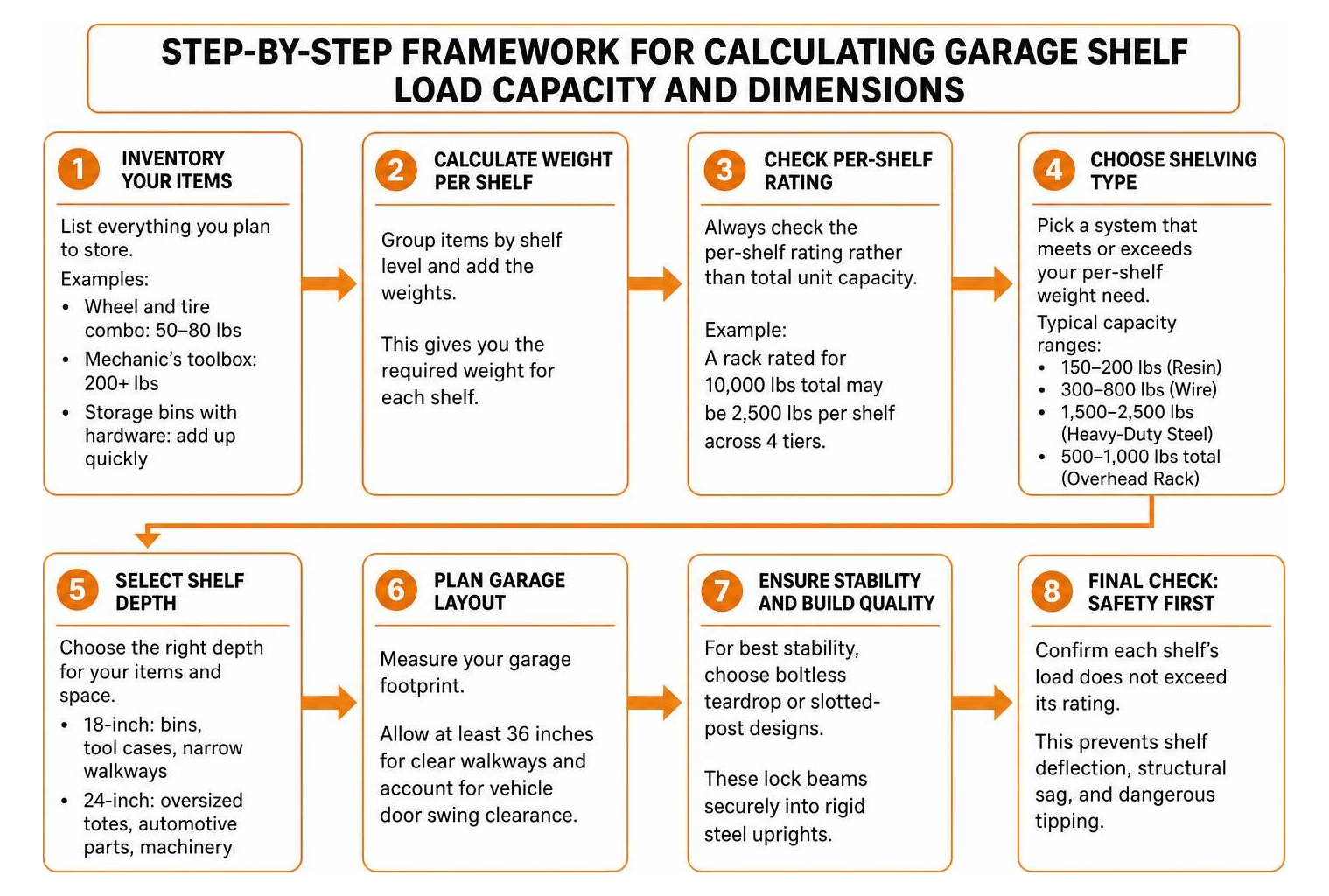
Standard commercial shelving depths range from 18 inches to 24 inches. An 18-inch-deep shelf works well for standard plastic bins and tool cases while preserving narrow walkways. A 24-inch-deep shelf accommodates oversized totes, automotive parts, and machinery. For the best stability, look for boltless teardrop or slotted-post designs that lock horizontal beams securely into rigid vertical steel uprights.
How to Choose the Best Garage Racking for Your Space
Before buying any shelving unit, grab a tape measure and map out your garage footprint. You need to account for clear walkway widths (at least 36 inches is recommended) and vehicle door swing clearance. In a typical two-car garage, placing a 24-inch-deep rack along a side wall can make opening car doors difficult if floor space is already tight.
Checking comprehensive evaluations of top garage shelving shows that user satisfaction comes down to ease of assembly, structural stability, and modular adjustability. Look for units that allow you to adjust shelf heights in 1-inch to 3-inch increments so you can adapt your storage as your needs change.
Selecting the Best Garage Racking for Heavy-Duty Loads
For serious automotive restoration, industrial machinery, or heavy hardware, heavy-duty steel racking is essential.
Top performers in this category include:
- Welded Steel 4-Tier Heavy-Duty Racks: Deliver a 2,000-lb capacity per shelf level (8,000 lbs total) with dual-slotted uprights and wire deck support straps that prevent beam spreading under heavy concentrated loads.
- Industrial Metal Shelving Units: Support up to 2,500 lbs per shelf level, making them a reliable choice for stacking engine parts, suspension components, and steel tool chests.
- 4-Tier Industrial Racks with Composite Decking: Feature composite decking alongside steel supports, holding up to 10,000 lbs total with industrial-grade locking pins that prevent accidental shelf disengagement.
- 77.2" Industrial Racks: Offer an impressive load rating of 8,500 lbs per unit (2,125 lbs per shelf) using dense grid steel decks and heavy-gauge uprights.
When loading these industrial racks, always bolt the baseplates or secure top anchor brackets to your wall studs to eliminate any chance of sway.
Racking Options for Lightweight and Everyday Utility
Not every garage needs an industrial steel monster capable of holding an engine block. If your storage consists of plastic storage totes, holiday ornaments, sporting goods, and household paper goods, lightweight wire or modular resin shelving provides an efficient, budget-friendly solution.
- 4-Shelf Adjustable Wire Units: Hold 350 lbs per shelf on leveling feet (1,400 lbs total), giving you an adjustable, rust-resistant platform for everyday bins.
- 68" 4-Tier Metal Garage Shelving: Delivers an impressive 1,800-lb capacity per shelf (7,200 lbs total unit weight limit) in a clean, compact footprint suitable for tight storage rooms.
- 4-Tier Resin Units: Yield 200 lbs per shelf (800 lbs total), assembling in less than five minutes without tools while resisting chemical spills and moisture.
For a cohesive look across your property, pairing modular garage wire racks with broader whole-home storage solutions makes it easy to keep pantries, closets, and utility rooms organized using matching bins and labels.
Maximizing Vertical and Specialty Storage

When floor space is limited, the smartest direction to build is up. Adjustable metal shelving units designed to maximize vertical space can increase your usable garage storage by up to 40% compared to static, floor-bound setups.
Overhead ceiling racks are particularly effective for reclaiming unused air space. Heavy-duty overhead storage units offer weight capacities up to 1,000 pounds when properly anchored into ceiling joists. This allows you to suspend bulky, seldom-used gear—such as camping equipment, seasonal decorations, and long-term storage totes—completely off the ground.
When planning an overhead installation, consult an expert guide to heavy duty garage shelving to ensure your ceiling joists can handle the load and that the rack clears your garage door openers and tracks.
Best Garage Racking Layouts for Maximizing Vertical Space
To get the most out of your square footage, use a zoned perimeter layout:
- High-Zone Ceiling Racks: Install overhead racks along the rear ceiling area or above horizontal garage door tracks for long-term storage bins.
- Mid-Zone Wall Rails: Mount track systems and slotted wall channels from 4 feet to 7 feet off the ground for hanging ladders, extension cords, and long-handled garden tools.
- Low-to-Mid Floor Racks: Position 72-inch to 84-inch freestanding steel racks along sidewalls where ceiling height is unrestricted, keeping heavy power equipment and primary totes within easy arm's reach.
Integrating Specialty Gear and Equipment
Standard flat shelves do not always work well for awkward, bulky items like bicycles, ladders, and spare tires.
For families with multiple bikes, designated racks prevent flat tires, bent spokes, and cluttered walkways. When planning out your layout, storing bicycles in garage setups can be streamlined using dedicated vertical mounts. To get bikes completely off the floor, installing heavy-duty ceiling bike hangers allows you to use overhead space effectively. Alternatively, space-saving wall-mounted bike clips for garage wall hold bikes securely by the front tire along open side walls.
Essential Installation and Safety Practices
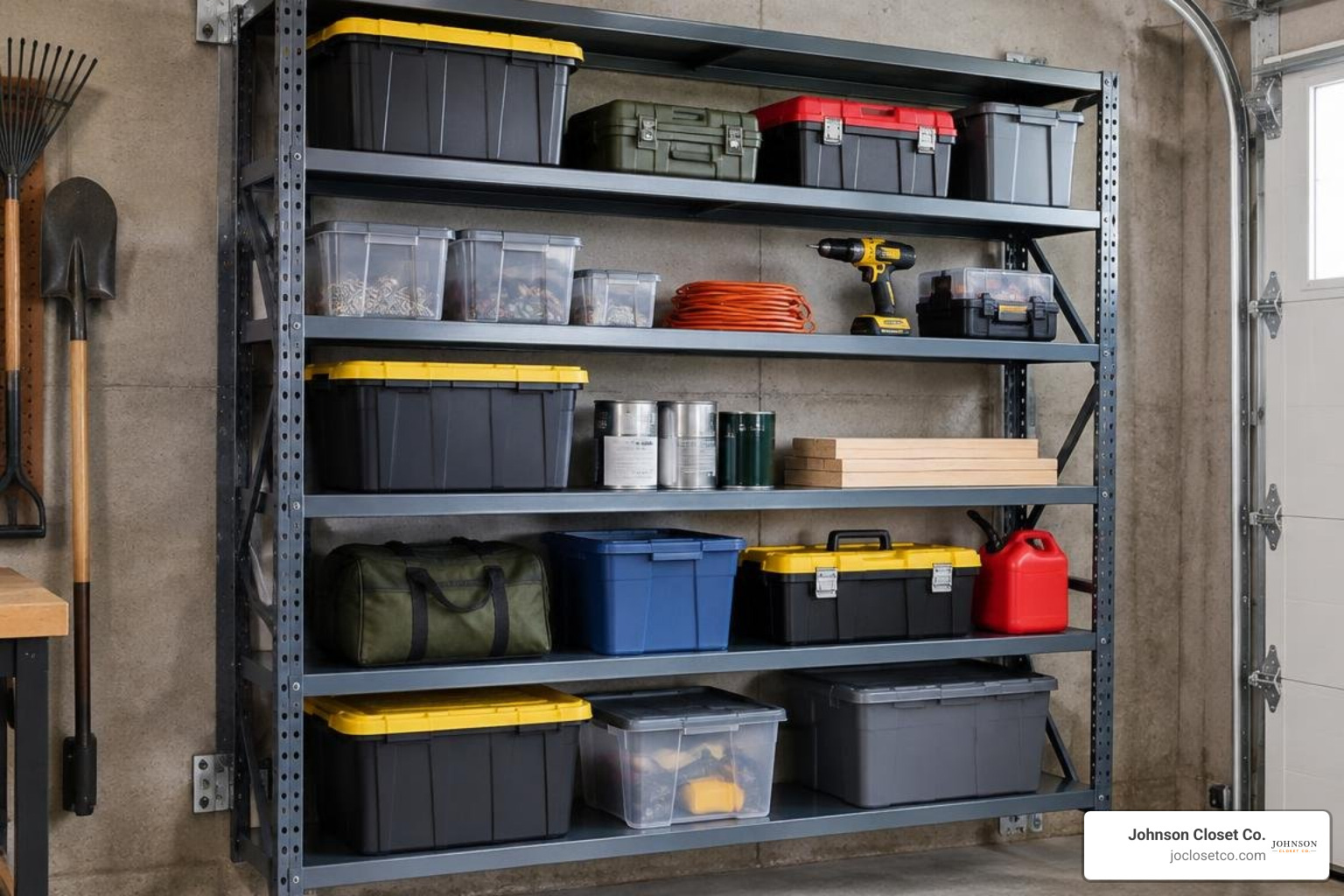
Safety is essential when assembling and loading high-capacity storage racks. A single overloaded or unanchored shelving unit poses a serious tipping hazard, risking injury and vehicle damage.
When setting up industrial storage, following standard workplace storage guidelines—such as the 1926.250 - General requirements for storage outlined by OSHA—ensures materials are stacked, racked, and blocked safely to prevent sliding or collapse.
Garage Racking Installation Safety Checklist
- [ ] Check Level Alignment: Verify the concrete slab is level. Use shims or adjustable leveling feet to eliminate base wobble before adding weight.
- [ ] Anchor to Wall Studs: Secure freestanding units taller than 48 inches to solid wall studs using heavy-duty steel L-brackets or anti-tip straps.
- [ ] Lower the Center of Gravity: Always place your heaviest items (compressors, paint cans, tool chests) on the bottom two shelves. Keep lighter bins and gear on upper tiers.
- [ ] Verify Joist Structural Attachment: For ceiling racks, drive heavy-duty lag bolts directly into the center of solid ceiling joists. Never rely on drywall anchors for overhead storage.
- [ ] Distribute Loads Evenly: Spread weight across the full width and depth of each shelf deck to prevent point-load sagging and beam deflection.
Frequently Asked Questions About Garage Racking
What is the most durable material for garage shelving?
Industrial powder-coated steel is the most durable material for garage shelving. Heavy-gauge steel uprights and welded crossbeams support thousands of pounds without bowing or warping under load. The baked-on powder-coat finish protects the underlying steel from rust, chipping, and chemical spills, ensuring the unit lasts for decades in high-traffic garage environments.
How much weight capacity do standard garage shelves require?
For everyday household storage—such as plastic bins, seasonal decor, and sports equipment—a capacity of 200 to 350 pounds per shelf is usually plenty. However, if you are storing automotive parts, heavy toolboxes, hardware collections, or industrial machinery, choose heavy-duty steel racking rated for 1,500 to 2,500 pounds per shelf.
Should garage storage racks be anchored to the wall?
Yes, you should always anchor freestanding garage racks to wall studs, especially units over 48 inches tall or racks loaded with heavy equipment. Anchoring prevents accidental tipping caused by earthquakes, uneven load distribution, or bumps from vehicles, ensuring your family and belongings stay protected.
Conclusion
Finding the right balance of freestanding steel racks, wall rails, and overhead storage transforms a cluttered garage into a functional, clean, and organized space. By matching shelf weight capacities to your gear, anchoring tall units to wall studs, and taking advantage of your vertical space, you can keep your floor clear and your tools easy to find.
At Jo Closet Co., we help homeowners across the Phoenix Valley—including Scottsdale, Gilbert, Chandler, Mesa, and Tempe—maximize their storage potential. From custom-designed garage cabinets manufactured on precision CNC machinery to engineered garage cycle storage systems, our team builds clean, durable storage built around your exact lifestyle.