
Top Cheap Firewood Storage Ideas for Any Backyard Budget
The most effective cheap firewood storage ideas include no-tool cinder block and 2x4 lumber racks, elevated platforms built from free heat-treated (HT) wooden pallets, reclaimed galvanized IBC tote cages, and adjustable steel bracket kits. These budget solutions keep logs elevated 4 to 8 inches off damp soil, provide structural end support, and promote continuous cross-ventilation for fast seasoning without the expense of a pre-built shed.
Here across the Phoenix Valley—from Scottsdale to Gilbert, Chandler, Mesa, and Tempe—our intense dry heat can season firewood quickly, but leaving logs sitting directly in dirt invites termites, scorpions, and bottom-log dry rot. By using repurposed materials, scrap lumber, and smart structural layouts, you can build reliable log holders for a fraction of retail prices.
No-Tool Cinder Block Rack: Cheap Firewood Storage Ideas for Fast Setups
If you need a sturdy holder assembled in under ten minutes without drilling a single pilot hole, the classic concrete cinder block and lumber build is unmatched.
To build this setup, you need:
- 2 to 4 standard two-hole concrete cinder blocks
- 4 to 6 pressure-treated 2x4s (or 2x6s for heavier loads)
How to assemble it:
- Place two cinder blocks flat on level ground, spaced roughly 4 to 6 feet apart, with their open holes pointing straight up toward the sky.
- Insert two 2x4s horizontally through the bottom inner gaps or rest them across the blocks to serve as your bottom wood rails.
- Slide two vertical 2x4 posts straight into the outer holes of each cinder block at a slight outward angle.
- The weight of the stacked firewood pushes outward against the vertical 2x4 posts, which locks the lumber securely into the concrete block holes.
Resting your horizontal support beams directly across concrete blocks takes the shear pressure off screws and fasteners, preventing mechanical joint failures. This gives you instant ground clearance of 4 to 8 inches, completely cutting off the damp soil conduit while costing less than $25 in basic materials.
Repurposed Wooden Pallets: Cheap Firewood Storage Ideas Under $20
Standard wooden shipping pallets are one of the most accessible free or low-cost materials for outdoor storage. Over 1.9 billion wooden pallets circulate across the United States, and local distribution centers, landscaping yards, and construction sites often give them away for free.
When sourcing pallets, always check the structural stamp on the wood:
- Look for pallets stamped with HT (Heat-Treated). These are kiln-baked to safely kill pests without chemicals.
- Avoid pallets marked MB (Methyl Bromide), which indicates treatment with toxic chemical pesticides that should never be placed near fuel wood.
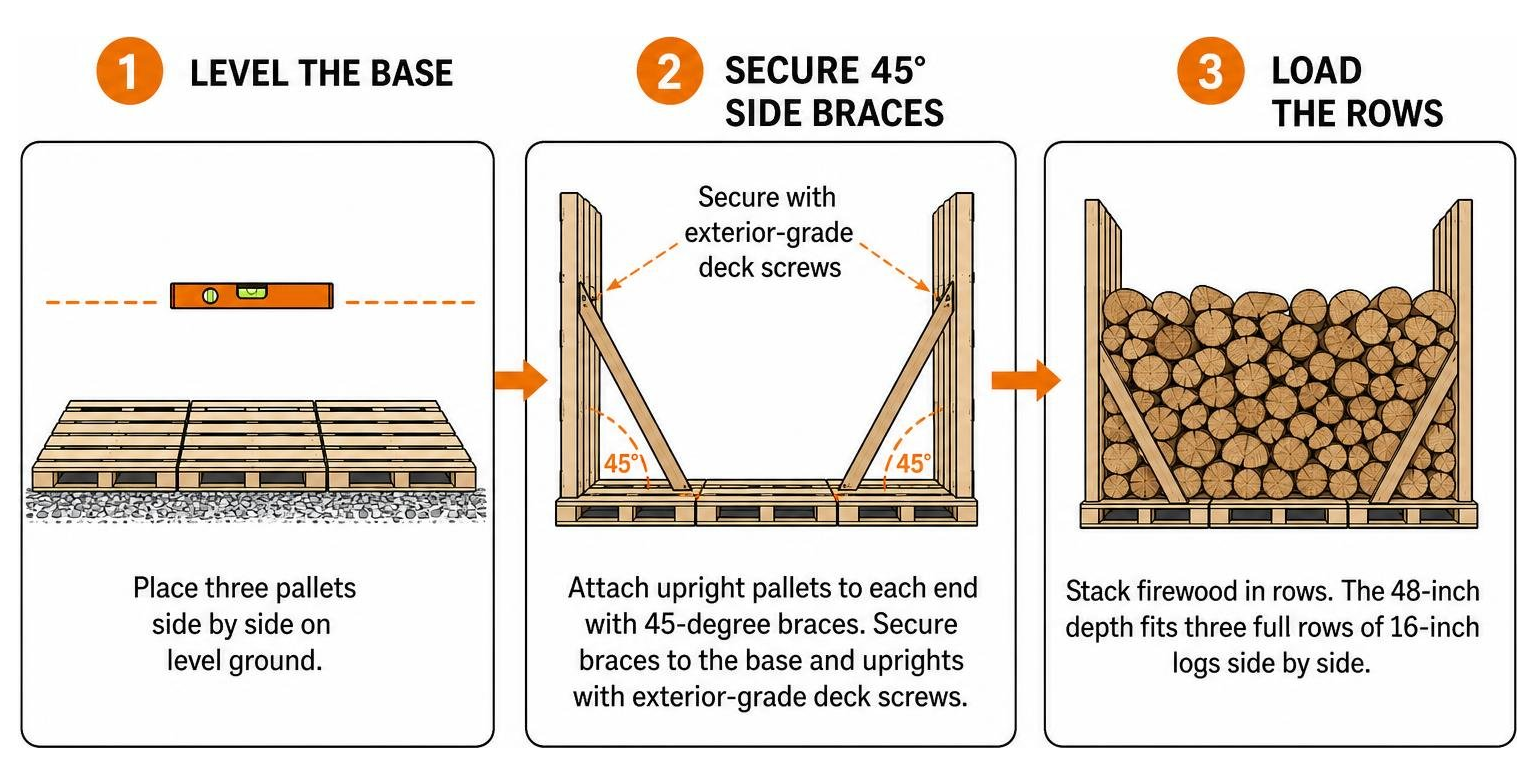
A standard shipping pallet measures 40 inches by 48 inches. Because a standard cut firewood log is 16 inches long, a single 48-inch pallet depth accommodates three full rows of firewood side by side. By lining up three pallets lengthwise on a level gravel pad, you create a 10-foot-wide elevated platform that can easily hold a full cord of firewood (128 cubic feet).
To build sturdy end walls, secure upright pallets to each end of the base using 45-degree angled timber braces attached with exterior-grade deck screws. You can review detailed guidelines for building a pallet firewood rack to see how side slats keep multiple cord stacks separated and neatly organized.
Reclaimed IBC Tote Metal Cages
Intermediate Bulk Containers (IBC totes) are heavy-duty industrial tanks encased in galvanized steel tube frames, widely used for transporting liquids. Once emptied, 275-gallon and 330-gallon totes often sell on local classifieds for $35 to $75.
When converted into log stores, these galvanized steel cages last over 10 to 15 years outdoors without rusting or decaying. To prep one for firewood:
- Ensure the tote previously held safe materials (such as food-grade liquids, water, or organic mulch dyes—never toxic industrial solvents or pesticides).
- Remove the top support crossbars with a socket wrench.
- Slide out the inner plastic container (the HDPE bladder).
- Use an angle grinder or reciprocating saw to cut an access opening on the front side so you can easily reach logs at the bottom.
- Reinstall the top metal crossbars for maximum rigidity.
A single 275-gallon tote holds roughly 1/3 of a cord (approx. 24 to 28 cubic feet of stacked wood). For those with rural properties, hobby farms, or access to pallet forks, check out this IBC tote firewood storage setup guide to explore how these modular cages can be moved around your yard as firewood cures.
Bonus budget tip: Cut the discarded plastic bladder diagonally corner-to-corner to create a free, peaked rain cap that fits over the top of the metal frame while leaving all four mesh sides completely open for wind drying.
Adjustable Metal Bracket Racks and T-Post Stacks
If you want a neat profile with minimal DIY effort, heavy-duty powder-coated steel bracket kits provide an inexpensive middle ground. These bracket sets (typically $25 to $40 online) sit flat on the ground and feature pre-welded square slots designed to receive standard 2x4 lumber.
Because you supply your own 2x4s, the rack length is completely adjustable. You can insert 4-foot boards for a compact patio rack, or 8-to-10-foot rails for high-volume yard seasoning. For extra stability when building racks longer than 6 feet, use carriage bolts rather than drywall screws, and tie the top ends of the vertical 2x4s together with high-tensile wire or heavy rope.
Another zero-lumber alternative is driving four metal agricultural T-posts into the dirt at the corners of your stack, laying two landscape timbers between them as a floor bed, and tying the top ends of opposing T-posts together with wire. The wire prevents the heavy firewood from pushing the posts outward as the stack settles.
Low-Cost Lean-To Sheds with Corrugated Roofing
If you live in an area that gets seasonal monsoon storms or winter rain, an open-sided lean-to shed offers the ultimate balance between weather shielding and ventilation.
Building a free-standing 8x8 shed with pressure-treated dimensional lumber can cost $600 to $900. However, using an existing structure—such as the sturdy exterior wall of a detached workshop, garage, or block fence line—cuts structural framing costs almost in half.
Key structural recommendations for a cheap lean-to build include:
- Setting 4x4 pressure-treated posts in quick-set concrete or on concrete deck piers 4 feet away from the support wall.
- Sloping the roof rafters at a 15- to 20-degree pitch to ensure rainfall sheds quickly.
- Topping the frame with corrugated galvanized steel roofing panels, which are hail-resistant, budget-friendly, and simple to screw into rafters using rubber washer roofing screws.
- Leaving a 1- to 2-inch ventilation gap between the wood stack and any support wall to prevent moisture transfer and mildew.
Take a look at these simple lean-to firewood shed plans for step-by-step guidance on constructing an open-sided, high-airflow shelter that keeps your fuel dry through every season.
Essential Rules for Seasoning and Protecting Budget Firewood
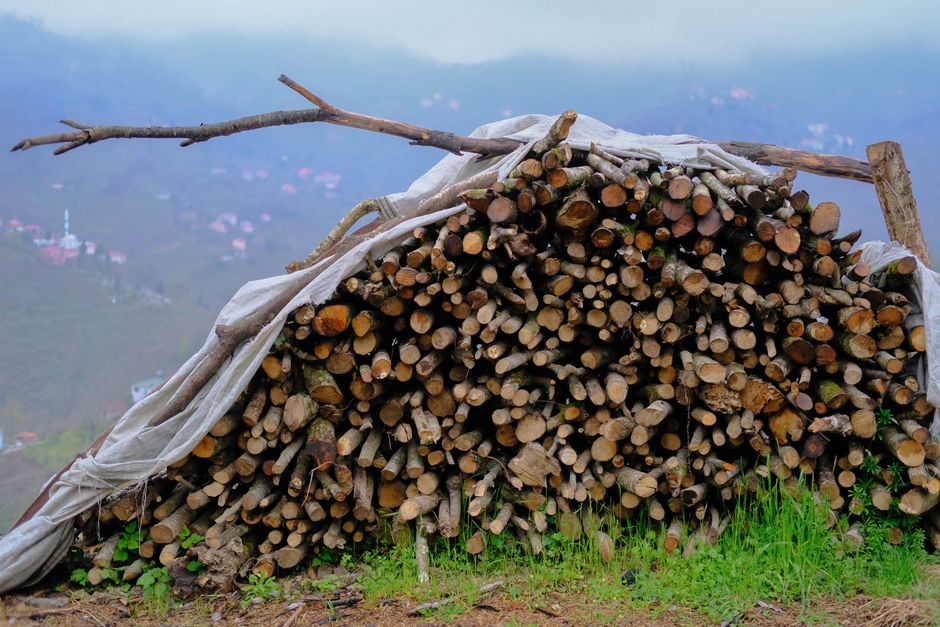
A budget firewood rack will only perform as well as your stacking strategy. Firewood needs three critical elements to dry properly: solar heat, continuous cross-ventilation, and isolation from ground dampness.
When green wood is cut, its moisture content is often above 45% to 50%. For safe, clean burning that produces high heat and minimal creosote chimney buildup, that moisture level must drop below 20%. Softwoods generally require 6 to 8 months to season, while dense hardwoods like oak, pecan, and mesquite need 12 to 18 months.
Follow these proven seasoning and protection practices:
- Elevate the bottom row at least 4 to 8 inches: Stacking logs directly on soil allows ground moisture to wick into the wood, ruining the bottom tiers and inviting subterranean termites. Always use concrete blocks, gravel beds, or treated wood skids.
- Maintain wide-open cross-ventilation: Do not seal your woodpile inside plastic wraps or enclosed storage boxes. Trapped humidity causes mold and fungal rot. Air must pass freely through the ends of the logs.
- Cover the top only: According to EPA Burn Wise storage recommendations, you should only protect the top surface of the pile from falling rain and snow. Keep the sides uncovered so evaporating moisture can escape freely. If building a permanent roof, maintain a 1-foot roof overhang on all sides to shed runoff away from the wood.
- Orient the stack bark-side up on top rows: On the very top row of an open stack, turn split logs bark-side up to act as natural water-shedding shingles. On interior and lower tiers, orienting bark down allows internal moisture to evaporate freely from the split grain.
- Observe strict pest setbacks: Firewood piles are natural magnets for beetles, ants, spiders, and termites. Never stack firewood flush against your home's exterior walls or foundation. Maintain a clearance perimeter of at least 20 feet from residential structures, and never spray firewood with chemical insecticides, as burning treated logs releases toxic fumes into your living space.
DIY vs. Store-Bought Racks: Cost Breakdown and Sizing Guide
To determine whether you should build a DIY rack or buy a prefabricated metal kit, compare capacity, overall material expenses, and required assembly time:
| Rack Size / Style | Cord Capacity | Est. DIY Cost (New / Salvaged) | Est. Retail Kit Cost | Assembly Time | Best Use Case |
|---|---|---|---|---|---|
| 4-Foot Compact Rack | 1/8 to 1/6 Cord (~16–21 cu ft) | $15 – $30 | $35 – $65 | 15–30 mins | Covered porches, back patios, fire pits |
| 8-Foot Standard Rack | 1/3 to 1/2 Cord (~42–64 cu ft) | $25 – $65 | $70 – $130 | 30–60 mins | Typical residential seasonal heating |
| 12-Foot Dual-Bay Rack | 3/4 to 1 Full Cord (~96–128 cu ft) | $60 – $140 | $150 – $260+ | 1–3 hours | Heavy wood stove users & homesteaders |
| 3-Pallet Custom Base | 1 Full Cord (128 cu ft) | $0 – $25 | N/A | 45 mins | High-capacity bulk outdoor seasoning |
| Converted IBC Tote | 1/3 Cord (~25 cu ft) | $35 – $75 | N/A | 1 hour | Modular, forklift-movable log storage |
Sizing and Capacity Considerations
A standard full cord of firewood measures 128 cubic feet (4 feet high by 4 feet deep by 8 feet long). A "face cord" (or rick) is a single stack 4 feet high by 8 feet long using standard 16-inch logs, representing roughly one-third of a full cord.
For smaller backyards, buying an 8-foot tubular steel retail rack under $100 is often cost-effective because it includes a fitted weather cover. However, when storing two or more cords, commercial metal racks become expensive. Repurposed shipping pallets or DIY cinder block rails offer far better value per cubic foot of storage.
Watch Out for Hidden Hardware Costs
When pricing out DIY projects, factor in the small accessories that can add up:
- Fasteners: Standard drywall screws will shear under the weight of hundreds of pounds of timber. Budget $10 to $15 for heavy-duty structural exterior wood screws or 3/8-inch carriage bolts.
- Footing Blocks: Placing wooden legs on bare dirt accelerates rot. Factor in $8 to $16 for concrete patio pavers or deck blocks.
- Top Covers: Heavy-duty UV-resistant tarps or corrugated metal offcuts usually cost between $15 and $30.
Frequently Asked Questions About Budget Firewood Storage
How do you keep firewood dry outdoors on a tight budget?
The most reliable method is placing two parallel 2x4 rails across cinder blocks on a gravel base, stacking your wood in loose, alternating rows, and securing a corrugated plastic panel or heavy-duty tarp across the top row only. Fasten the cover down using bungee cords tied to the rack frame or weight it with a couple of split logs. Leaving all four sides exposed ensures airflow continues to draw moisture out of the logs.
What is the cheapest way to store a full cord of wood?
The lowest-cost approach to storing a full cord (128 cubic feet) is laying three free heat-treated (HT) shipping pallets side-by-side on level, well-drained ground. This creates a 10-foot-wide by 4-foot-deep elevated platform. Stack your 16-inch split logs three rows deep across the pallets. Use end pallets braced at 45-degree angles or criss-cross your end logs in alternating perpendicular directions (box cribbing) to create self-supporting end pillars that keep the stack stable without expensive framing.
Can you stack firewood directly against an exterior house wall?
No. Stacking firewood flush against a home's siding or foundation creates serious moisture and pest hazards. Firewood stacks attract subterranean termites, carpenter ants, bark beetles, and rodents seeking shelter. Furthermore, logs stacked against exterior siding trap humidity against the wall, causing mold, paint peeling, and siding rot. Always maintain a minimum clearance perimeter of 20 feet from your home whenever possible, and leave at least 1 to 2 feet of space between wood stacks and any boundary fences or outbuildings to maintain clear airflow.
Conclusion
Getting your firewood up off the ground and properly protected doesn't require expensive kits or complicated construction. Whether you choose a 10-minute no-tool cinder block rack, convert discarded wooden pallets, or repurpose a rugged IBC tote cage, the core formula remains simple: provide solid elevation, keep the top shielded from overhead rain, and let cross-ventilation handle the rest. By putting these affordable storage ideas to work, your firewood will dry faster, burn hotter, and stay completely free of ground rot and pests all winter long.
When you're ready to bring that same level of clean, functional organization inside your home, our team at Jo Closet Co. is here to help. From garage utility cabinets and heavy-duty workshop shelving to custom closets and entertainment centers, we specialize in high-precision, tailored storage solutions designed specifically for Arizona homes across the Phoenix Valley. Explore our custom home storage and organization solutions today to transform your everyday spaces with durable, built-to-order craftsmanship!